
Pulp Fiction, 1925 · page 22 of 170
Argosy All-Story Weekly, June 13, 1925 — page 22: what you’re looking at
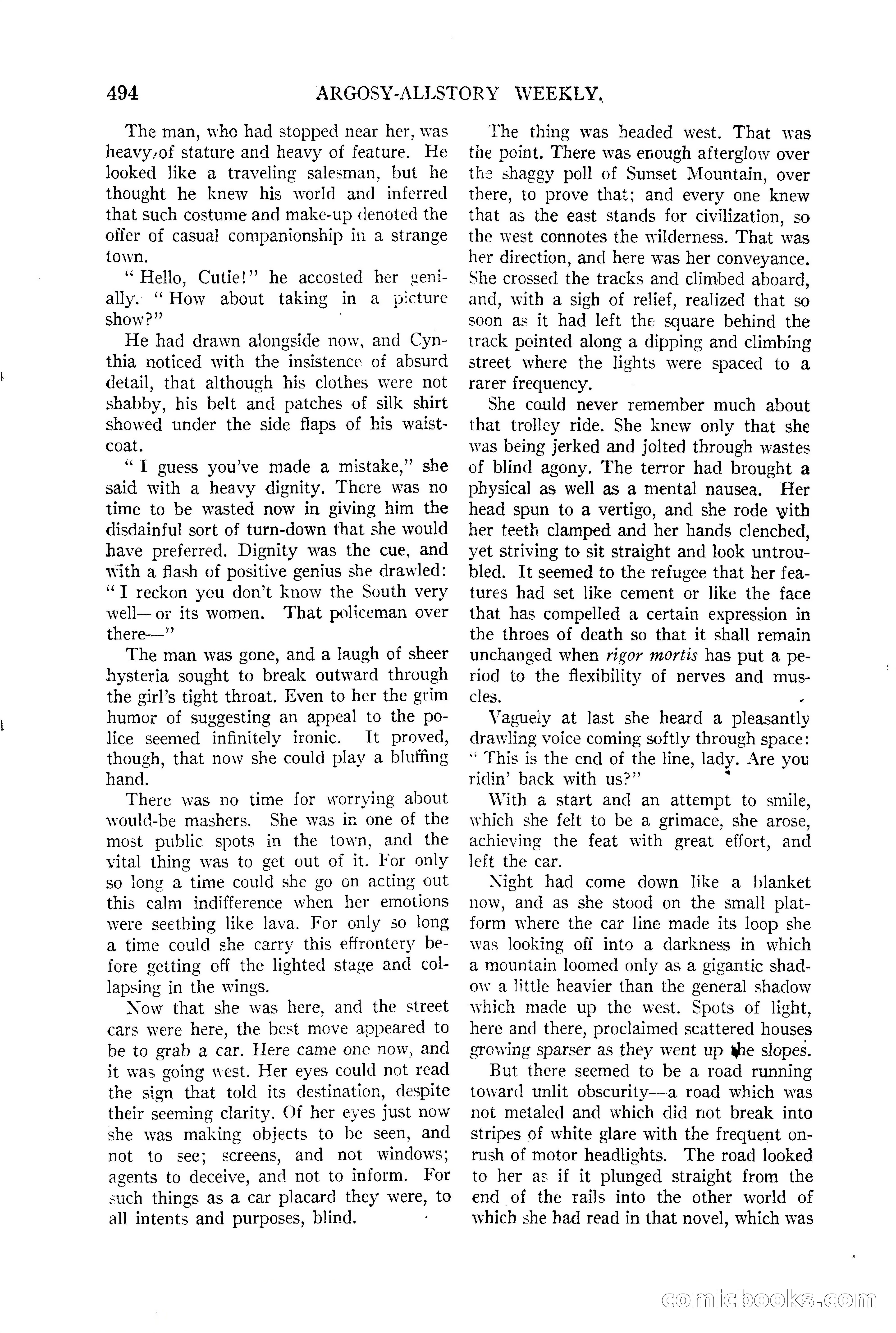
A restored page from Pulp Fiction, 1925. Page through the whole issue in the reader above.
📄 Transcribed text from this page (OCR, searchable)
Machine-transcribed from the original scan — historical spelling and the odd misread are preserved.
A494 The man, who had stopped near her, was heavy-of stature and heavy of feature. He looked Jike a traveling salesman, but he thought he knew his world and inferred that such costume and make-up denoted the offer of casual companionship in a strange town. ‘* Hello, Cutie!” he accosted her geni- ally. ‘“How about taking in a picture show?” : | He had drawn alongside now, and Cyn- thia noticed with the insistence of absurd detail, that although his clothes were not shabby, his belt and patches of silk shirt showed under the side flaps of his waist- coat. ‘““T guess you’ve made a mistake,” she said with a heavy dignity. There was no time to be wasted now in giving him the disdainful sort of turn-down that she would have preferred. Dignity was the cue, and With a flash of positive genius she drawled: ‘““T reckon you don’t know the South very well—or its women. That policeman over there—”’ The man was gone, and a laugh of sheer hysteria sought to break outward through the girl’s tight throat. Even to her the grim humor of suggesting an appeal to the po- lice seemed infinitely ironic. It proved, though, that now she could play a bluffing hand. There was no time for worrying about would-be mashers. She was in one of the most public spots in the town, and the vital thing was to get out of it. lor only so long a time could she go on acting out this calm indifference when her emotions were seething like lava. For only so long a time could she carry this effrontery be- fore getting off the lighted stage and col- lapsing in the wings. Now that she was here, and the street cars were here, the best move appeared to be to grab a car. Here came one now, and it was going west. Her eyes could not read the sign that told its destination, despite their seeming clarity. Of her eyes just now she was making objects to be seen, and not to see; screens, and not windows; agents to deceive, and not to inform. For such things as a car placard they were, to all intents and purposes, blind. ARGOSY-ALLSTORY WEEKLY. The thing was headed west. That was the point, There was enough afterglow over the shaggy poll of Sunset Mountain, over there, to prove that; and every one knew that as the east stands for civilization, so the west connotes the wilderness. That was her direction, and here was her conveyance. She crossed the tracks and climbed aboard, and, with a sigh of relief, realized that so soon as it had left the square behind the track pointed. along a dipping and climbing street where the lights were spaced to a rarer frequency. She could never remember much about that trolley ride. She knew only that she was being jerked and jolted through wastes of blind agony. The terror had brought a physical as well as a mental nausea. Her head spun to a vertigo, and she rode with her teeth clamped and her hands clenched, yet striving to sit straight and look untrou- bled. It seemed to the refugee that her fea- tures had set like cement or like the face that has compelled a certain expression in the throes of death so that it shall remain unchanged when rigor mortis has put a pe- riod to the flexibility of nerves and mus- cles. y Vagueiy at last she heard a pleasantly drawling voice coming softly through space: ‘ This is the end of the line, lady. Are you ridin’ back with us?” . With a start and an attempt to smile, which she felt to be a grimace, she arose, achieving the feat with great effort, and left the car. Night had come down like a blanket now, and as she stood on the smal! plat- form where the car line made its loop she was looking off into a darkness in which a mountain loomed only as a gigantic shad- ow a little heavier than the general shadow which made up the west. Spots of light, here and there, proclaimed scattered houses growing sparser as they went up the slopes. But there seemed to be a road running toward unlit obscurity——a road which was not metaled and which did not break into stripes of white glare with the frequent on- rush of motor headlights. The road looked to her as if it plunged straight from the end of the rails into the other world of which she had read in that novel, which was COIN ClooolKS.com