
Pulp Fiction, 1925 · page 23 of 170
Argosy All-Story Weekly, June 13, 1925 — page 23: what you’re looking at
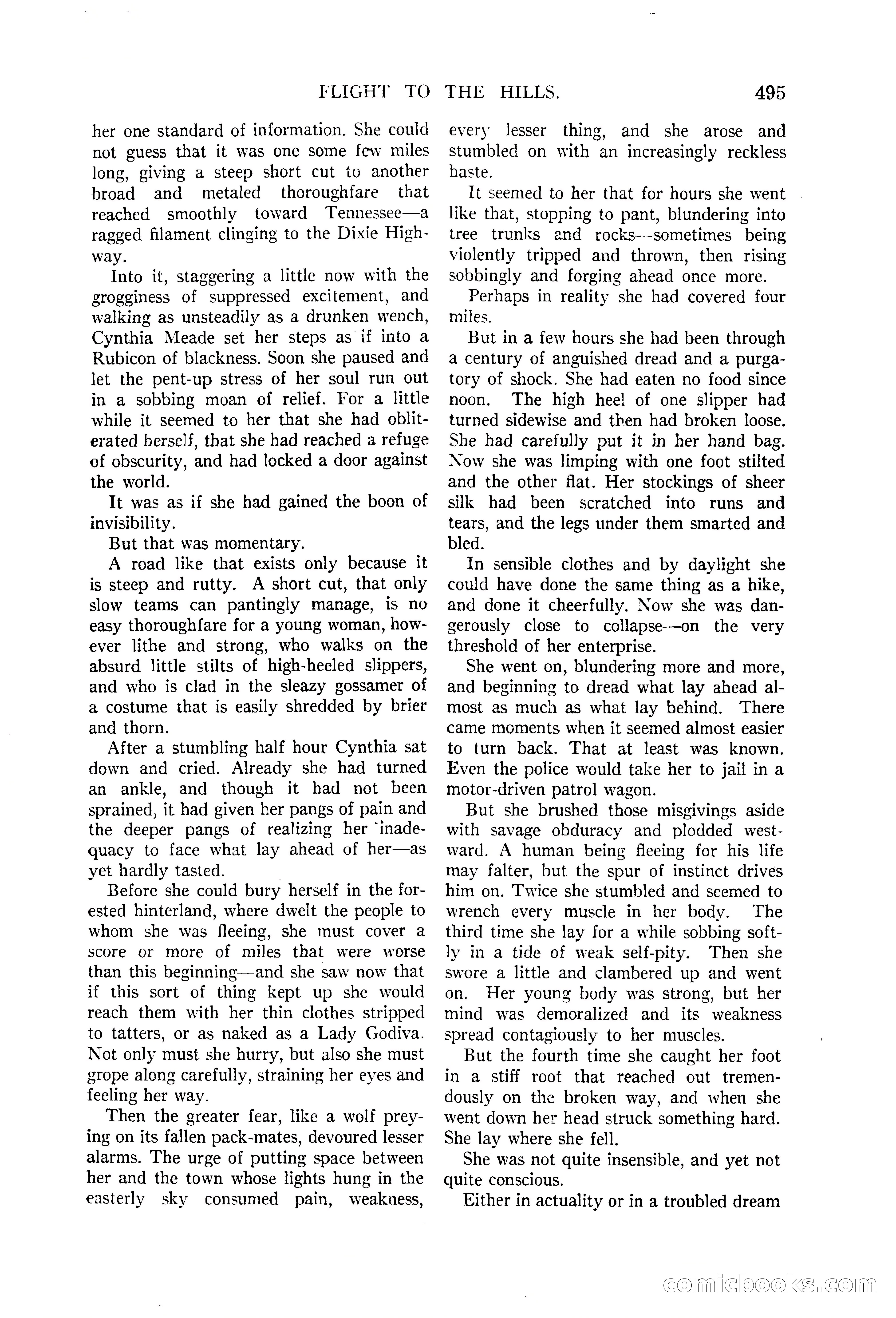
A restored page from Pulp Fiction, 1925. Page through the whole issue in the reader above.
📄 Transcribed text from this page (OCR, searchable)
Machine-transcribed from the original scan — historical spelling and the odd misread are preserved.
FLIGHT TO her one standard of information. She could not guess that it was one some few miles long, giving a steep short cut to another broad and metaled thoroughfare that reached smoothly toward Tennessee—a ragged filament clinging to the Dixie High- way. Into it, staggering a little now with the grogginess of suppressed excitement, and walking as unsteadily as a drunken wench, Cynthia Meade set her steps as if into a Rubicon of blackness. Soon she paused and let the pent-up stress of her soul run out in a sobbing moan of relief. For a little while it seemed to her that she had oblit- erated herself, that she had reached a refuge of obscurity, and had locked a door against the world. It was as if she had gained the boon of invisibility. But that was momentary. A road like that exists only because it is steep and rutty. A short cut, that only slow teams can pantingly manage, is no easy thoroughfare for a young woman, how- ever lithe and strong, who walks on the absurd little stilts of high-heeled slippers, and who is clad in the sleazy gossamer of a costume that is easily shredded by brier and thorn. After a stumbling half hour Cynthia sat down and cried. Already she had turned an ankle, and though it had not been sprained, it had given her pangs of pain and the deeper pangs of realizing her “Inade- quacy to face what lay ahead of her—as yet hardly tasted. | Before she could bury herself in the for- ested hinterland, where dwelt the people to whom she was fleeing, she must cover a score or more of miles that were worse than this beginning—and she saw now that if this sort of thing kept up she would reach them with her thin clothes stripped to tatters, or as naked as a Lady Godiva. Not only must she hurry, but also she must grope along carefully, straining her eyes and feeling her way. Then the greater fear, like a wolf prey- ing on its fallen pack-mates, devoured lesser alarms. The urge of putting space between her and the town whose lights hung in the easterly sky consumed pain, weakness, THE HILLS. 495 every lesser thing, and she arose and stumbled on with an increasingly reckless haste. It seemed to her that for hours she went like that, stopping to pant, blundering into tree trunks and rocks—-sometimes being violently tripped and thrown, then rising sobbingly and forging ahead once more. Perhaps in reality she had covered four miles. But in a few hours she had been through a century of anguished dread and a purga- tory of shock. She had eaten no food since noon. The high hee! of one slipper had turned sidewise and then had broken loose. She had carefully put it in her hand bag. Now she was limping with one foot stilted and the other flat. Her stockings of sheer sik had been scratched into runs and tears, and the legs under them smarted and bled. In sensible clothes and by daylight she could have done the same thing as a hike, and done it cheerfully. Now she was dan- gerously close to collapse—on the very threshold of her enterprise. She went on, blundering more and more, and beginning to dread what lay ahead al- most as much as what lay behind. There came moments when it seemed almost easier to turn back. That at least was known. Even the police would take her to jail in a motor-driven patrol wagon. But she brushed those misgivings aside with savage obduracy and plodded west- ward. A human being fleeing for his life may falter, but the spur of instinct drives him on. Twice she stumbled and seemed to wrench every muscle in her body. The third time she lay for a while sobbing soft- ly in a tide of weak self-pity. Then she swore a little and clambered up and went on. Her young body was strong, but her mind was demoralized and its weakness spread contagiously to her muscles. But the fourth time she caught her foot in a stiff root that reached out tremen- dously on the broken way, and when she went down her head struck something hard. She lay where she fell. She was not quite insensible, and yet not quite conscious. Either in actuality or in a troubled dream Connicloool