
Pulp Fiction, 1907 · page 10 of 228
The Argosy, March 1907 — page 10: what you’re looking at
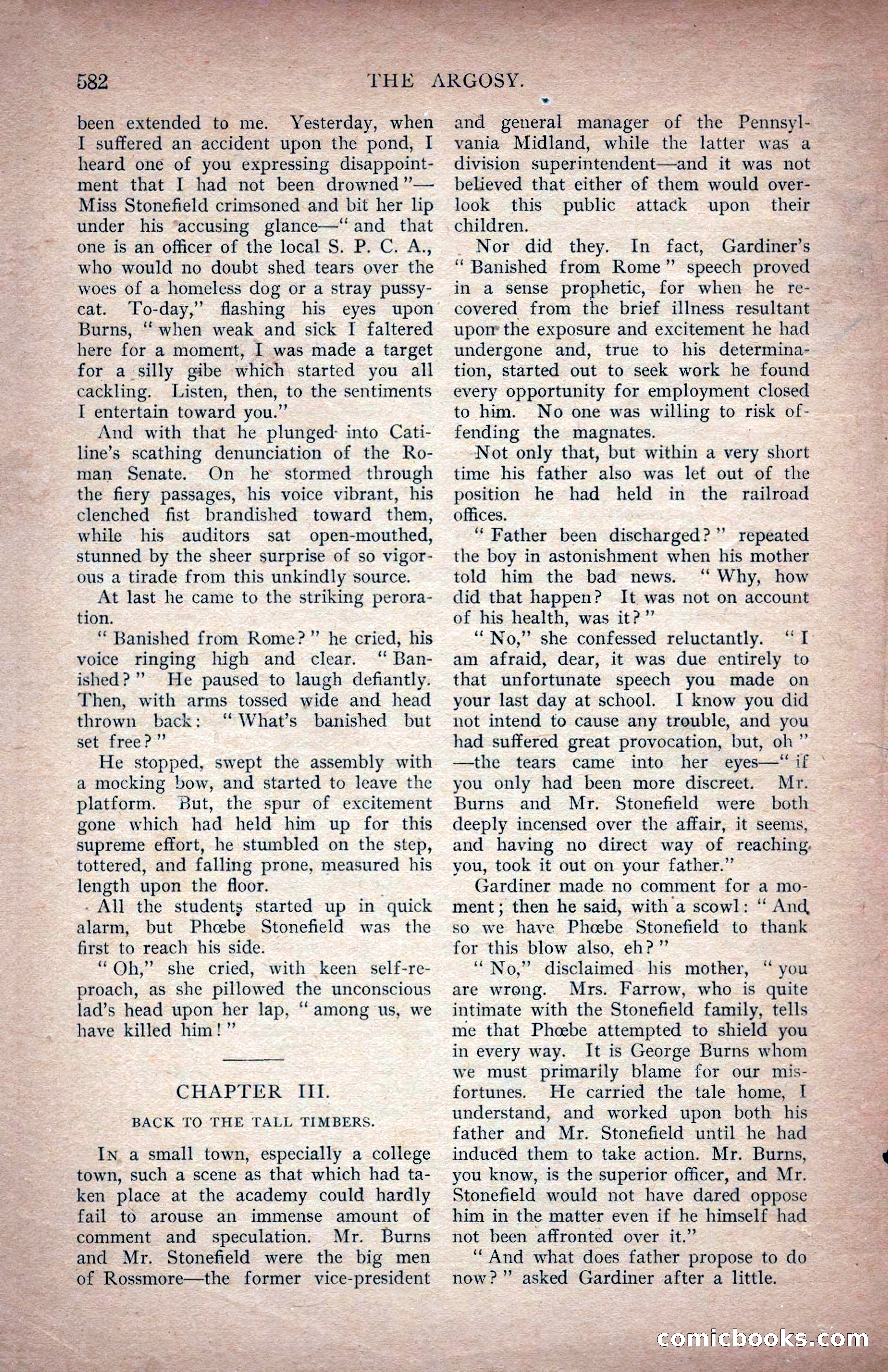
A restored page from Pulp Fiction, 1907. Page through the whole issue in the reader above.
📄 Transcribed text from this page (OCR, searchable)
Machine-transcribed from the original scan — historical spelling and the odd misread are preserved.
been extended to me. Yesterday, when I suffered an accident upon the pond, I heard one of you expressing disappoint- ment that I had not been drowned ”— Miss Stonefield crimsoned and bit her lip under his “accusing glance—“ and that one is an officer of the local S. P. C. A., who would no doubt shed tears over the woes of a homeless dog or a stray pussy- cat. To-day,” flashing his eyes upon Burns, “ when weak and sick I faltered here for a moment, I was made a target for a silly gibe which started you all cackling. Listen, then, to the sentiments I entertain toward you.” And with that he plunged: into Cati- line’s scathing denunciation of the Ro- man Senate. On he stormed through the fiery passages, his voice vibrant, his clenched fist brandished toward them, while his auditors sat open-mouthed, stunned by the sheer surprise of so vigor- ous a tirade from this unkindly source. At last he came to the striking perora- tion. ‘* Banished from Rome?” he cried, his voice ringing high and clear. “ Ban- ished?” He paused to laugh defiantly. Then, with arms tossed wide and head thrown back: “ What’s banished but set free?” He stopped, swept the assembly with a mocking bow, and started to leave the platform. But, the spur of excitement gone which had held him up for this supreme effort, he stumbled on the step, tottered, and falling prone, measured his length upon the floor. . All the students started up in quick alarm, but Phoebe Stonefield was the first to reach his side. “Oh,” she cried, with keen self-re- proach, as she pillowed the unconscious lad’s head upon her lap, “ among us, we have killed him!” CHAPTER III. BACK TO THE TALL TIMBERS. In a small town, especially a college town, such a scene as that which had ta- ken place at the academy could hardly fail to arouse an immense amount of comment and speculation. Mr. Burns and Mr. Stonefield were the big men of Rossmore—the former vice-president ARGOSY. . and general manager of the Pennsyl- _ vania Midland, while the latter was a division superintendent—and it was not believed that either of them would over- look this public attack upon their children. Nor did they. In fact, Gardiner’s “ Banished from Rome” speech proved in a sense prophetic, for when he re-— covered from the brief illness resultant — upom the exposure and excitement he had undergone and, true to his determina- tion, started out to seek work he found every opportunity for employment closed to him. No one was willing to risk of- fending the magnates. Not only that, but within a very short time his father ‘also was let out of the position he had held in the railroad offices. “ Father been discharged?” repeated the boy in astonishment when his mother told him the bad news. ‘“ Why, how did that happen? It was not on account of his health, was it?” ‘“No,” she confessed reluctantly. “I am afraid, dear, it was due entirely to that unfortunate speech you made on your last day at school. I know you did not intend to cause any trouble, and you had suffered great provocation, but, oh” —the tears came into her eyes—‘if © you only had been more discreet. Mr. Burns and Mr. Stonefield were both deeply incensed over the affair, it seems, and having no direct way of reaching. you, took it out on your father.” Gardiner made no comment for a mo- ment; then he said, with a scowl: ‘‘ And, so we have Phoebe Stonefield to thank for this blow also, eh?” “No,” disclaimed his mother, “ you are wrong. Mrs. Farrow, who is quite intimate with the Stonefield family, tells me that Phoebe attempted to shield you in every way. It is George Burns whom we must primarily blame for our mis- fortunes. He carried the tale home, [ understand, and worked upon both his father and Mr. Stonefield until he had induced them to take action. Mr. Burns, you know, is the superior officer, and Mr. Stonefield would not have dared oppose him in the matter even if he himself had not been affronted over it.” ‘“And what does father propose to ie : now?” asked Gardiner after a little. : 900ks.. =C 1 : i Vote Pl ae ] vate ah .g yon & bs ish Vin ghia Lh ots Ey etl he £ 7 a oe iG ae Vin foe 4 bd ee <— > ~ d - * -