
Pulp Fiction, 1907 · page 9 of 228
The Argosy, March 1907 — page 9: what you’re looking at
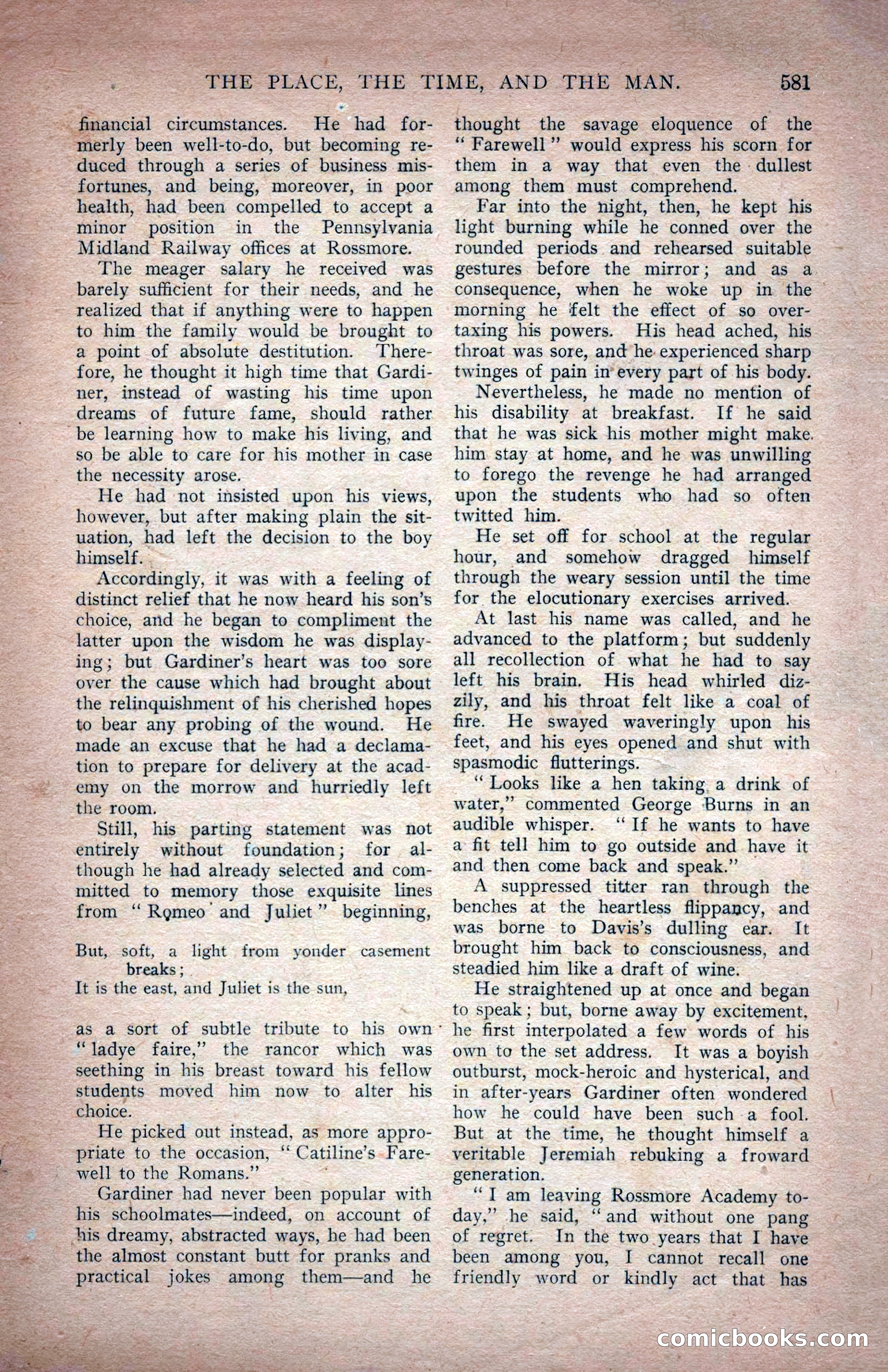
A restored page from Pulp Fiction, 1907. Page through the whole issue in the reader above.
📄 Transcribed text from this page (OCR, searchable)
Machine-transcribed from the original scan — historical spelling and the odd misread are preserved.
_— mow a point of absolute destitution. fore, he thought it high time that Gardi- entirely without foundation ; But, soft, ss ap been well-to-do, but becoming re- duced through a series of business mis- - fortunes, and being, moreover, in poor health, had been compelled to accept a “minor position in the Pennsylvania Midland Railway offices at Rossmore. The meager salary he received was barely sufficient for their needs, and he s : realized that if anything were to happen to him the family would be brought to There- ner, instead of wasting his time upon dreams of future fame, should rather be learning how to make his living, and so be able to care for his mother in case the necessity arose. He had not insisted upon his views, however, but after making plain the sit- uation, had left the decision to the boy himself. Accordingly, it was with a feeling of distinct relief that he now heard his son’s choice, and he began to compliment the latter upon the wisdom he was display- ing; but Gardiner’s heart was too sore over the cause which had brought about the relinquishment of his cherished hopes to bear any probing of the wound. He made an excuse that he had a declama- tion to prepare for delivery at the acad- — -emy on the morrow and hurriedly left _ the room. Still, his parting statement was not for al- though he had already selected and com- mitted to memory those exquisite lines from “ Remeo and Juliet” beginning, a light from yonder casement breaks ; ~ It is the east, and Juliet is the sun, as a sort of subtle tribute to his own’ = “ladye faire,”’ the rancor which was seething in Hc breast toward his fellow "students Moved him now to alter his = choice. He picked out instead, as more appro- priate to the occasion, ‘ Catiline’s Fare- = well to the Romans.” Gardiner had never been popular with his schoolmates—indeed, on account of his dreamy, abstracted ways, he had been ‘the almost constant butt for pranks and _ Practical jokes — among them—and he “ Farewell” would express his scorn or mis them in a way that even the dullest — among them must comprehend. Far into the night, then, he kept his light burning while he conned over the rounded periods and rehearsed suitable gestures before the mirror; and as a. consequence, when he woke up in the ~ morning he felt the effect of so over- taxing his powers. throat was sore, and he: experienced sharp twinges of pain in’every part of his body. Nevertheless, he made no mention of his disability at breakfast. him stay at home, and he was unwilling to forego the revenge he had arranged upon the students who had so often twitted him. His head ached, his If he said that he was sick his mother might make. He set off for school at the regular | hour, and somehow dragged himself through the weary session until the time for the elocutionary exercises arrived. At last his name was called, and he advanced to the platform; but suddenly all recollection of what he had to say left his brain. His head whirled diz- zily, and his throat felt like a coal of fire. He swayed waveringly upon his feet, and his eyes opened and shut with spasmodic flutterings. * Looks like a hen taking. a drink of water,” commented George Burns in an audible whisper. “If he wants to have a fit tell him to go outside and have it and then come back and speak.” — A suppressed titter ran through the benches at the heartless flippancy, and was borne to Davis’s dulling ear. It brought him back to consciousness, and steadied him like a draft of wine. He straightened up at once and began to speak; but, borne away by excitement, he first interpolated a few words of his own to the set address. It was a boyish outburst, mock-heroic and hysterical, and in after-years Gardiner often wondered how he could have been such a fool. But at the time, he thought himself a veritable Jeremiah rebuking a froward generation. “I am leaving Rossmore Academy to- day,” he said, ‘and without one pang of regret. In the two years that I have been among you, I cannot recall one friendly word or kindly act that has ~ : ~A : Lv UA x PASAT Rae of ‘we Be