
Pulp Fiction, 1922 · page 70 of 180
Argosy All-Story Weekly, 4 February 1922 — page 70: what you’re looking at
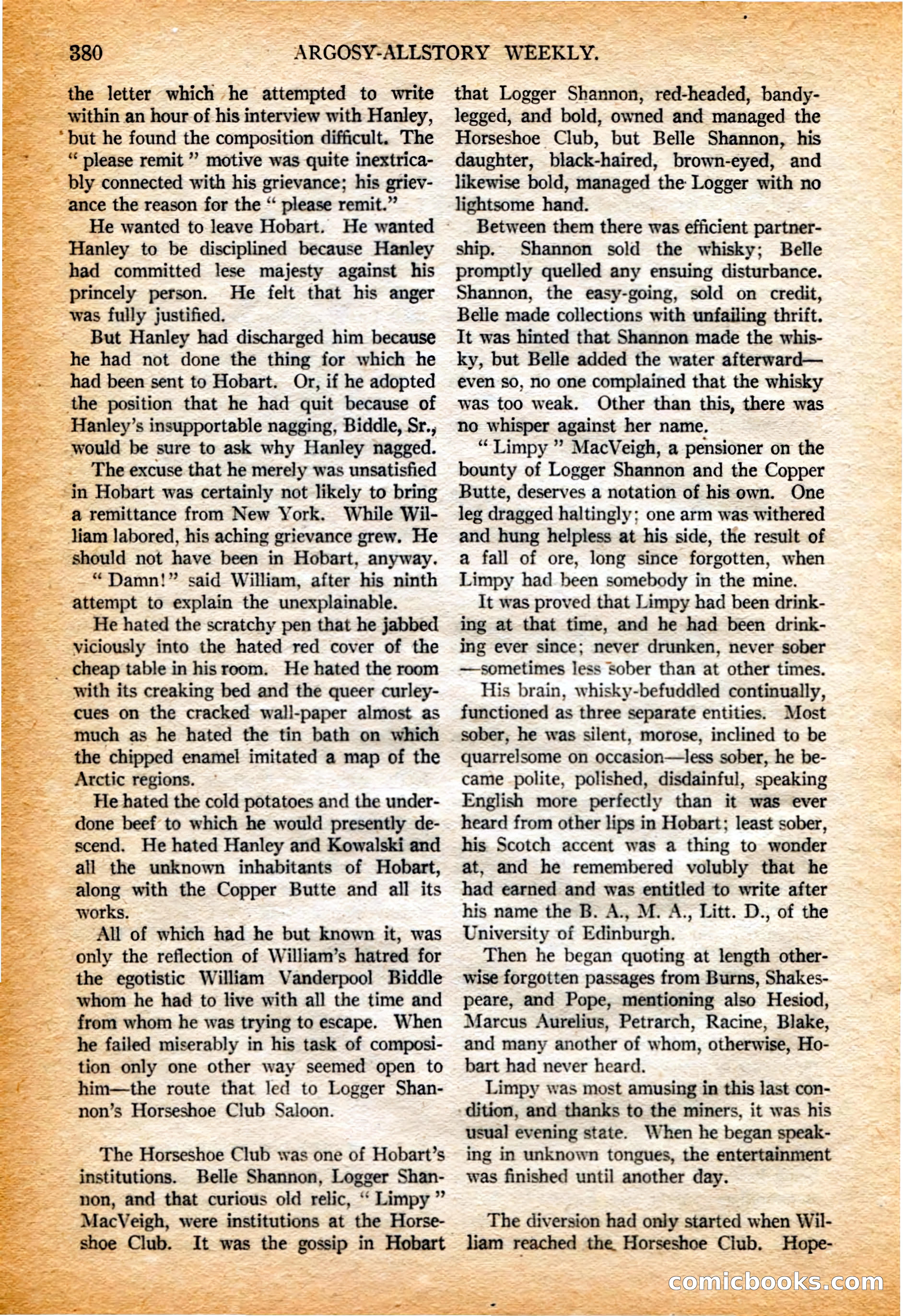
A restored page from Pulp Fiction, 1922. Page through the whole issue in the reader above.
📄 Transcribed text from this page (OCR, searchable)
Machine-transcribed from the original scan — historical spelling and the odd misread are preserved.
Rea ss + A) | wy within an hour of his interview with Hanley, ‘but he found the composition difficult. The “ please remit ’’ motive was quite inextrica- ~~ bly connected with his grievance; his griev- ance the reason for the “ please remit.” He wanted to leave Hobart. He wanted - Hanley to be disciplined because Hanley had committed lese majesty against his princely person. He felt that his anger was fully justified. But Hanley had discharged him because he had not done the thing for which he had been sent to Hobart. Or, if he adopted the position that he had quit because of Hanley’s insupportable nagging, Biddle, Sr., would be sure to ask why Hanley nagged. The excuse that he merely was unsatisfied -in Hobart was certainly not likely to bring a remittance from New York. While Wil- liam Jabored, his aching grievance grew. He should not have been in Hobart, anyway. “Damn!” said William, after his ninth attempt to explain the unexplainable. He hated the scratchy pen that he jabbed viciously into the hated red cover of the _ cheap table in hisroom. He hated the room with its creaking bed and the queer curley- cues on the cracked wall-paper almost as much as he hated the tin bath on which the chipped enamel imitated a map of the Arctic regions. — He hated the cold potatoes and the under- done beef to which he would presently de- scend. He hated Hanley and Kowalski and all the unknown inhabitants of Hobart, along with the Copper Butte and all its works. All of which had he but known it, was _ only the reflection of William’s hatred for the egotistic William Vanderpool Biddle whom he had to live with all the time and from whom he was trying to escape. When he failed miserably in his task of composi- tion only one other way seemed open to _ him—the route that led to Logger Shan- non’s Horseshoe Club Saloon. The Horseshoe Club was one of Hobart’s institutions. Belle Shannon, Logger Shan- non, and that curious old relic, “ Limpy ” MacVeigh, were institutions at the Horse- shoe Club. It was the gossip in Hobart | ARGOSY-ALLSTORY WEEKLY. the letter which he attempted to write that Logger Shannon, red-headed, bandy- legged, and bold, owned and managed the Horseshoe Club, but Belle Shannon, his daughter, black-haired, brown-eyed, and likewise bold, managed the Logger with no lightsome hand. Between them there was efficient partner- ship. Shannon sold the whisky; Belle promptly quelled any ensuing disturbance. Shannon, the easy-going, sold on credit, Belle made collections with unfailing thrift. It was hinted that Shannon made the whis- ky, but Belle added the water afterward— even so, no one complained that the whisky was too weak. Other than this, there was no whisper against her name. “Limpy ” MacVeigh, a pensioner on the bounty of Logger Shannon and the Copper Butte, deserves a notation of his own. One leg dragged haltingly: one arm was withered and hung helpless at his side, the result of a fall of ore, long since forgotten, when Limpy had been somebody in the mine. It was proved that Limpy had been drink- ing at that time, and he had been drink- ing ever since; never drunken, never sober —sometimes less Sober than at other times. His brain, whisky-befuddled continually, functioned as three separate entities. Most sober, he was silent, morose, inclined to be quarrelsome on occasion—less sober, he be- came polite, polished, disdainful, speaking English more perfectly than it was ever heard from other lips in Hobart; least sober, his Scotch accent was a thing to wonder at, and he remembered volubly that he had earned and was entitled to write after his name the B. A., M. A., Litt. D., of the University of Edinburgh. Then he began quoting at length other- wise forgotten passages from Burns, Shakes- peare, and Pope, mentioning also Hesiod, Marcus Aurelius, Petrarch, Racine, Blake, and many another of whom, otherwise, Ho- bart had never heard. Limpy was most amusing in this last con- dition, and thanks to the miners, it was his usual evening state. When he began speak- ing in unknown tongues, the entertainment was finished until another day. The diversion had only started when Wil- liam reached the Horseshoe Club. Hope- Gomichbooks:co