
Pulp Fiction, 1922 · page 71 of 180
Argosy All-Story Weekly, 4 February 1922 — page 71: what you’re looking at
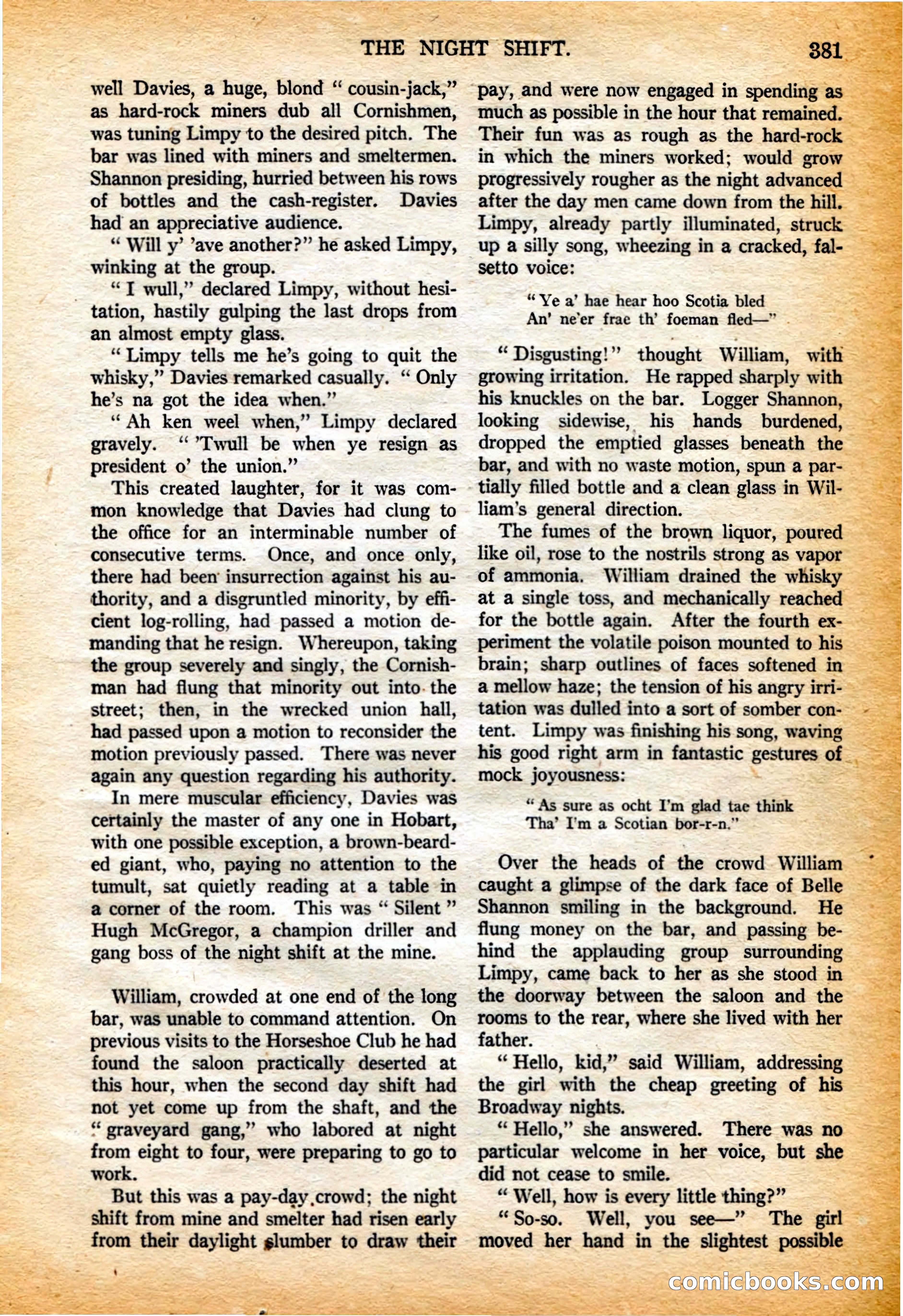
A restored page from Pulp Fiction, 1922. Page through the whole issue in the reader above.
📄 Transcribed text from this page (OCR, searchable)
Machine-transcribed from the original scan — historical spelling and the odd misread are preserved.
well Davies, a huge, blond ‘ cousin-jack;” as hard-rock miners dub all Cornishmen, was tuning Limpy to the desired pitch. The bar was lined with miners and smeltermen. Shannon presiding, hurried between his rows of bottles and the cash-register. Davies had an appreciative audience. “ Will y’ ’ave another?” he asked Limpy, winking at the group. “TJ wull,” declared Limpy, without hesi- - tation, hastily gulping the last drops from an almost empty glass. “Limpy tells me he’s going to quit the whisky,” Davies remarked casually. “ Only he’s na got the idea when.” ‘““Ah ken weel when,” Limpy declared gravely. ‘‘ ’Iwull be when ye resign as president o’ the union.” This created laughter, for it was com- mon knowledge that Davies had clung to the office for an interminable number of consecutive terms. Once, and once only, there had been insurrection against his au- thority, and a disgruntled minority, by effi- cient log-rolling, had passed a motion de- manding that he resign. Whereupon, taking the group severely and singly, the Cornish- man had flung that minority out into. the street; then, in the wrecked union hall, had passed upon a motion to reconsider the motion previously passed. There was never _ again any question regarding his authority. In mere muscular efficiency, Davies was certainly the master of any one in Hobart, with one possible exception, a brown-beard- ed giant, who, paying no attention to the tumult, sat quietly reading at a table in a corner of the room. This was “ Silent ” Hugh McGregor, a champion driller and gang boss of the night shift at the mine. William, crowded at one end of the long bar, was unable to command attention. On previous visits to the Horseshoe Club he had found the saloon practically deserted at this hour, when the second day shift had not yet come up from the shaft, and the “ graveyard gang,” who labored at night from eight to four, were preparing to go to work. But this was a pay-day crowd; the night shift from mine and smelter had risen early from their daylight glumber to draw their “pay, and were now engaged in spending as = i ™, es ~ ee ee Si ~_— ~ - = me eg —- - on T . much as possible in the hour that remained. — Their fun was as rough as the hard-ro ck in which the miners worked; would grow | progressively rougher as the night advanced after the day men came down from the h Ne Limpy, already partly illuminated, struck —_ up a silly song, wheezing in a cracked, fale setto voice: “Ye a’ hae hear hoo Scotia bled An’ ne'er frae th’ foeman fled—” . = Disgusting! “2 thought William, with = growing irritation. He rapped sharply with — his knuckles on the bar. Logger Shanaosia : looking sidewise, his hands burdened, _ dropped the emptied glasses beneath the bar, and with no waste motion, spun a pé Be * tially filled bottle and a clean glass in Wik = liam’s general direction. Se The fumes of the brown liquor, poure do like oil, rose to the nostrils strong as vapor of ammonia. William drained the ety at a single toss, and mechanically reached — for the bottle again. After the fourth ex- — periment the volatile poison mounted to his ee brain; sharp outlines of faces sonriees in a mellow haze; the tension of his angry irri- tation was dulled into a sort of somber con- tent. Limpy was finishing his song, wavir = ss his good right arm in fantastic gestnren. of = *~ a ~~ mock joyousness: a 3 “ As sure as ocht I’m glad tae think — = << 3 Tha’ I'm a Scotian bor-r-n.” ea ee Over the heads of the crowd. Wi 5 | caught a glimpse of the dark face of a 2 Shannon smiling in the background. He | flung money on the bar, and passing be- hind the applauding group surrounding > Limpy, came back to her as she stood in the doorway between the saloon and the rooms to the rear, where she lived with sea father. “ Hello, kid,” said William, addressing the girl with the cheap greeting of his Broadway nights. “ Hello,” she answered. There was no particular welcome in her voice, but ae. | did not cease to smile. or “ Well, how is every little thing?” *So-so. Well, _you see—” The ¢ Xe ~P a Pu? > ve bal ee Na - es ra Xo ~~" 7