
Pulp Fiction, 1909 · page 91 of 227
The Argosy for May — page 91: what you’re looking at
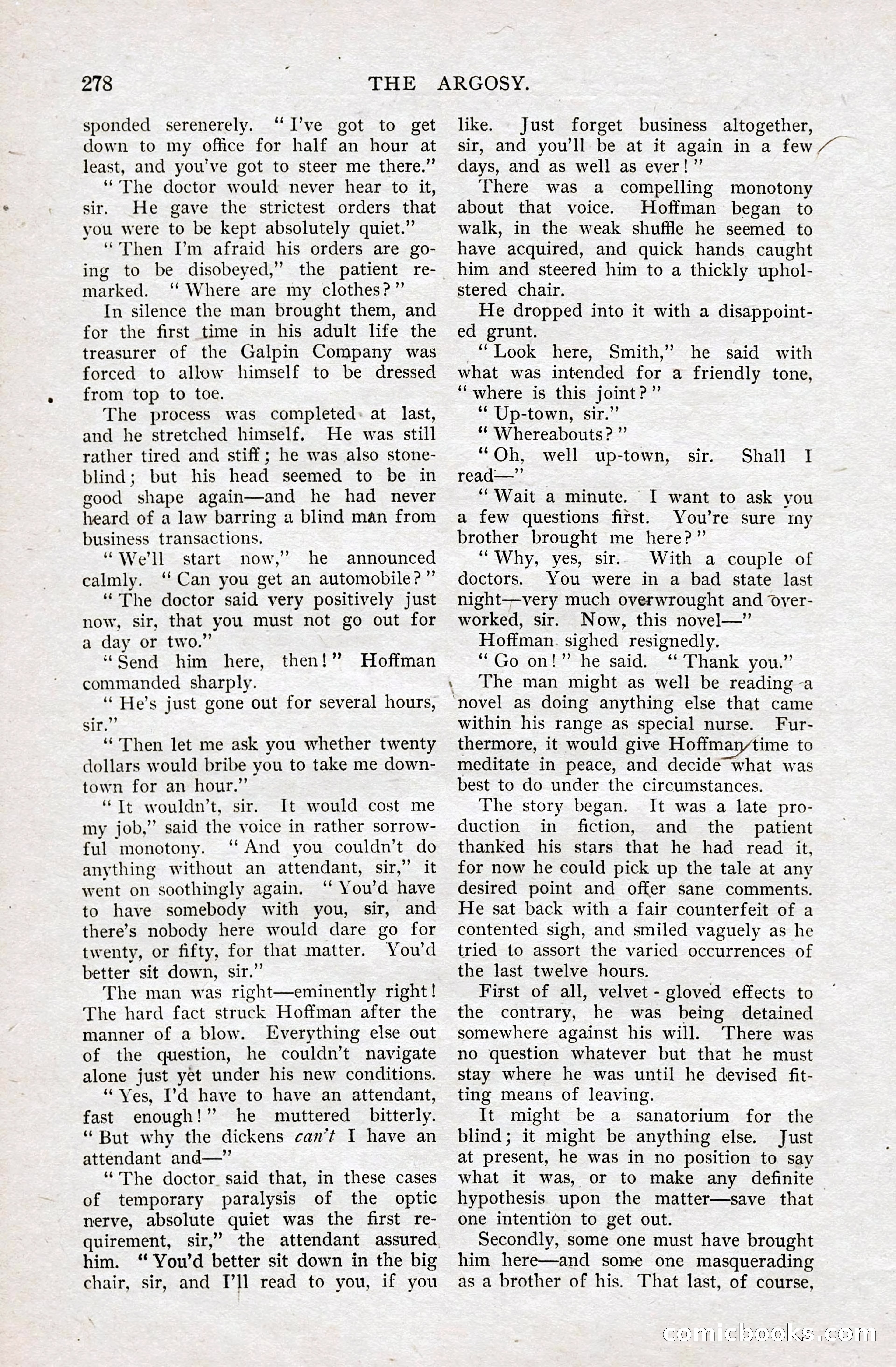
A restored page from Pulp Fiction, 1909. Page through the whole issue in the reader above.
📄 Transcribed text from this page (OCR, searchable)
Machine-transcribed from the original scan — historical spelling and the odd misread are preserved.
278 sponded serenerely. “I’ve got to get down to my office for half an hour at least, and you’ve got to steer me there.” “The doctor would never hear to it, sir. He gave the strictest orders that you were to be kept absolutely quiet.” ' “Then I’m afraid his orders are go- ing to be disobeyed,” the patient re- marked. ‘‘ Where are my clothes?” In silence the man brought them, and for the first time in his adult life the treasurer of the Galpin Company was forced to allow himself to be dressed from top to toe. The process was completed: at last, and he stretched himself. He was still rather tired and stiff; he was also stone- blind; but his head seemed to be in good shape again—and he had never heard of a law barring a blind man from business transactions. “We'll start now,” he announced calmly. ‘Can you get an automobile?” ‘The doctor said very positively just now, sir, that you must not go out for a day or two.” “Send him here, commanded sharply. ‘“He’s just gone out for several hours, sine ‘Then let me ask you whether twenty dollars would bribe you to take me down- town for an hour.” “Tt wouldn’t, sir. It would cost me my job,” said the voice in rather sorrow- ful monotony. ‘And you couldn’t do anything without an attendant, sir,” it went on soothingly again. ‘‘ You’d have to have somebody with you, sir, and there’s nobody here would dare go for twenty, or fifty, for that matter. You'd better sit down, sir.” The man was right—eminently right! The hard fact struck Hoffman after the manner of a blow. Everything else out of the question, he couldn’t navigate alone just yet under his new conditions. “Ves, I’d have to have an attendant, fast enough!” he muttered bitterly. “But why the dickens can’t I have an attendant and—’’ ‘‘ The doctor. said that, in these cases of temporary paralysis of the optic nerve, absolute quiet was the first re- {?? then Hoffman quirement, sir,” the attendant assured him. ‘ You'd better sit down in the big chair, sir, and I’ll read to you, if you ad THE ARGOSY. like. Just forget business altogether, sir, and you'll be at it again in a few days, and as well as ever!” There was a compelling monotony about that voice. Hoffman began to walk, in the weak shuffle he seemed to have acquired, and quick hands caught him and steered him to a thickly uphol- stered chair. He dropped into it with a disappoint- grunt. “Look here, Smith,” he said with what was intended for a friendly tone, “where is this joint?” ‘** Up-town, sir.” “* Whereabouts ? ” “Oh, well up-town, read—”’ “Wait a minute. I want to ask you a few questions first. You’re sure ny brother brought me here?” “Why, yes, sir. With a couple of doctors. You were in a bad state last night—very much overwrought and over- worked, sir. Now, this novel—”’ Hoffman. sighed resignedly. “Go on!” he said. ‘ Thank you.” The man might as well be reading -a ed sir. Shall I novel as doing anything else that came within his range as special nurse. Fur- thermore, it would give Hoffman/time to meditate in peace, and decide what was best to do under the circumstances. The story began. It was a late pro- duction in fiction, and the _ patient thanked his stars that he had read it, for now he could pick up the tale at any desired point and offer sane comments. He sat back with a fair counterfeit of a contented sigh, and smiled vaguely as he tried to assort the varied occurrences of the last twelve hours. First of all, velvet - gloved effects to the contrary, he was being detained somewhere against his will. There was no question whatever but that he must stay where he was until he devised fit- ting means of leaving. It might be a sanatorium for the blind; it might be anything else. Just at present, he was in no position to say what it was, or to make any definite hypothesis upon the matter—save that one intention to get out. Secondly, some one must have brought him here—and some one masquerading as a brother of his. That last, of course, MICLOOC) SS (C@