
Pulp Fiction, 1909 · page 92 of 227
The Argosy for May — page 92: what you’re looking at
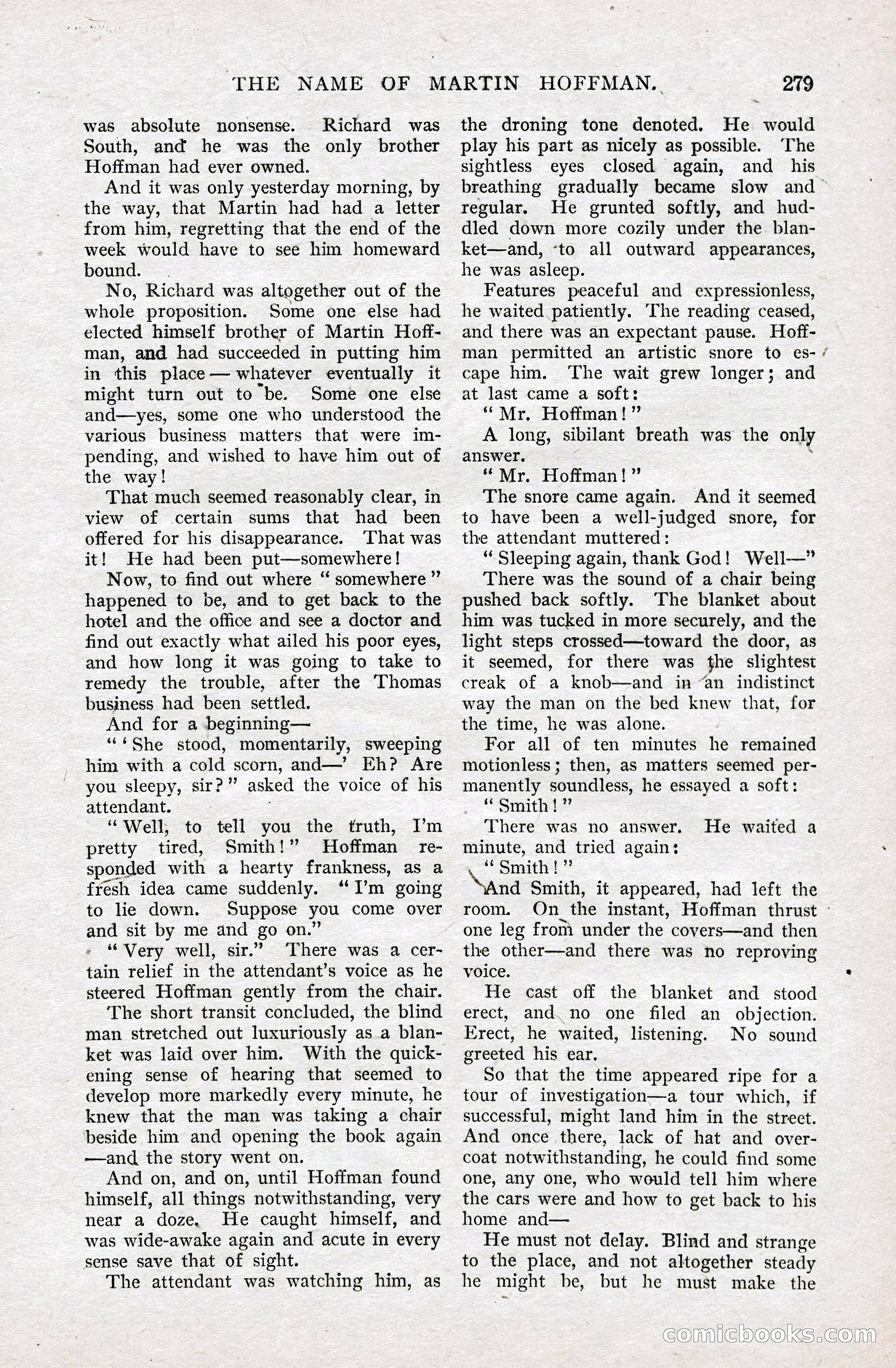
A restored page from Pulp Fiction, 1909. Page through the whole issue in the reader above.
📄 Transcribed text from this page (OCR, searchable)
Machine-transcribed from the original scan — historical spelling and the odd misread are preserved.
THE NAME OF MARTIN HOFFMAN. was absolute nonsense. Richard was South, and he was the only brother Hoffman had ever owned. 3 And it was only yesterday morning, by the way, that Martin had had a letter from him, regretting that the end of the week would have to see him homeward bound. No, Richard was altogether out of the whole proposition. Some one else had elected himself brother of Martin Hoff- man, and had succeeded in putting him in this place — whatever eventually it might turn out to be. Some one else and—yes, some one who understood the various business matters that were im- pending, and wished to have him out of the way! That much seemed reasonably clear, in view of certain sums that had been offered for his disappearance. ‘That was it! He had been put—somewhere! Now, to find out where “ somewhere ” happened to be, and to get back to the hotel and the office and see a doctor and find out exactly what ailed his poor eyes, and how long it was going to take to remedy the trouble, after the Thomas business had been settled. And for a beginning— ‘““* She stood, momentarily, sweeping him with a cold scorn, and—’ Eh? Are you sleepy, sir?’ asked the voice of his attendant. ‘Well, to tell you the truth, I’m pretty tired, Smith!” Hoffman re- sponded with a hearty frankness, as a fresh idea came suddenly. “I’m going to lie down. Suppose you come over and sit by me and go on.” ““Very well, sir.’ ‘There was a cer- tain relief in the attendant’s voice as he steered Hoffman gently from the chair. The short transit concluded, the blind man stretched out luxuriously as a blan- ket was laid over him. With the quick- ening sense of hearing that seemed to develop more markedly every minute, he knew that the man was taking a chair beside him and opening the book again —and the story went on. And on, and on, until Hoffman found himself, all things notwithstanding, very near a doze, He caught himself, and was wide-awake again and acute in every sense save that of sight. The attendant was watching him, as 279 the droning tone denoted. He would play his part as nicely as possible. ‘The sightless eyes closed again, and his breathing gradually became slow and regular. He grunted softly, and hud- dled down more cozily under the blan- ket—and, ‘to all outward appearances, he was asleep. Features peaceful and expressionless, he waited patiently. The reading ceased, and there was an expectant pause. Hoff- man permitted an artistic snore to es- cape him. The wait grew longer; and at last came a soft: “ Mr. Hoffman!” A long, sibilant breath was the only answer. j “ Mr. Hoffman!” The snore came again. And it seemed to have been a well-judged snore, for the attendant muttered: “ Sleeping again, thank God! Well—” There was the sound of a chair being pushed back softly. ‘The blanket about him was tucked in more securely, and the light steps crossed—toward the door, as it seemed, for there was the slightest creak of a knob—and in “an indistinct way the man on the bed knew that, for the time, he was alone. For all of ten minutes he remained motionless; then, as matters seemed per- manently soundless, he essayed a soft: Smith!” ‘There was no answer. minute, and tried again: Smith!” nd Smith, it appeared, had left the He waited a ~*~. room. On the instant, Hoffman thrust one leg from under the covers—and then the other—and there was no reproving voice. He cast off the blanket and stood erect, and. no one filed an objection. Erect, he waited, listening. No sound greeted his ear. So that the time appeared ripe for a tour of investigation—a tour which, if successful, might land him in the street. And once there, lack of hat and over- coat notwithstanding, he could find some one, any one, who would tell him where the cars were and how to get back to his home and— He must not delay. Blind and strange to the place, and not altogether steady he might be, but he must make the CORnnICLOo S (C@