
Pulp Fiction, 1914 · page 125 of 266
The Argosy, Vol. 76, No. 3 — page 125: what you’re looking at
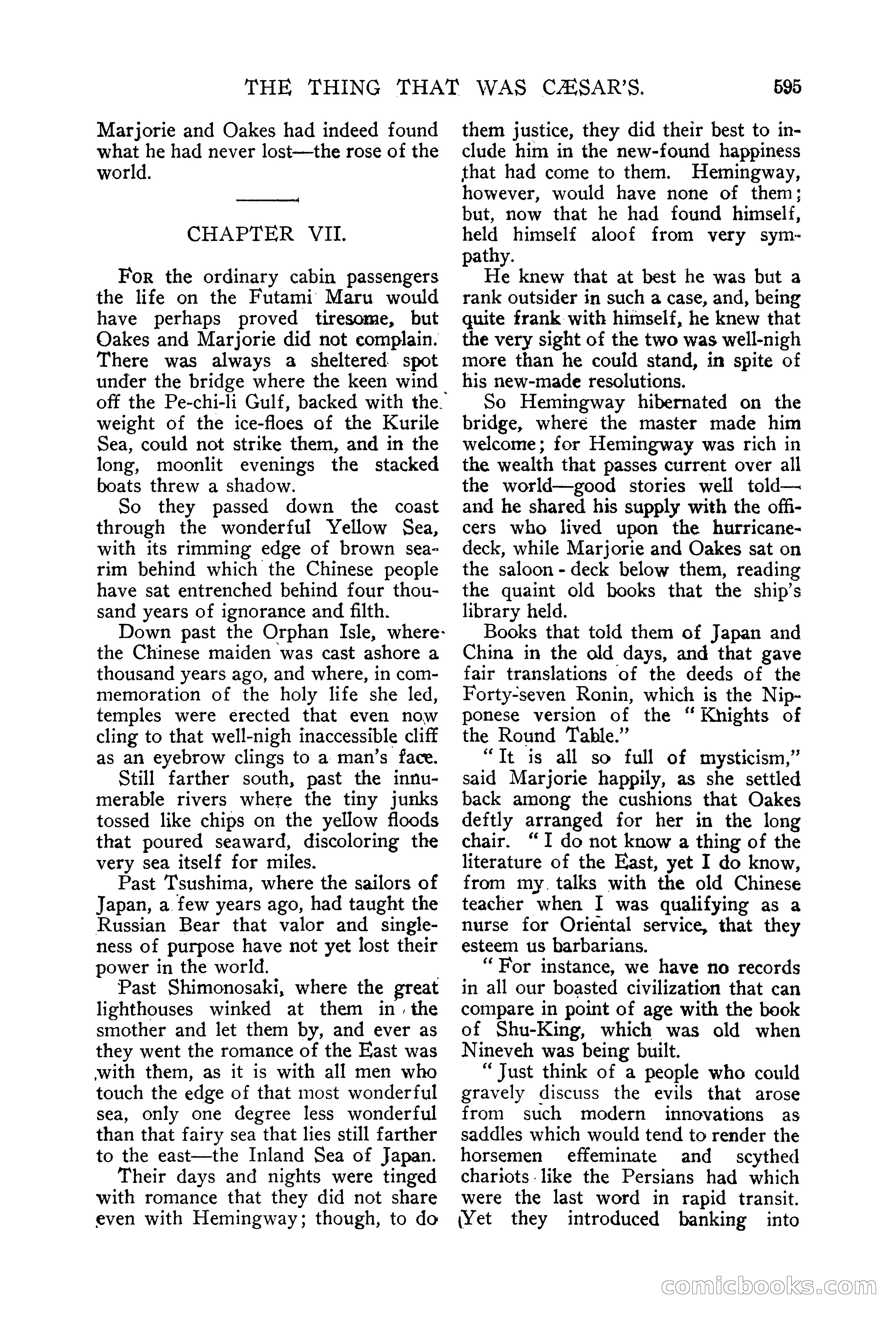
A restored page from Pulp Fiction, 1914. Page through the whole issue in the reader above.
📄 Transcribed text from this page (OCR, searchable)
Machine-transcribed from the original scan — historical spelling and the odd misread are preserved.
THE THING THAT WAS CAASAR’S. Marjorie and Oakes had indeed found what he had never lost—the rose of the world. CHAPTER VII. For the ordinary cabin passengers the life on the Futami Maru would have perhaps proved tiresome, but Oakes and Marjorie did not complain. There was always a sheltered spot under the bridge where the keen wind off the Pe-chi-li Gulf, backed with the. weight of the ice-floes of the Kurile Sea, could not strike them, and in the long, moonlit evenings the stacked boats threw a shadow. So they passed down the coast through the wonderful Yellow Sea, with its rimming edge of brown sea- rim behind which the Chinese people have sat entrenched behind four thou- sand years of ignorance and filth. Down past the Orphan Isle, where- the Chinese maiden was cast ashore a thousand years ago, and where, in com- memoration of the holy life she led, temples were erected that even now cling to that well-nigh inaccessible cliff as an eyebrow clings to a man’s face. Still farther south, past the innu- merable rivers where the tiny junks tossed like chips on the yellow floods that poured seaward, discoloring the very sea itself for miles. Past Tsushima, where the sailors of Japan, a. few years ago, had taught the Russian Bear that valor and single- ness of purpose have not yet lost their power in the world. | Past Shimonosaki, where the great lighthouses winked at them inthe smother and let them by, and ever as they went the romance of the East was with them, as it is with all men who touch the edge of that most wonderful sea, only one degree less wonderful than that fairy sea that lies still farther to the east—the Inland Sea of Japan. Their days and nights were tinged with romance that they did not share even with Hemingway; though, to do 595 them justice, they did their best to in- clude him in the new-found happiness that had come to them. Hemingway, however, would have none of them; but, now that he had found himself, held himself aloof from very sym- pathy. He knew that at best he was but a rank outsider in such a case, and, being quite frank with himself, he knew that the very sight of the two was well-nigh more than he could stand, in spite of his new-made resolutions. So Hemingway hibernated on the bridge, where the master made him welcome; for Hemingway was rich in the wealth that passes current over all the world—good stories well told— and he shared his supply with the offi- cers who lived upon the hurricane- deck, while Marjorie and Oakes sat on the saloon - deck below them, reading the quaint old books that the ship’s library held. Books that told them of Japan and China in the old days, and that gave fair translations of the deeds of the Forty-seven Ronin, which is the Nip-~ ponese version of the “ Knights of the Round Table.” “Tt is all so full of mysticism,” said Marjorie happily, as she settled back among the cushions that Oakes deftly arranged for her in the long chair. “I do not know a thing of the literature of the East, yet I do know, from my. talks with the old Chinese teacher when I was qualifying as a nurse for Oriental service, that they esteem us barbarians. “For instance, we have no records in all our boasted civilization that can compare in point of age with the book of Shu-King, which was old when Nineveh was being built. “Just think of a people who could gravely discuss the evils that arose from such modern innovations as saddles which would tend to render the horsemen effeminate and_ scythed chariots like the Persians had which were the last word in rapid transit. (Yet they introduced banking into COMicdoo S CO@