
Pulp Fiction, 1914 · page 126 of 266
The Argosy, Vol. 76, No. 3 — page 126: what you’re looking at
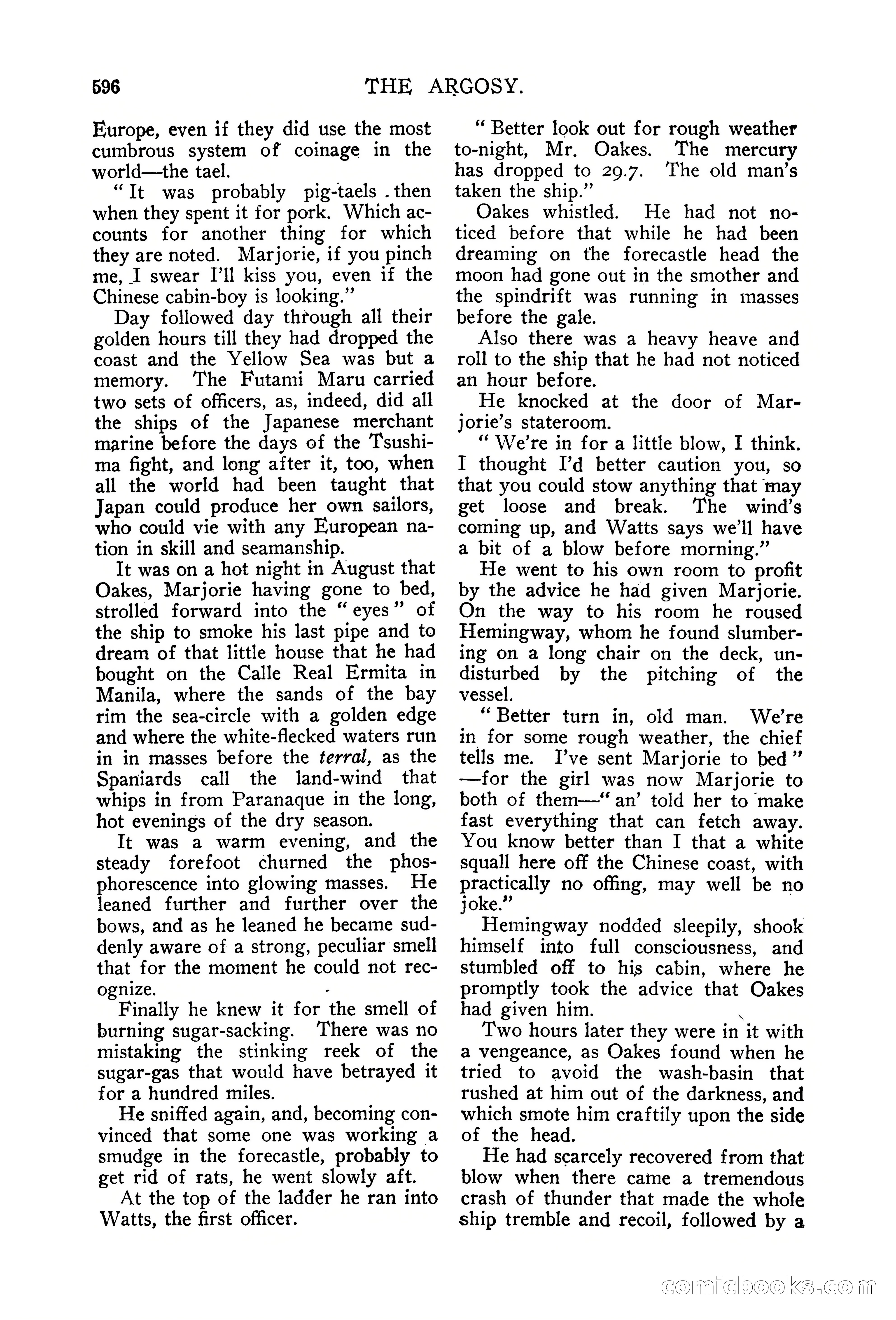
A restored page from Pulp Fiction, 1914. Page through the whole issue in the reader above.
📄 Transcribed text from this page (OCR, searchable)
Machine-transcribed from the original scan — historical spelling and the odd misread are preserved.
596 Europe, even if they did use the most cumbrous system of coinage in the world—the tael. “It was probably pig-taels . then when they spent it for pork. Which ac- counts for another thing for which they are noted. Marjorie, if you pinch me, I swear I’ll kiss you, even if the Chinese cabin-boy is looking.” Day followed day thtough all their golden hours till they had dropped the coast and the Yellow Sea was but a memory. The Futami Maru carried two sets of officers, as, indeed, did all the ships of the Japanese merchant marine before the days of the Tsushi- ma fight, and long after it, too, when all the world had been taught that Japan could produce her own sailors, who could vie with any European na- tion in skill and seamanship. It was on a hot night in August that Oakes, Marjorie having gone to bed, strolled forward into the “eyes” of the ship to smoke his last pipe and to dream of that little house that he had bought on the Calle Real Ermita in Manila, where the sands of the bay rim the sea-circle with a golden edge and where the white-flecked waters run in in masses before the terral, as the Spaniards call the land-wind that whips in from Paranaque in the long, hot evenings of the dry season. It was a warm evening, and the steady forefoot churned the phos- phorescence into glowing masses. He leaned further and further over the bows, and as he leaned he became sud- denly aware of a strong, peculiar smell that for the moment he could not rec- ognize. - Finally he knew it for the smell of burning sugar-sacking. There was no mistaking the stinking reek of the sugar-gas that would have betrayed it for a hundred miles. He sniffed again, and, becoming con- vinced that some one was working a smudge in the forecastle, probably to get rid of rats, he went slowly aft. At the top of the ladder he ran into Watts, the first officer. THE ARGOSY. “Better look out for rough weather to-night, Mr. Oakes. The mercury has dropped to 29.7. The old man’s taken the ship.” Oakes whistled. He had not no- ticed before that while he had been dreaming on the forecastle head the moon had gone out in the smother and the spindrift was running in masses before the gale. Also there was a heavy heave and roll to the ship that he had not noticed an hour before. He knocked at the door of Mar- jorie’s stateroom. * We're in for a little blow, I think. I thought I’d better caution you, so that you could stow anything that may get loose and break. The wind’s coming up, and Watts says we'll have a bit of a blow before morning.” He went to his own room to profit by the advice he had given Marjorie. On the way to his room he roused Hemingway, whom he found slumber- ing on a long chair on the deck, un- disturbed by the pitching of the vessel. * Better turn in, old man. We’re in for some rough weather, the chief tells me. I’ve sent Marjorie to bed ”’ —for the girl was now Marjorie to both of them—“ an’ told her to make fast everything that can fetch away. You know better than I that a white squall here off the Chinese coast, with practically no offing, may well be no joke.” Hemingway nodded sleepily, shook himself into full consciousness, and stumbled off to his cabin, where he promptly took the advice that Oakes had given him. . Two hours later they were in it with a vengeance, as Oakes found when he tried to avoid the wash-basin that rushed at him out of the darkness, and which smote him craftily upon the side of the head. He had scarcely recovered from that blow when there came a tremendous crash of thunder that made the whole ship tremble and recoil, followed by a COMicdoo S CO@