
Pulp Fiction, 1914 · page 246 of 266
The Argosy, Vol. 76, No. 3 — page 246: what you’re looking at
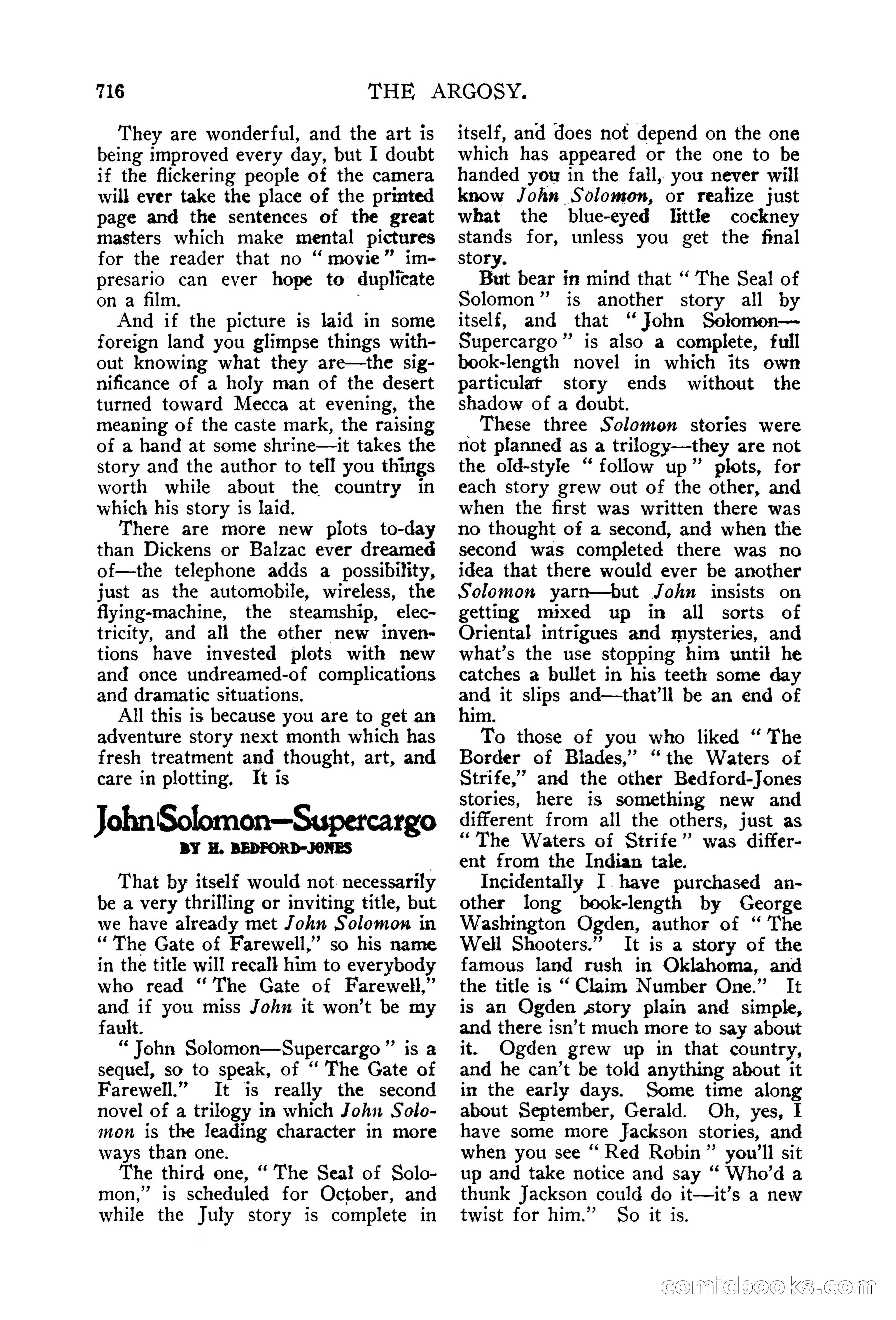
A restored page from Pulp Fiction, 1914. Page through the whole issue in the reader above.
📄 Transcribed text from this page (OCR, searchable)
Machine-transcribed from the original scan — historical spelling and the odd misread are preserved.
716 They are wonderful, and the art is being improved every day, but I doubt if the flickering people of the camera will ever take the place of the printed page and the sentences of the great masters which make mental pictures for the reader that no “ movie” im- presario can ever hope to duplicate on a film. And if the picture is laid in some foreign land you glimpse things with- out knowing what they are—the sig- nificance of a holy man of the desert turned toward Mecca at evening, the meaning of the caste mark, the raising of a hand at some shrine—it takes the story and the author to tell you things worth while about the country in which his story is laid. There are more new plots to-day than Dickens or Balzac ever dreamed of—the telephone adds a possibility, just as the automobile, wireless, the flying-machine, the steamship, elec- tricity, and all the other new inven- tions have invested plots with new and once undreamed-of complications and dramatic situations. All this 1s because you are to get an adventure story next month which has fresh treatment and thought, art, and care in plotting. It is John Solomon—Supercargo BY H. BEDFORD-JONES That by itself would not necessarily be a very thrilling or inviting title, but we have already met John Solomon in “The Gate of Farewell,” so his name in the title will recalk him to everybody who read “ The Gate of Farewell,” and if you miss John it won’t be my fault. “ John Solomon—Supercargo ” is a sequel, so to speak, of ‘‘ The Gate of Farewell.” It is really the second novel of a trilogy in which John Solo- mon is the leading character in more ways than one. The third one, “ The Seal of Solo- mon,” is scheduled for October, and while the July story is complete in b THE ARGOSY. itself, and does not depend on the one which has appeared or the one to be handed yow in the fall, you never will know John Solomon, or realize just what the blue-eyed little cockney stands for, unless you get the final story. But bear in mind that ‘‘ The Seal of Solomon” is another story all by itself, and that “ John Solomon— Supercargo ” is also a complete, full book-length novel in which its own particulat story ends without the shadow of a doubt. These three Solomon stories were not planned as a trilogy—they are not the old-style “follow up” plots, for each story grew out of the other, and when the first was written there was no thought of a second, and when the second was completed there was no idea that there would ever be another Solomon yarn—but John insists on getting mtxed up in all sorts of Oriental intrigues and mysteries, and what’s the use stopping him until he catches a bullet in his teeth some day and it slips and—that’ll be an end of him. To those of you who liked “ The Border of Blades,” “the Waters of Strife,” and the other Bedford-Jones stories, here is something new and different from all the others, just as “The Waters of Strife” was differ- ent from the Indian tale. Incidentally I. have purchased an- other long book-length by George Washington Ogden, author of “ The Well Shooters.” It is a story of the famous land rush in Oklahoma, and the title is “ Claim Number One.” It is an Ogden story plain and simple, and there isn’t much more to say about it. Ogden grew up in that country, and he can’t be told anything about it in the early days. Some time along about September, Gerald. Oh, yes, I have some more Jackson stories, and when you see “ Red Robin” you'll sit up and take notice and say “ Who'd a thunk Jackson could do it—it’s a new twist for him.” So it is. COMicdoo S CO@