
Pulp Fiction, 1916 · page 106 of 220
The Argosy, April 1916 — page 106: what you’re looking at
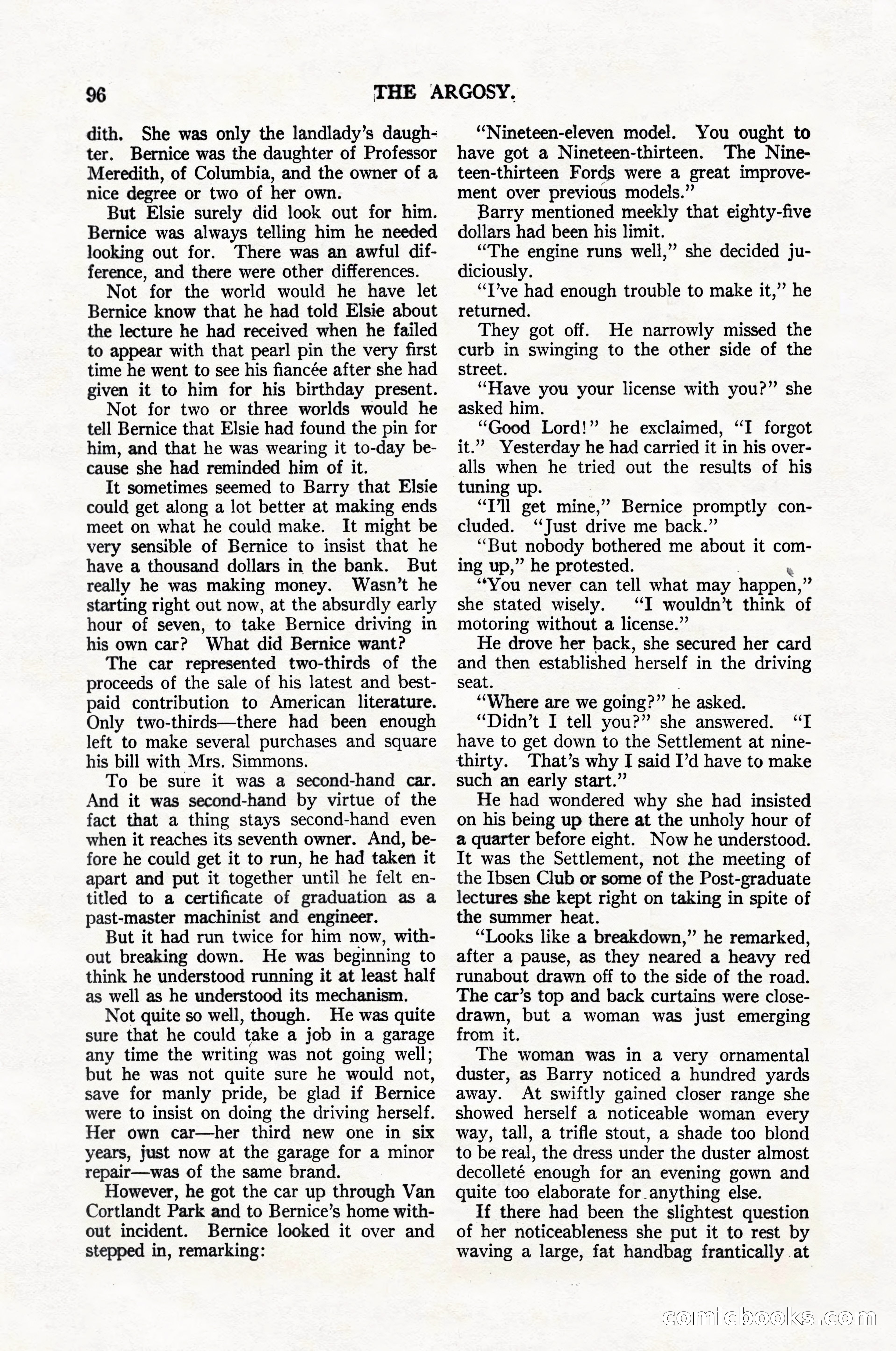
A restored page from Pulp Fiction, 1916. Page through the whole issue in the reader above.
📄 Transcribed text from this page (OCR, searchable)
Machine-transcribed from the original scan — historical spelling and the odd misread are preserved.
96 dith. She was only the landlady’s daugh- ter. Bernice was the daughter of Professor Meredith, of Columbia, and the owner of a nice degree or two of her own. But Elsie surely did look out for him. Bernice was always telling him he needed looking out for. There was an awful dif- ference, and there were other differences. Not for the world would he have let Bernice know that he had told Elsie about the lecture he had received when he failed to appear with that pearl pin the very first time he went to see his fiancée after she had given it to him for his birthday present. Not for two or three worlds would he tell Bernice that Elsie had found the pin for him, and that he was wearing it to-day be- cause she had reminded him of it. It sometimes seemed to Barry that Elsie could get along a lot better at making ends meet on what he could make. It might be very sensible of Bernice to insist that he have a thousand dollars in the bank. But really he was making money. Wasn’t he starting right out now, at the absurdly early hour of seven, to take Bernice driving in his own car? What did Bernice want? The car represented two-thirds of the proceeds of the sale of his latest and best- paid contribution to American literature. Only two-thirds—there had been enough left to make several purchases and square his bill with Mrs. Simmons. To be sure it was a second-hand car. And it was second-hand by virtue of the fact that a thing stays second-hand even when it reaches its seventh owner. And, be- fore he could get it to run, he had taken it apart and put it together until he felt en- titled to a certificate of graduation as a past-master machinist and engineer. But it had run twice for him now, with- out breaking down. He was beginning to think he understood running it at least half as well as he understood its mechanism. Not quite so well, though. He was quite sure that he could ‘take a job in a garage any time the writing was not going well; but he was not quite sure he would not, save for manly pride, be glad if Bernice were to insist on doing the driving herself. Her own car—her third new one in six years, just now at the garage for a minor repair—was of the same brand. However, he got the car up through Van Cortlandt Park and to Bernice’s home with- out incident. Bernice looked it over and stepped in, remarking: THE ARGOSY. “‘Nineteen-eleven model. You ought to have got a Nineteen-thirteen. The Nine- teen-thirteen Fords were 2 great improve- ment over previous models.” Barry mentioned meekly that eighty-five dollars had been his limit. “The engine runs well,’ she decided ju- diciously. “I’ve had enough trouble to make it,” he returned. They got off. He narrowly missed the curb in swinging to the other side of the street. “Have you your license with you?” she asked him. “Good Lord!” he exclaimed, “I forgot it.’ Yesterday he had carried it in his over- alls when he tried out the results of his tuning up. “Tl get mine,” Bernice promptly con- cluded. ‘Just drive me back.” ‘But nobody bothered me about it com- ing up,” he protested. r ‘*You never can tell what may happen, i she stated wisely. “I wouldn't think of motoring without a license.” He drove her back, she secured her card and then established herself in the driving seat. ““Where are we going?” he asked. “Didn’t I tell you?” she answered. “I have to get down to the Settlement at nine- thirty. That’s why I said I’d have to make such an early start.” He had wondered why she had insisted on his being up there at the unholy hour of a quarter before eight. Now he understood. It was the Settlement, not the meeting of the Ibsen Club or some of the Post-graduate lectures she kept right on taking in spite of the summer heat. “Looks like a breakdown,” he remarked, after a pause, as they neared a heavy red runabout drawn off to the side of the road. The car’s top and back curtains were close- drawn, but a woman was just emerging from it. The woman was in a very ornamental duster, as Barry noticed a hundred yards away. At swiftly gained closer range she showed herself a noticeable woman every way, tall, a trifle stout, a shade too blond to be real, the dress under the duster almost decolleté enough for an evening gown and quite too elaborate for_anything else. If there had been the slightest question of her noticeableness she put it to rest by waving a large, fat handbag frantically at cCoOmicloooks (©