
Pulp Fiction, 1916 · page 112 of 220
The Argosy, April 1916 — page 112: what you’re looking at
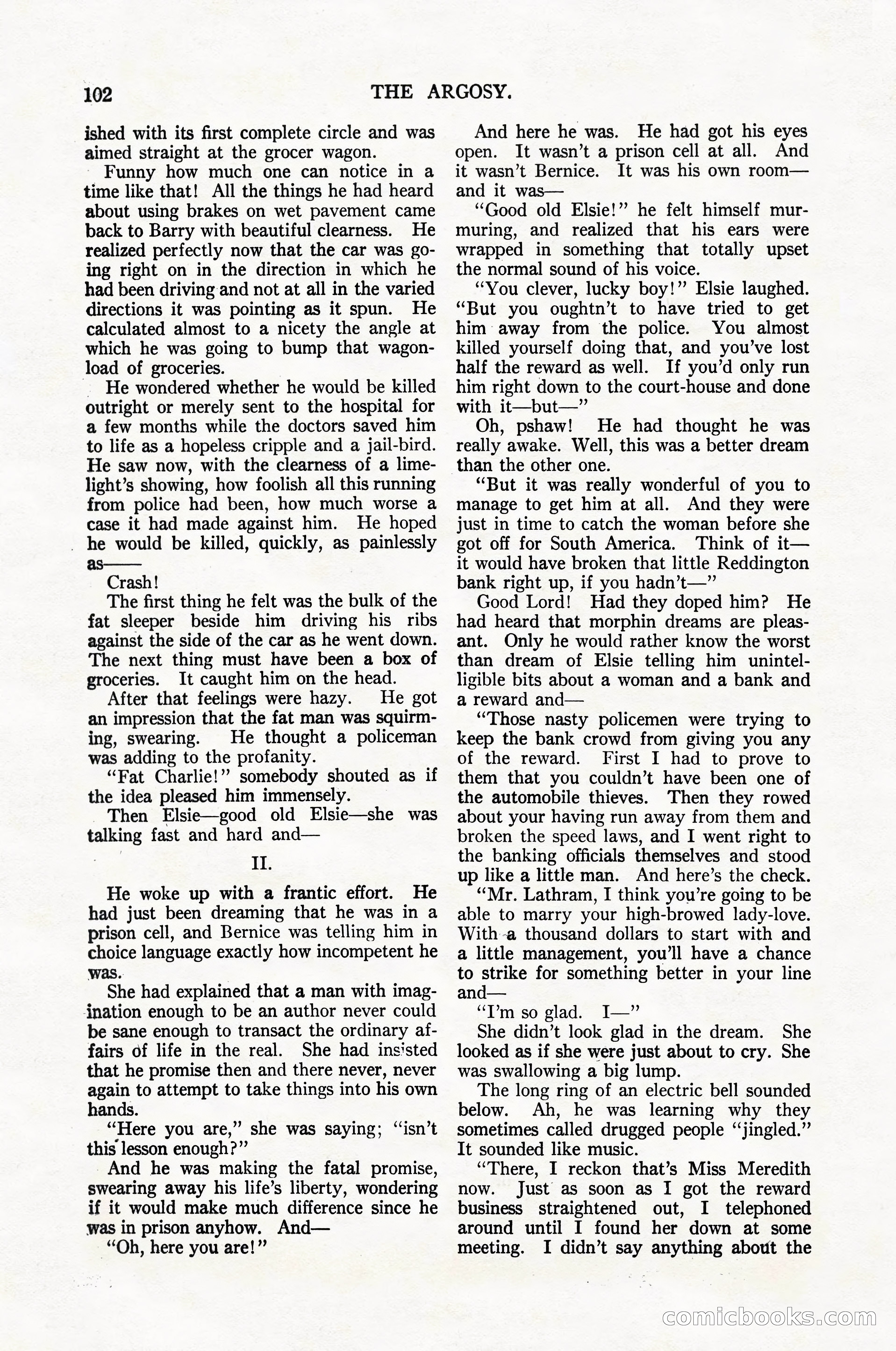
A restored page from Pulp Fiction, 1916. Page through the whole issue in the reader above.
📄 Transcribed text from this page (OCR, searchable)
Machine-transcribed from the original scan — historical spelling and the odd misread are preserved.
102 ished with its first complete circle and was aimed straight at the grocer wagon. Funny how much one can notice in a time like that! All the things he had heard about using brakes on wet pavement came back to Barry with beautiful clearness. He realized perfectly now that the car was go- ing right on in the direction in which he had been driving and not at all in the varied directions it was pointing as it spun. He calculated almost to a nicety the angle at which he was going to bump that wagon- load of groceries. - He wondered whether he would be killed outright or merely sent to the hospital for a few months while the doctors saved him to life as a hopeless cripple and a jail-bird. He saw now, with the clearness of a lime- light’s showing, how foolish all this running from police had been, how much worse a case it had made against him. He hoped _ he would be killed, quickly, as painlessly as Crash! The first thing he felt was the bulk of the fat sleeper beside him driving his ribs against the side of the car as he went down. The next thing must have been a box of groceries. It caught him on the head. After that feelings were hazy. He got an impression that the fat man was squirm- ing, swearing. He thought a policeman was adding to the profanity. “Fat Charlie!”? somebody shouted as if the idea pleased him immensely. _ Then Elsie—good old Elsie—she was talking fast and hard and— II. He woke up with a frantic effort. He had just been dreaming that he was in a prison cell, and Bernice was telling him in choice language exactly how incompetent he She had explained that a man with imag- ination enough to be an author never could be sane enough to transact the ordinary af- fairs of life in the real. She had insisted that he promise then and there never, never again to attempt to take things into his own hands. “Here you are,’ this lesson enough?” And he was making the fatal promise, swearing away his life’s liberty, wondering if it would make much difference since he was in prison anyhow. And— “Qh, here you are!” ’ she was saying; “‘isn’t THE ARGOSY. And here he was. He had got his eyes open. It wasn’t a prison cell at all. And it wasn’t Bernice. It was his own room— and it was— “Good old Elsie!” he felt himself mur- muring, and realized that his ears were wrapped in something that totally upset the normal sound of his voice. “You clever, lucky boy!” Elsie laughed. “But you oughtn’t to have tried to get him away from the police. You almost killed yourself doing that, and you’ve lost half the reward as well. If you’d only run him right down to the court-house and done with it—but—” Oh, pshaw! He had thought he was really awake. Well, this was a better dream than the other one. “But it was really wonderful of you to manage to get him at all. And they were just in time to catch the woman before she got off for South America. Think of it— it would have broken that little Reddington bank right up, if you hadn’t—” Good Lord! Had they doped him? He had heard that morphin dreams are pleas- ant. Only he would rather know the worst than dream of Elsie telling him unintel- ligible bits about a woman and a bank and a reward and— “Those nasty policemen were trying to keep the bank crowd from giving you any of the reward. First I had to prove to them that you couldn’t have been one of the automobile thieves. Then they rowed about your having run away from them and broken the speed laws, and I went right to the banking officials themselves and stood up like a little man. And here’s the check. “Mr. Lathram, I think you’re going to be able to marry your high-browed lady-love. With-a thousand dollars to start with and a little management, you'll have a chance to strike for something better in your line and— “T’m so glad. I—” She didn’t look glad in the dream. She looked as if she were just about to cry. She was swallowing a big lump. The long ring of an electric bell sounded below. Ah, he was learning why they sometimes called drugged people ‘‘jingled.”’ It sounded like music. “There, I reckon that’s Miss Meredith now. Just as soon as I got the reward business straightened out, I telephoned around until I found her down at some meeting. I didn’t say anything about the COmiclboo S C©