
Pulp Fiction, 1916 · page 123 of 220
The Argosy, April 1916 — page 123: what you’re looking at
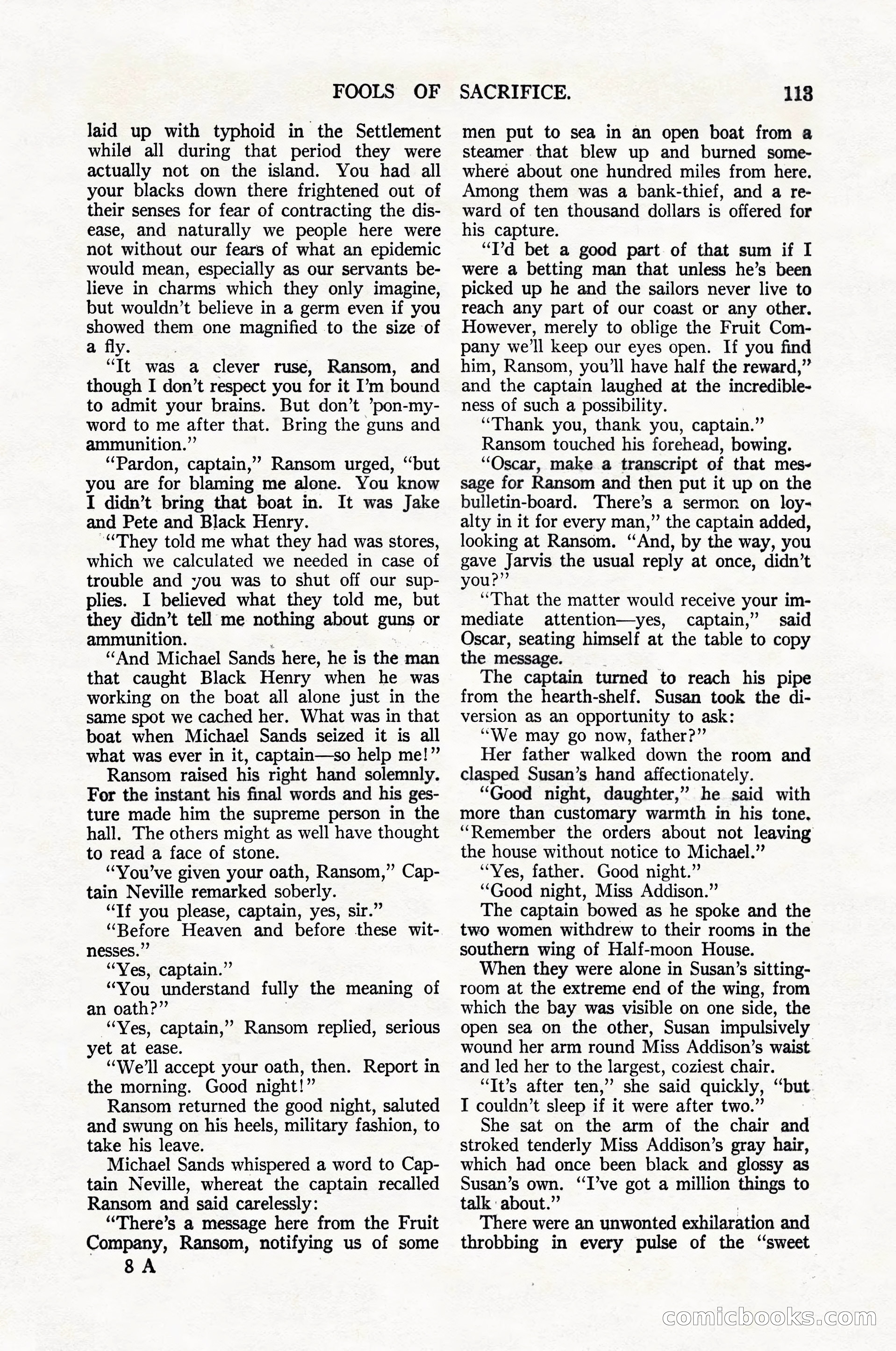
A restored page from Pulp Fiction, 1916. Page through the whole issue in the reader above.
📄 Transcribed text from this page (OCR, searchable)
Machine-transcribed from the original scan — historical spelling and the odd misread are preserved.
FOOLS OF laid up with typhoid in the Settlement while all during that period they were actually not on the island. You had all your blacks down there frightened out of their senses for fear of contracting the dis- ease, and naturally we people here were not without our fears of what an epidemic would mean, especially as our servants be- lieve in charms which they only imagine, but wouldn’t believe in a germ even if you showed them one magnified to the size of a fly. “Tt was a clever ruse, Ransom, and though I don’t respect you for it I’m bound to admit your brains. But don’t ’pon-my- word to me after that. Bring the guns and ammunition.” “Pardon, captain,” Ransom urged, ‘‘but you are for blaming me alone. You know I didn’t bring that boat in. It was Jake and Pete and Black Henry. ““They told me what they had was stores, which we calculated we needed in case of trouble and you was to shut off our sup- plies. I believed what they told me, but they didn’t tell me nothing about ey or ammunition. “And Michael Sands here, he is the man that caught Black Henry when he was working on the boat all alone just in the same spot we cached her. What was in that boat when Michael Sands seized it is all what was ever in it, captain—so help me!”’ Ransom raised his right hand solemnly. For the instant his final words and his ges- ture made him the supreme person in the hall. The others might as well have thought to read a face of stone. ‘“You’ve given your oath, Ransom,” Cap- tain Neville remarked soberly. “Tf you please, captain, yes, sir.” “Before Heaven and before these wit- nesses.” “Ves, captain.” “You understand fully the meaning of an oath?” “Ves, captain,” Ransom replied, serious yet at ease. “We'll accept your oath, then. Report in the morning. Good night!” Ransom returned the good night, saluted and swung on his heels, military fashion, to take his leave. Michael Sands whispered a word to Cap- tain Neville, whereat the captain recalled Ransom and said carelessly: “There’s a message here from the Fruit Company, Ransom, notifying us of some 8A SACRIFICE. 113 men put to sea in an open boat from a steamer that blew up and burned some- where about one hundred miles from here. Among them was a bank-thief, and a re- ward of ten thousand dollars is offered for his capture. “T’d bet a good part of that sum if I were a betting man that unless he’s been picked up he and the sailors never live to reach any part of our coast or any other. However, merely to oblige the Fruit Com- pany we'll keep our eyes open. If you find him, Ransom, you'll have half the reward,” and the captain laughed at the incredible- ness of such a possibility. “Thank you, thank you, captain.” Ransom touched his forehead, bowing. “Oscar, make a transcript of that mes- sage for Ransom and then put it up on the bulletin-board. There’s a sermon on loy- alty in it for every man,” the captain added, looking at Ransom. “And, by the way, you gave Jarvis the usual reply at once, didn’t you?” ‘That the matter would receive your im- mediate attention—yes, captain,” said Oscar, seating himself at the table to copy the message. The captain turned to reach his pipe from the hearth-shelf. Susan took the di- version as an opportunity to ask: “We may go now, father?” Her father walked down the room and clasped Susan’s hand affectionately. “Good night, daughter,” he said with more than customary warmth in his tone, ‘Remember the orders about not leaving the house without notice to Michael.” “Yes, father. Good night.” “Good night, Miss Addison.” The captain bowed as he spoke and the two women withdrew to their rooms in the southern wing of Half-moon House. When they were alone in Susan’s sitting- room at the extreme end of the wing, from which the bay was visible on one side, the open sea on the other, Susan impulsively wound her arm round Miss Addison’s waist and led her to the largest, coziest chair. “Tt’s after ten,” she said quickly, “but I couldn’t sleep if it were after two.” She sat on the arm of the chair and stroked tenderly Miss Addison’s gray hair, which had once been black and glossy as Susan’s own. “I’ve got a million things to talk about.” There were an unwonted exhilaration and throbbing in every pulse of the “sweet MICLOOOK C@