
Pulp Fiction, 1916 · page 128 of 220
The Argosy, April 1916 — page 128: what you’re looking at
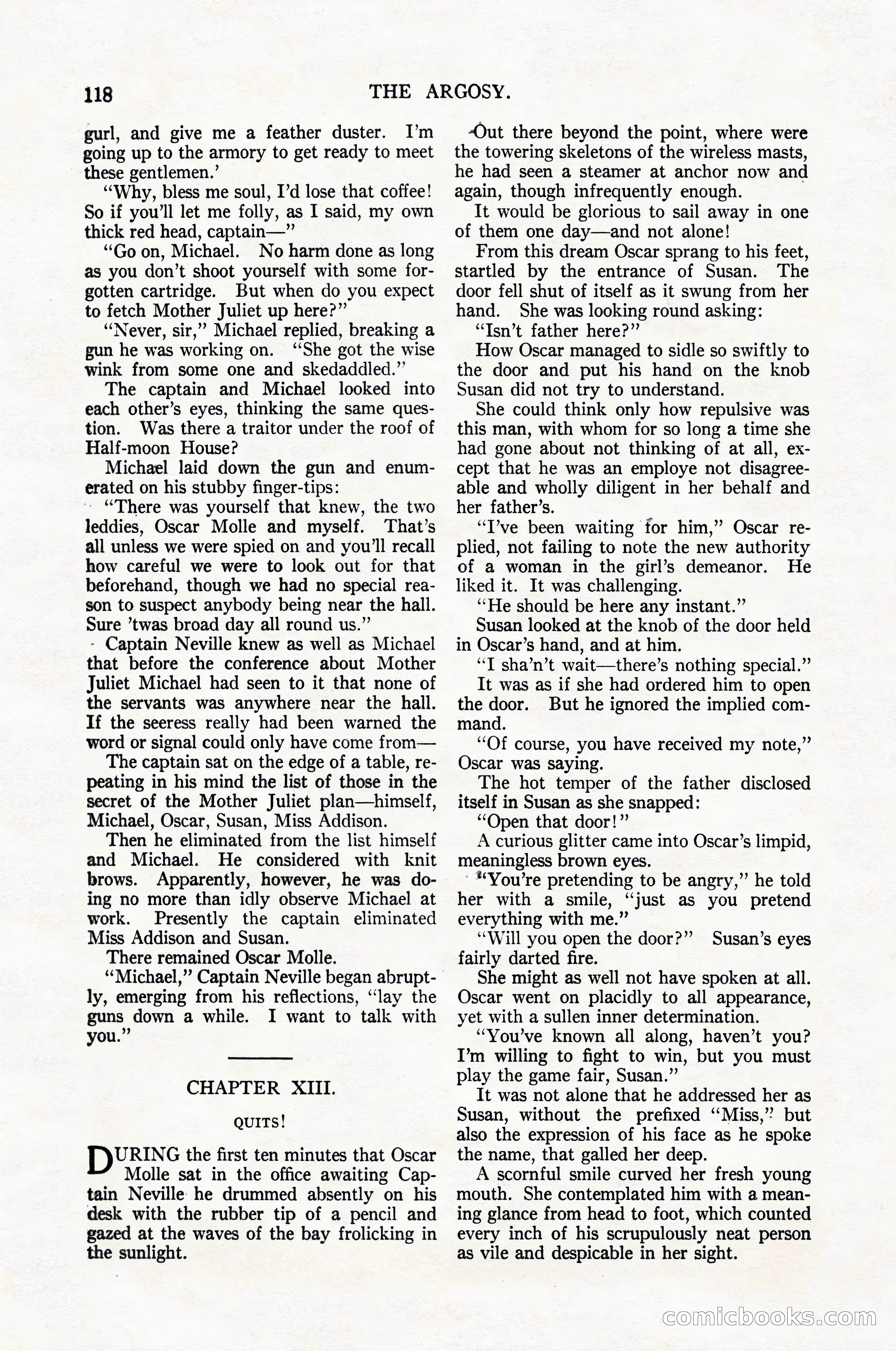
A restored page from Pulp Fiction, 1916. Page through the whole issue in the reader above.
📄 Transcribed text from this page (OCR, searchable)
Machine-transcribed from the original scan — historical spelling and the odd misread are preserved.
118 gurl, and give me a feather duster. I’m going up to the armory to get ready to meet ‘these gentlemen.’ ‘“‘Why, bless me soul, I’d lose that coffee! So if you'll let me folly, as I said, my own thick red head, captain—”’ “Go on, Michael. No harm done as long as you don’t shoot yourself with some for- gotten cartridge. But when do you expect to fetch Mother Juliet up here?” “Never, sir,” Michael replied, breaking a gun he was working on. “She got the wise wink from some one and skedaddled.”’ The captain and Michael looked into each other’s eyes, thinking the same ques- tion. Was there a traitor under the roof of Half-moon House? Michael laid down the gun and enum- erated on his stubby finger-tips: ' “There was yourself that knew, the two leddies, Oscar Molle and myself. That’s all unless we were spied on and you'll recall how careful we were to look out for that beforehand, though we had no special rea- son to suspect anybody being near the hall. Sure ’twas broad day all round us.” - Captain Neville knew as well as Michael that before the conference about Mother Juliet Michael had seen to it that none of the servants was anywhere near the hall. If the seeress really had been warned the word or signal could only have come from— The captain sat on the edge of a table, re- peating in his mind the list of those in the secret of the Mother Juliet plan—himself, Michael, Oscar, Susan, Miss Addison. Then he eliminated from the list himself and Michael. He considered with knit brows. Apparently, however, he was do- ing no more than idly observe Michael at work. Presently the captain eliminated Miss Addison and Susan. There remained Oscar Molle. ““Michael,”’ Captain Neville began abrupt- ly, emerging from his reflections, “lay the guns down a while. I want to talk with you.” CHAPTER XIII. QUITS! URING the first ten minutes that Oscar Molle sat in the office awaiting Cap- tain Neville he drummed absently on his desk with the rubber tip of a pencil and gazed at the waves of the bay frolicking in the sunlight. THE ARGOSY. Out there beyond the point, where were the towering skeletons of the wireless masts, he had seen a steamer at anchor now and again, though infrequently enough. It would be glorious to sail away in one of them one day—and not alone! From this dream Oscar sprang to his feet, startled by the entrance of Susan. The door fell shut of itself as it swung from her hand. She was looking round asking: ““Isn’t father here?”’ How Oscar managed to sidle so swiftly to the door and put his hand on the knob Susan did not try to understand. She could think only how repulsive was this man, with whom for so long a time she had gone about not thinking of at all, ex- cept that he was an employe not disagree- able and wholly diligent in her behalf and her father’s. “T’ve been waiting for him,” Oscar re- plied, not failing to note the new authority of a woman in the girl’s demeanor. He liked it. It was challenging. ‘‘He should be here any instant.”’ Susan looked at the knob of the door held in Oscar’s hand, and at him. “T sha’n’t wait—there’s nothing special.” It was as if she had ordered him to open the door. But he ignored the implied com- mand. “Of course, you have received my note,” Oscar was saying. The hot temper of the father disclosed itself in Susan as she snapped: “Open that door!” A curious glitter came into Oscar’s limpid, meaningless brown eyes. **Vou’re pretending to be angry,” he told her with a smile, “just as you pretend everything with me.” “Will you open the door?”’ fairly darted fire. She might as well not have spoken at all. Oscar went on placidly to all appearance, yet with a sullen inner determination. ‘““You’ve known all along, haven’t you? I’m willing to fight to win, but you must play the game fair, Susan.” It was not alone that he addressed her as Susan, without the prefixed ‘Miss,’ but also the expression of his face as he spoke the name, that galled her deep. A scornful smile curved her fresh young mouth. She contemplated him with a mean- ing glance from head to foot, which counted every inch of his scrupulously neat person as vile and despicable in her sight. Susan’s eyes Co OOOLK mm ©