
Pulp Fiction, 1916 · page 130 of 220
The Argosy, April 1916 — page 130: what you’re looking at
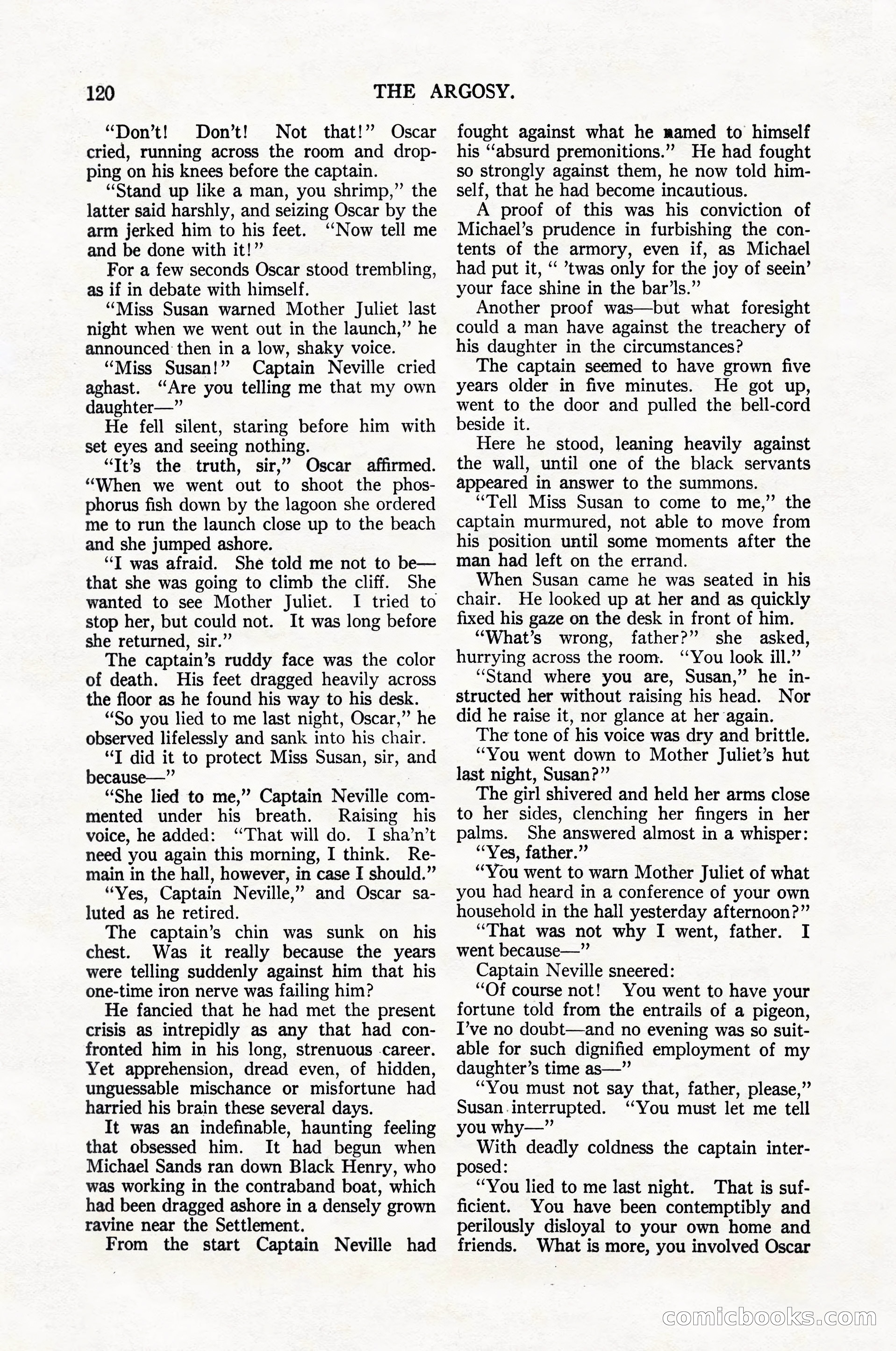
A restored page from Pulp Fiction, 1916. Page through the whole issue in the reader above.
📄 Transcribed text from this page (OCR, searchable)
Machine-transcribed from the original scan — historical spelling and the odd misread are preserved.
120 “Don’t! Don’t! Not that!” Oscar cried, running across the room and drop- ping on his knees before the captain. “Stand up like a man, you shrimp,” the latter said harshly, and seizing Oscar by the arm jerked him to his feet. ‘‘Now tell me and be done with it!” For a few seconds Oscar stood trembling, as if in debate with himself. “Miss Susan warned Mother Juliet last night when we went out in the launch,” he announced then in a low, shaky voice. “Miss Susan!” Captain Neville cried aghast. “Are you telling me that my own daughter—” He fell silent, staring before him with set eyes and seeing nothing. “Tt’s the truth, sir,” Oscar affirmed. “When we went out to shoot the phos- phorus fish down by the lagoon she ordered me to run the launch close up to the beach and she jumped ashore. “T was afraid. She told me not to be— that she was going to climb the cliff. She wanted to see Mother Juliet. I tried to stop her, but could not. It was long before she returned, sir.” The captain’s ruddy face was the color of death. His feet dragged heavily across the floor as he found his way to his desk. “So you lied to me last night, Oscar,” he observed lifelessly and sank into his chair. “T did it to protect Miss Susan, sir, and because—”’ . “She lied to me,” Captain Neville com- mented under his breath. Raising his voice, he added: ‘That will do. I sha’n’t need you again this morning, I think. Re- main in the hall, however, in case I should.” “Ves, Captain Neville,” and Oscar sa- luted as he retired. The captain’s chin was sunk on his chest. Was it really because the years were telling suddenly against him that his one-time iron nerve was failing him? He fancied that he had met the present crisis as intrepidly as any that had con- fronted him in his long, strenuous career. Yet apprehension, dread even, of hidden, unguessable mischance or misfortune had harried his brain these several days. It was an indefinable, haunting feeling that obsessed him. It had begun when Michael Sands ran down Black Henry, who was working in the contraband boat, which had been dragged ashore in a densely grown ravine near the Settlement. From the start Captain Neville had THE ARGOSY. fought against what he named to himself his “‘absurd premonitions.” He had fought so strongly against them, he now told him- self, that he had become incautious. A proof of this was his conviction of Michael’s prudence in furbishing the con- tents of the armory, even if, as Michael had put it, “‘ twas only for the joy of seein’ your face shine in the bar’ls.”’ Another proof was—but what foresight could a man have against the treachery of his daughter in the circumstances? The captain seemed to have grown five years older in five minutes. He got up, went to the door and pulled the bell-cord beside it. Here he stood, leaning heavily against the wall, until one of the black servants appeared in answer to the summons. “Tell Miss Susan to come to me,” the captain murmured, not able to move from his position until some moments after the man had left on the errand. When Susan came he was seated in his chair. He looked up at her and as quickly fixed his gaze on the desk in front of him. ‘“‘What’s wrong, father?” she asked, hurrying across the room. ‘You look ill.” ‘Stand where you are, Susan,” he in- structed her without raising his head. Nor did he raise it, nor glance at her again. The tone of his voice was dry and brittle. ‘You went down to Mother Juliet’s hut last night, Susan?” The girl shivered and held her arms close to her sides, clenching her fingers in her palms. She answered almost in a whisper: “Ves, father.” “You went to warn Mother Juliet of what you had heard in a conference of your own household in the hall yesterday afternoon?”’ “That was not why I went, father. I went because—”’ Captain Neville sneered: “Of course not! You went to have your fortune told from the entrails of a pigeon, I’ve no doubt—and no evening was so suit- able for such dignified employment of my daughter’s time as—”’ ‘You must not say that, father, please,” Susan. interrupted. ‘You must let me tell you why—” With deadly coldness the captain inter- posed: ‘You lied to me last night. That is suf- ficient. You have been contemptibly and perilously disloyal to your own home and friends. What is more, you involved Oscar Connicloooks Cc C©