
Pulp Fiction, 1916 · page 148 of 220
The Argosy, April 1916 — page 148: what you’re looking at
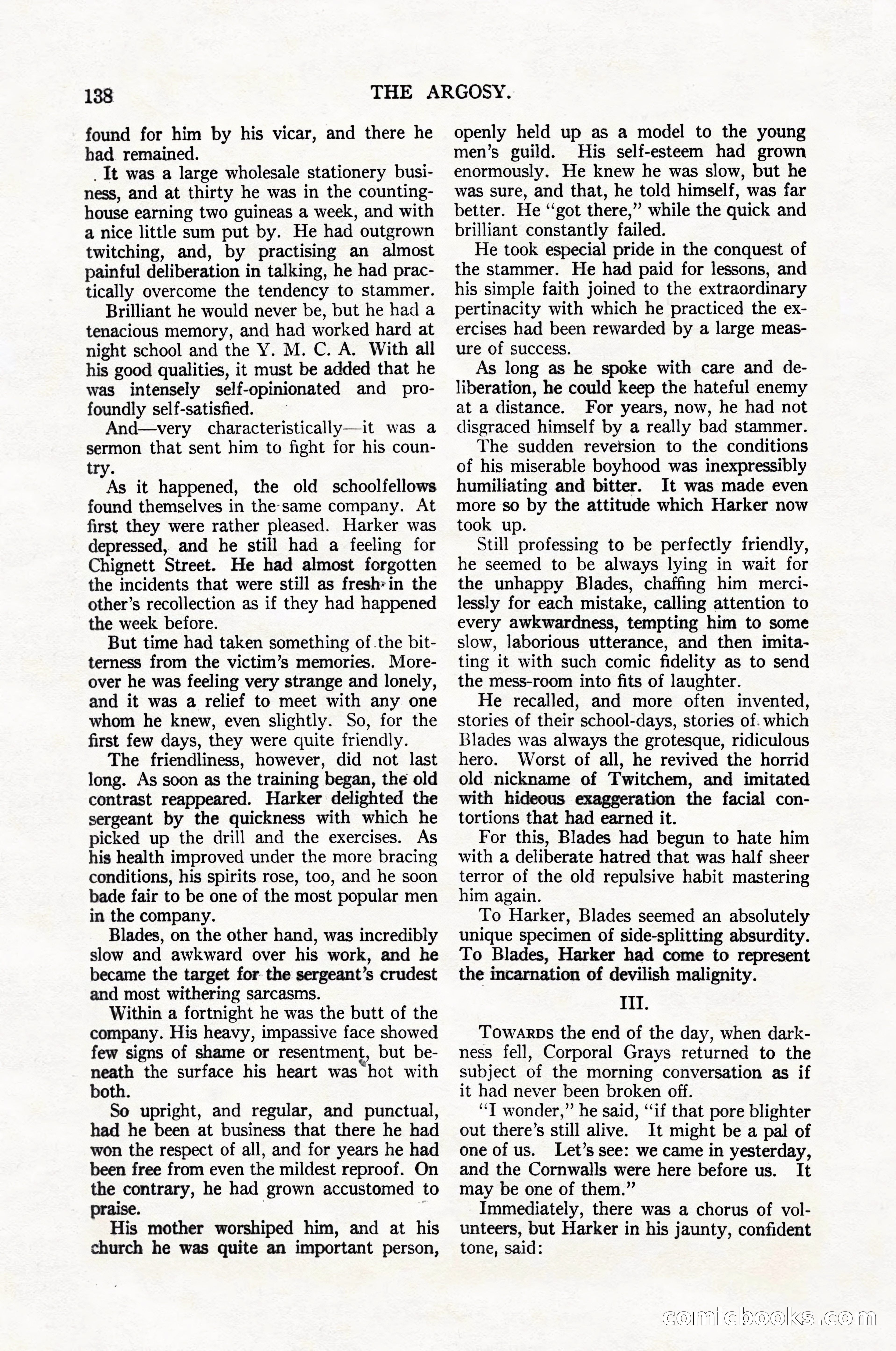
A restored page from Pulp Fiction, 1916. Page through the whole issue in the reader above.
📄 Transcribed text from this page (OCR, searchable)
Machine-transcribed from the original scan — historical spelling and the odd misread are preserved.
188 found for him by his vicar, and there he had remained. _It was a large wholesale stationery busi- ness, and at thirty he was in the counting- house earning two guineas a week, and with a nice little sum put by. He had outgrown twitching, and, by practising an almost painful deliberation in talking, he had prac- tically overcome the tendency to stammer. Brilliant he would never be, but he had a tenacious memory, and had worked hard at night school and the Y. M. C. A. With all his good qualities, it must be added that he was intensely self-opinionated and_pro- foundly self-satisfied. And—very characteristically—it was a sermon that sent him to fight for his coun- try. As it happened, the old _ schoolfellows found themselves in the-same company. At first they were rather pleased. Harker was depressed, and he still had a feeling for Chignett Street. He had almost forgotten the incidents that were still as fresh*in the other’s recollection as if they had happened the week before. But time had taken something of.the bit- terness from the victim’s memories. More- over he was feeling very strange and lonely, and it was a relief to meet with any one whom he knew, even slightly. So, for the first few days, they were quite friendly. The friendliness, however, did not last long. As soon as the training began, the old contrast reappeared. Harker delighted the sergeant by the quickness with which he picked up the drill and the exercises. As his health improved under the more bracing conditions, his spirits rose, too, and he soon bade fair to be one of the most popular men in the company. Blades, on the other hand, was incredibly slow and awkward over his work, and he became the target for the sergeant’s crudest and most withering sarcasms. Within a fortnight he was the butt of the company. His heavy, impassive face showed few signs of shame or resentment, but be- neath the surface his heart was “hot with both. So upright, and regular, and punctual, had he been at business that there he had won the respect of all, and for years he had been free from even the mildest reproof. On the contrary, he had grown accustomed to praise. His mother worshiped him, and at his church he was quite an important person, THE ARGOSY. openly held up as a model to the young men’s guild. His self-esteem had grown enormously. He knew he was slow, but he was sure, and that, he told himself, was far better. He “‘got there,” while the quick and brilliant constantly failed. He took especial pride in the conquest of the stammer. He had paid for lessons, and his simple faith joined to the extraordinary pertinacity with which he practiced the ex- ercises had been rewarded by a large meas- ure of success. As long as he spoke with care and de- liberation, he could keep the hateful enemy at a distance. For years, now, he had not disgraced himself by a really bad stammer. The sudden reversion to the conditions of his miserable boyhood was inexpressibly humiliating and bitter. It was made even more so by the attitude which Harker now took up. Still professing to be perfectly friendly, he seemed to be always lying in wait for the unhappy Blades, chaffing him merci- lessly for each mistake, calling attention to every awkwardness, tempting him to some slow, laborious utterance, and then imita- ting it with such comic fidelity as to send the mess-room into fits of laughter. He recalled, and more often invented, stories of their school-days, stories of. which Blades was always the grotesque, ridiculous hero. Worst of all, he revived the horrid old nickname of Twitchem, and imitated with hideous exaggeration the facial con- tortions that had earned it. For this, Blades had begun to hate him with a deliberate hatred that was half sheer terror of the old repulsive habit mastering him again. To Harker, Blades seemed an absolutely unique specimen of side-splitting absurdity. To Blades, Harker had come to represent the incarnation of devilish malignity. IIT. TowaArps the end of the day, when dark- ness fell, Corporal Grays returned to the subject of the morning conversation as if it had never been broken off. ‘“T wonder,” he said, ‘‘if that pore blighter out there’s still alive. It might be a pal of one of us. Let’s see: we came in yesterday, and the Cornwalls were here before us. It may be one of them.” Immediately, there was a chorus of vol- unteers, but Harker in his jaunty, confident tone, said: 1OOOLK im (©