
Pulp Fiction, 1916 · page 168 of 220
The Argosy, April 1916 — page 168: what you’re looking at
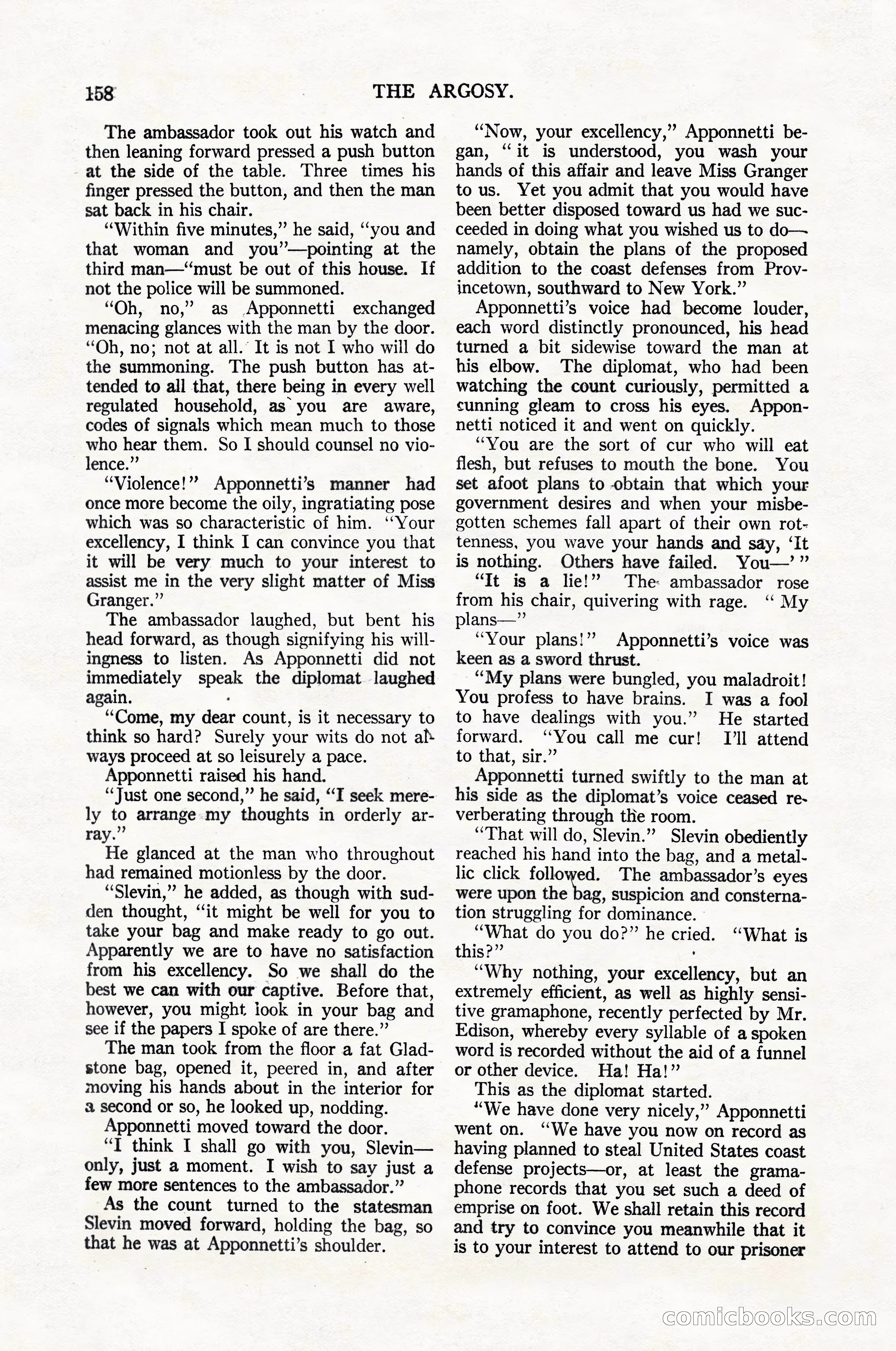
A restored page from Pulp Fiction, 1916. Page through the whole issue in the reader above.
📄 Transcribed text from this page (OCR, searchable)
Machine-transcribed from the original scan — historical spelling and the odd misread are preserved.
158 The ambassador took out his watch and then leaning forward pressed a push button at the side of the table. Three times his finger pressed the button, and then the man sat back in his chair. “Within five minutes,” he said, ‘‘you and that woman and you’—pointing at the third man—“‘must be out of this house. If not the police will be summoned. “Oh, no,’ as Apponnetti exchanged menacing glances with the man by the door. “Oh, no; not at all. It is not I who will do the summoning. The push button has at- tended to all that, there being in every well regulated household, as you are aware, codes of signals which mean much to those who hear them. So I should counsel no vio- lence.” “Violence!”” Apponnetti’s manner had once more become the oily, ingratiating pose which was so characteristic of him. ‘‘Your excellency, I think I can convince you that it will be very much to your interest to assist me in the very slight matter of Miss Granger.” The ambassador laughed, but bent his head forward, as though signifying his will- ingness to listen. As Apponnetti did not immediately speak the diplomat laughed again. ‘“‘Come, my dear count, is it necessary to think so hard? Surely your wits do not ah ways proceed at so leisurely a pace. Apponnetti raised his hand. ‘Just one second,” he said, “‘I seek mere- ly to arrange my thoughts in orderly ar- ray.” He glanced at the man who throughout had remained motionless by the door. “Slevin,” he added, as though with sud- den thought, “it might be well for you to take your bag and make ready to go out. Apparently we are to have no satisfaction from his excellency. So we shall do the best we can with our captive. Before that, however, you might look in your bag and see if the papers I spoke of are there.”’ The man took from the floor a fat Glad- stone bag, opened it, peered in, and after moving his hands about in the interior for a second or so, he looked up, nodding. Apponnetti moved toward the door. “I think I shall go with you, Slevin— only, just a moment. I wish to say just a few more sentences to the ambassador.” As the count turned to the statesman Slevin moved forward, holding the bag, so that he was at Apponnetti’s shoulder. THE ARGOSY. “Now, your excellency,’’ Apponnetti be- gan, “it is understood, you wash your hands of this affair and leave Miss Granger to us. Yet you admit that you would have been better disposed toward us had we suc- ceeded in doing what you wished us to do— namely, obtain the plans of the proposed addition to the coast defenses from Prov- incetown, southward to New York.” Apponnetti’s voice had become louder, each word distinctly pronounced, his head turned a bit sidewise toward the man at his elbow. The diplomat, who had been watching the count curiously, permitted a cunning gleam to cross his eyes. Appon- netti noticed it and went on quickly. “You are the sort of cur who will eat flesh, but refuses to mouth the bone. You set afoot plans to obtain that which your government desires and when your misbe- gotten schemes fall apart of their own rot- tenness, you wave your hands and say, ‘It is nothing. Others have failed. You—’ ” “It is a lie!” The: ambassador rose from his chair, quivering with rage. ‘“‘ My plans—” ‘Your plans!” Apponnetti’s voice was keen as a sword thrust. ‘““My plans were bungled, you maladroit! You profess to have brains. I was a fool to have dealings with you.” He started forward. “You call me cur! I’ll attend to that, sir.” Apponnetti turned swiftly to the man at his side as the diplomat’s voice ceased re- verberating through the room. “That will do, Slevin.” Slevin obediently reached his hand into the bag, and a metal- lic click followed. The ambassador’s eyes were upon the bag, suspicion and consterna- tion struggling for dominance. » ‘What do you do?” he cried. ‘What is this?” ‘Why nothing, your excellency, but an extremely efficient, as well as highly sensi- tive gramaphone, recently perfected by Mr. Edison, whereby every syllable of a spoken word is recorded without the aid of a funnel or other device. Ha! Ha!” This as the diplomat started. “We have done very nicely,” Apponnetti went on. “We have you now on record as having planned to steal United States coast defense projects—or, at least the grama- phone records that you set such a deed of emprise on foot. We shall retain this record and try to convince you meanwhile that it is to your interest to attend to our prisoner COmiclboo S C@