
Pulp Fiction, 1916 · page 184 of 220
The Argosy, April 1916 — page 184: what you’re looking at
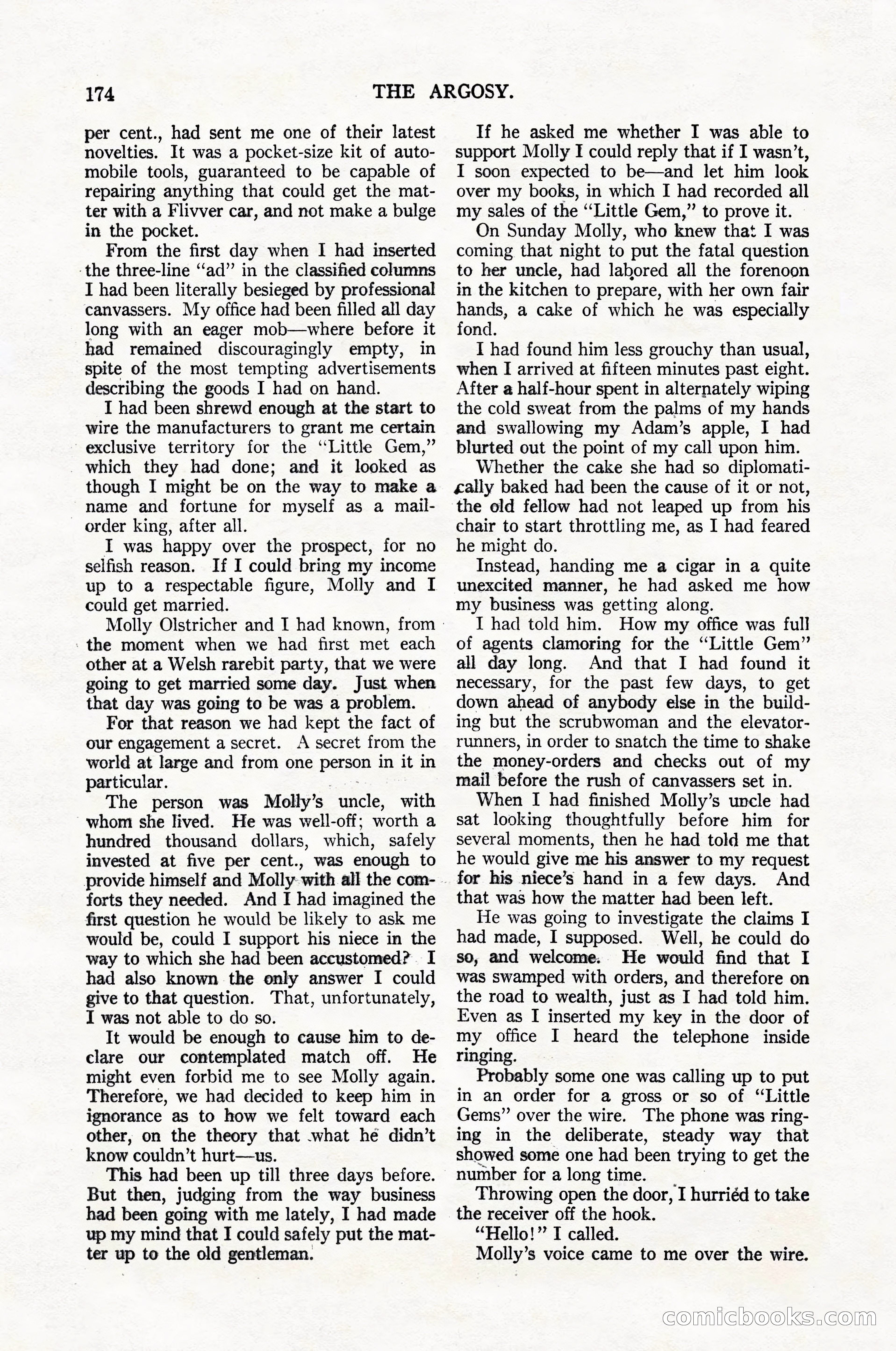
A restored page from Pulp Fiction, 1916. Page through the whole issue in the reader above.
📄 Transcribed text from this page (OCR, searchable)
Machine-transcribed from the original scan — historical spelling and the odd misread are preserved.
174 per cent., had sent me one of their latest novelties. It was a pocket-size kit of auto- mobile tools, guaranteed to be capable of repairing anything that could get the mat- ter with a Flivver car, and not make a bulge in the pocket. From the first day when I had inserted ‘the three-line ‘‘ad”’ in the classified columns I had been literally besieged by professional canvassers. My office had been filled all day long with an eager mob—where before it had remained discouragingly empty, in spite of the most tempting advertisements describing the goods I had on hand. I had been shrewd enough at the start to wire the manufacturers to grant me certain exclusive territory for the “Litthe Gem,” _ which they had done; and it looked as though I might be on the way to make a name and fortune for myself as a mail- order king, after all. I was happy over the prospect, for no selfish reason. If I could bring my income up to a respectable figure, Molly and I could get married. Molly Olstricher and I had known, from - -the moment when we had first met each other at a Welsh rarebit party, that we were going to get married some day. Just when that day was going to be was a problem. For that reason we had kept the fact of our engagement a secret. A secret from the world at large and from one pase in it in particular. The person was Molly’s uncle, with ‘whom she lived. He was well-off; worth a hundred thousand dollars, which, safely invested at five per cent., was enough to provide himself and Molly with all the com- - forts they needed. And I had imagined the first question he would be likely to ask me would be, could I support his niece in the way to which she had been accustomed? I had also known the only answer I could give to that question. That, unfortunately, I was not able to do so. It would be enough to cause him to de- clare our contemplated match off. He might even forbid me to see Molly again. Therefore, we had decided to keep him in ignorance as to how we felt toward each other, on the theory that what hé didn’t know couldn’t hurt—us. This had been up till three days before. But then, judging from the way business had been going with me lately, I had made up my mind that I could safely put the mat- ter up to the old gentleman. THE ARGOSY. If he asked me whether I was able to support Molly I could reply that if I wasn’t, I soon expected to be—and let him look over my books, in which I had recorded all my sales of the “Little Gem,” to prove it. On Sunday Molly, who knew that I was coming that night to put the fatal question to her uncle, had labored all the forenoon in the kitchen to prepare, with her own fair hands, a cake of which he was especially fond. I had found him less grouchy than usual, when I arrived at fifteen minutes past eight. After a half-hour spent in alternately wiping the cold sweat from the palms of my hands and swallowing my Adam’s apple, I had blurted out the point of my call upon him. Whether the cake she had so diplomati- sally baked had been the cause of it or not, the old fellow had not leaped up from his chair to start throttling me, as I had feared he might do. Instead, handing me a cigar in a quite unexcited manner, he had asked me how my business was getting along. I had told him. How my office was full of agents clamoring for the ‘Little Gem” all day long. And that I had found it necessary, for the past few days, to get down ahead of anybody else in the build- ing but the scrubwoman and the elevator- runners, in order to snatch the time to shake the money-orders and checks out of my mail before the rush of canvassers set in. When I had finished Molly’s uncle had sat looking thoughtfully before him for several moments, then he had told me that he would give me his answer to my request for his niece’s hand in a few days. And that was how the matter had been left. He was going to investigate the claims I had made, I supposed. Well, he could do so, and welcome: He would find that I was swamped with orders, and therefore on the road to wealth, just as I had told him. Even as I inserted my key in the door of my office I heard the telephone inside ringing. Probably some one was calling up to put in an order for a gross or so of “Little Gems” over the wire. The phone was ring- Ing in the deliberate, steady way that showed some one had been trying to get the number for a long time. Throwing open the door, I hurriéd to take the receiver off the hook. “Hello!” I called. Molly’s voice came to me over the wire. COmiclboo S C@