
Pulp Fiction, 1916 · page 193 of 220
The Argosy, April 1916 — page 193: what you’re looking at
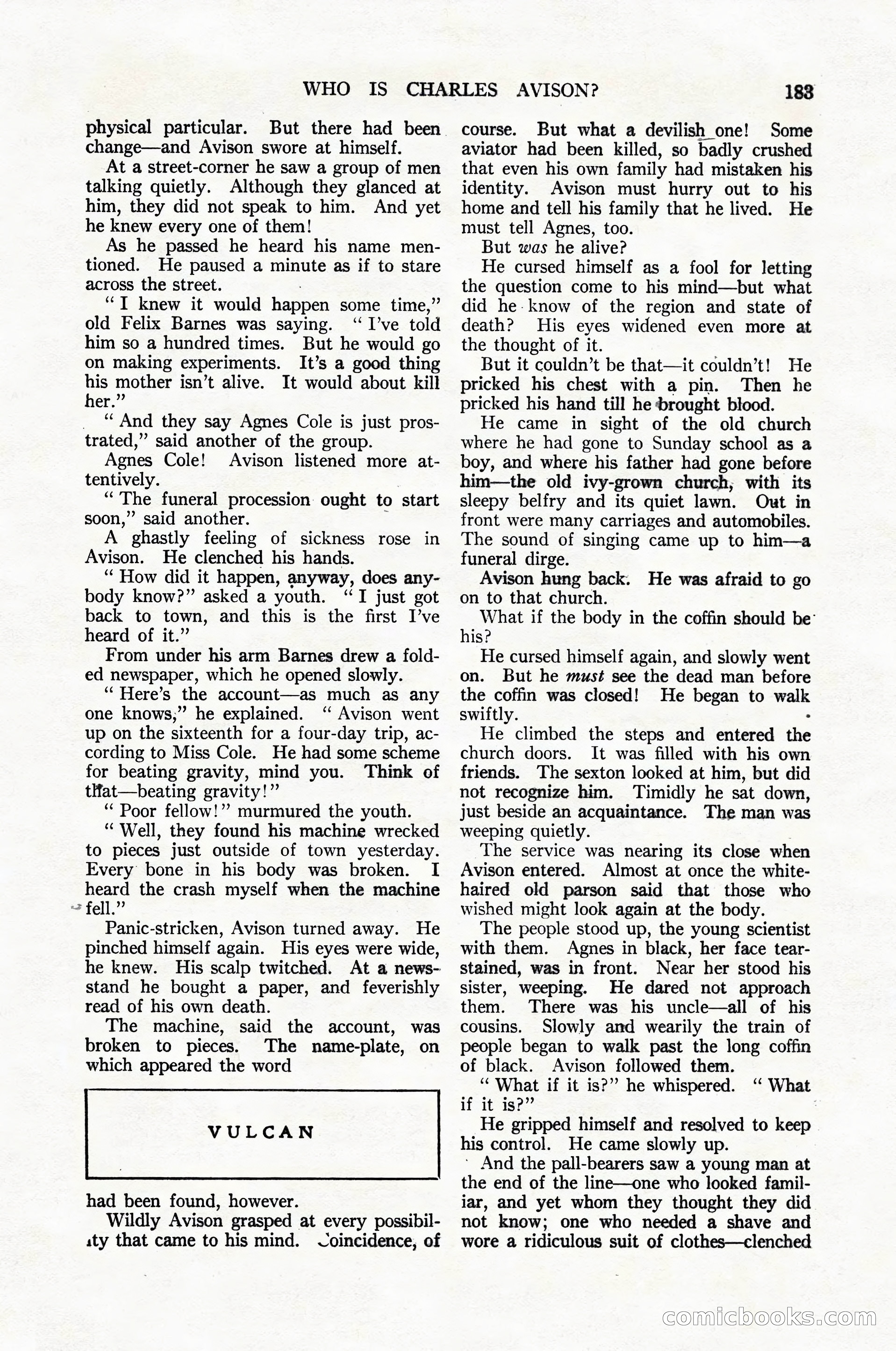
A restored page from Pulp Fiction, 1916. Page through the whole issue in the reader above.
📄 Transcribed text from this page (OCR, searchable)
Machine-transcribed from the original scan — historical spelling and the odd misread are preserved.
WHO IS CHARLES AVISON? physical particular. change—and Avison swore at himself. At a street-corner he saw a group of men talking quietly. Although they glanced at him, they did not speak to him. And yet he knew every one of them! As he passed he heard his name men- tioned. He paused a minute as if to stare across the street. “T knew it would happen some time,” old Felix Barnes was saying. “I’ve told him so a hundred times. But he would go on making experiments. It’s a good thing his mother isn’t alive. It would about kill her.” _ “ And they say Agnes Cole is just pros- trated,” said another of the group. Agnes Cole! Avison listened more at- tentively. = The funeral procession ought to ‘start soon,” said another. A ghastly feeling of sickness rose in Avison. He clenched his hands. ‘“ How did it happen, anyway, does any- body know?” asked a youth. “I just got back to town, and this is the first I’ve heard of it.” From under his arm Barnes drew a fold- ed newspaper, which he opened slowly. ‘““ Here’s the account—as much as any one knows,” he explained. ‘‘ Avison went up on the sixteenth for a four-day trip, ac- cording to Miss Cole. He had some scheme for beating gravity, mind you. Think of tHat—beating gravity!” ‘’ Poor fellow!”? murmured the youth. “Well, they found his machine wrecked to pieces just outside of town yesterday. Every bone in his body was broken. I heard the crash myself when the machine * fell.” Panic-stricken, Avison turned away. He pinched himself again. His eyes were wide, he knew. His scalp twitched. At a news- stand he bought a paper, and feverishly read of his own death. The machine, said the account, was broken to pieces. The name-plate, on which appeared the word VULCAN had been found, however. Wildly Avison grasped at every possibil- aty that came to his mind. But there had been. ~oincidence, of 183 course. But what a devilish one! Some aviator had been killed, so badly crushed that even his own family had mistaken his identity. Avison must hurry out to his home and tell his family that he lived. He must tell Agnes, too. But was he alive? He cursed himself as a fool for letting the question come to his mind—but what did he. know of the region and state of death? His eyes widened even more at the thought of it. But it couldn’t be that—it couldn’t! He pricked his chest with a pin. Then he pricked his hand till he brought blood. He came in sight of the old church where he had gone to Sunday school as a boy, and where his father had gone before him—the old ivy-grown church, with its sleepy belfry and its quiet lawn. Out in front were many carriages and automobiles. The sound of singing came up to him—a funeral dirge. Avison hung back. He was afraid to go on to that church. What if the body in the coffin should be’ his? He cursed himself again, and slowly went on. But he must see the dead man before the coffin was closed! He began to as swiftly. He climbed the steps and entered ibe church doors. It was filled with his own friends. The sexton looked at him, but did not recognize him. Timidly he sat down, just beside an acquaintance. The man was weeping quietly. The service was nearing its close when Avison entered. Almost at once the white- haired old parson said that those who wished might look again at the body. The people stood up, the young scientist with them. Agnes in black, her face tear- stained, was in front. Near her stood his sister, weeping. He dared not approach them. There was his uncle—all of his cousins. Slowly and wearily the train of people began to walk past the long coffin of black. Avison followed them. ‘What if it is?” he whispered. if it is?” He gripped himself and resolved to keep his control. He came slowly up. ' And the pall-bearers saw a young man at the end of the line—one who looked famil- iar, and yet whom they thought they did not know; one who needed a shave and wore a ridiculous suit of clothes—clenched 1OOOLK ‘“< What C@