
Pulp Fiction, 1916 · page 21 of 220
The Argosy, April 1916 — page 21: what you’re looking at
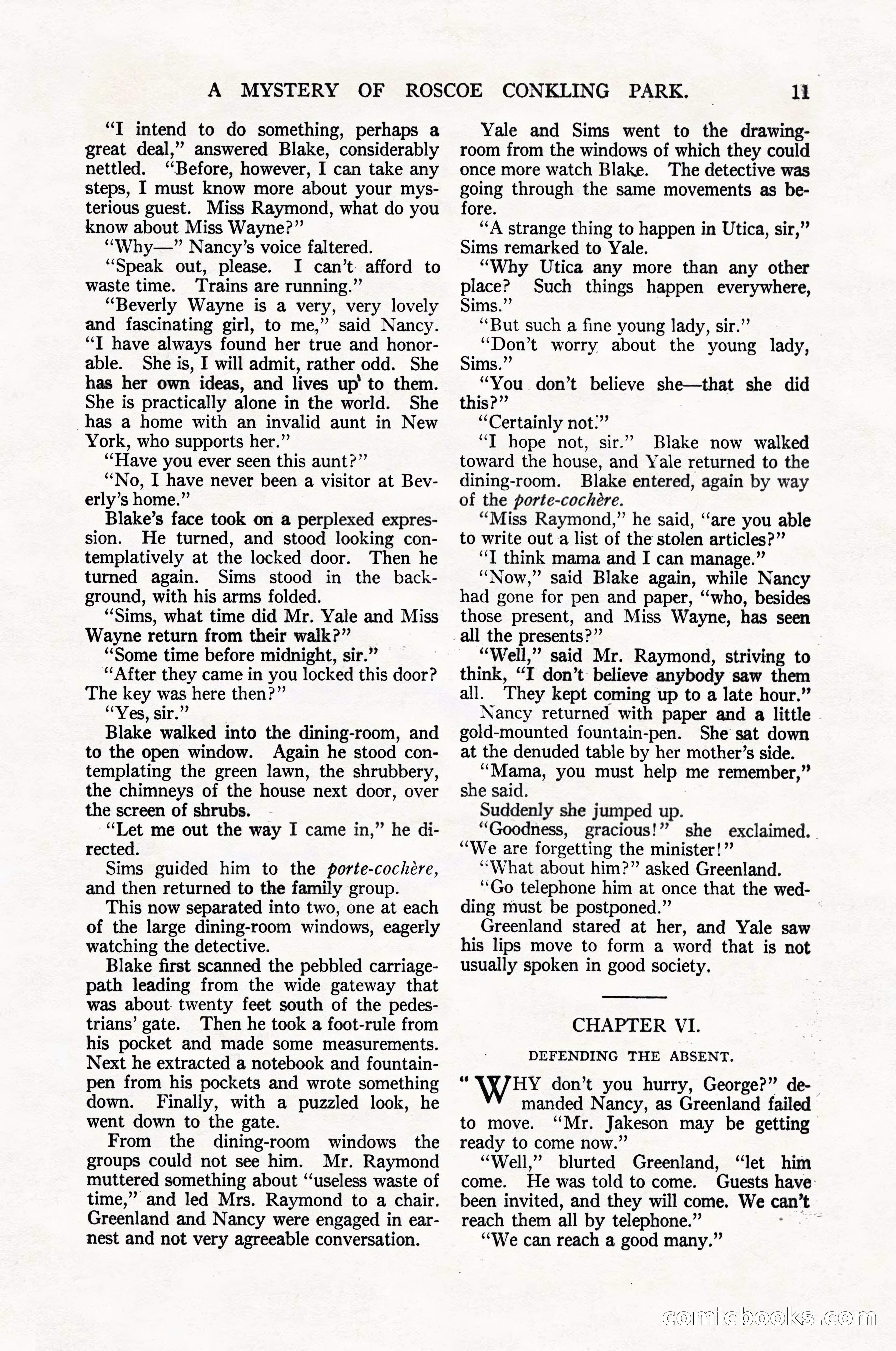
A restored page from Pulp Fiction, 1916. Page through the whole issue in the reader above.
📄 Transcribed text from this page (OCR, searchable)
Machine-transcribed from the original scan — historical spelling and the odd misread are preserved.
A MYSTERY OF ROSCOE CONKLING PARK. “Tf intend to do something, perhaps a great deal,’’ answered Blake, considerably nettled. ‘Before, however, I can take any steps, I must know more about your mys- terious guest. Miss Raymond, what do you know about Miss Wayne?”’ ‘““Why—” Nancy’s voice faltered. ‘Speak out, please. I can’t: afford to waste time. Trains are running.” “Beverly Wayne is a very, very lovely and fascinating girl, to me,” said Nancy. ‘“T have always found her true and honor- able. She is, I will admit, rather odd. She has her own ideas, and lives up’ to them. She is practically alone in the world. She has a home with an invalid aunt in New York, who supports her.”’ ‘“‘Hlave you ever seen this aunt?”’ ‘No, I have never been a visitor at Bev- erly’s home.” Blake’s face took on a perplexed expres- sion. He turned, and stood looking con- templatively at the locked door. Then he turned again. Sims stood in the back- ground, with his arms folded. ‘Sims, what time did Mr. Yale and Miss Wayne return from their walk?” “Some time before midnight, sir.” “After they came in you locked this door? The key was here then?” ‘Yes, sir.’ Blake walked into the dining-room, and to the open window. Again he stood con- templating the green lawn, the shrubbery, the chimneys of the house next door, over the screen of shrubs. “Tet me out the way I came in,” he di- rected. Sims guided him to the porte-cochere, and then returned to the family group. This now separated into two, one at each of the large dining-room windows, eagerly watching the detective. Blake first scanned the pebbled carriage- path leading from the wide gateway that was about. twenty feet south of the pedes- trians’ gate. Then he took a foot-rule from his pocket and made some measurements. Next he extracted a notebook and fountain- pen from his pockets and wrote something down. Finally, with a puzzled look, he went down to the gate. From the dining-room windows the groups could not see him. Mr. Raymond muttered something about “‘useless waste of time,” and led Mrs. Raymond to a chair. Greenland and Nancy were engaged in ear- nest and not very agreeable conversation. 11 Yale and Sims went to the drawing- room from the windows of which they could once more watch Blake. The detective was going through the same movements as be- fore. ‘‘A strange thing to happen in Utica, sir,”’ Sims remarked to Yale. “Why Utica any more than any other place? Such things happen everywhere, Sims.” ‘But such a fine young lady, sir.” “Don’t worry about the young lady, Sims.” “You don’t believe she—that she did this?” “Certainly not.” “T hope not, sir.” Blake now walked toward the house, and Yale returned to the dining-room. Blake entered, again by way of the porte-cochére. “Miss Raymond,” he said, ‘‘are you able to write out a list of the stolen articles?” ‘‘T think mama and I can manage.” “Now,” said Blake again, while Nancy had gone for pen and paper, ‘‘who, besides those present, and Miss Wayne, has seen _all the presents?”’ “Well,” said Mr. Raymond, striving to think, “T don’t believe anybody saw them all. They kept coming up to a late hour.” Nancy returned with paper and a little gold-mounted fountain-pen. She sat down at the denuded table by her mother’s side. “Mama, you must nel me remember,” she said. Suddenly she jumped up. ““Goodness, “We are forgetting the minister!” ‘What about him?” asked Greenland. ‘Go telephone him at once that the wed- ding must be postponed.” Greenland stared at her, and Yale saw his lips move to form a word that is not usually spoken in good society. CHAPTER VI. DEFENDING THE ABSENT. HY don’t you hurry, George?” de-— manded Nancy, as Greenland failed to move. “Mr. Jakeson may be getting ready to come now.” “Well,” blurted Greenland, come. He was told to come. “let him Guests have been invited, and they will come. We Soe reach them all by telephone.” ‘“‘We can reach a good many.” MICLOOOLK gracious!” she _ exclaimed. | C@