
Pulp Fiction, 1916 · page 29 of 220
The Argosy, April 1916 — page 29: what you’re looking at
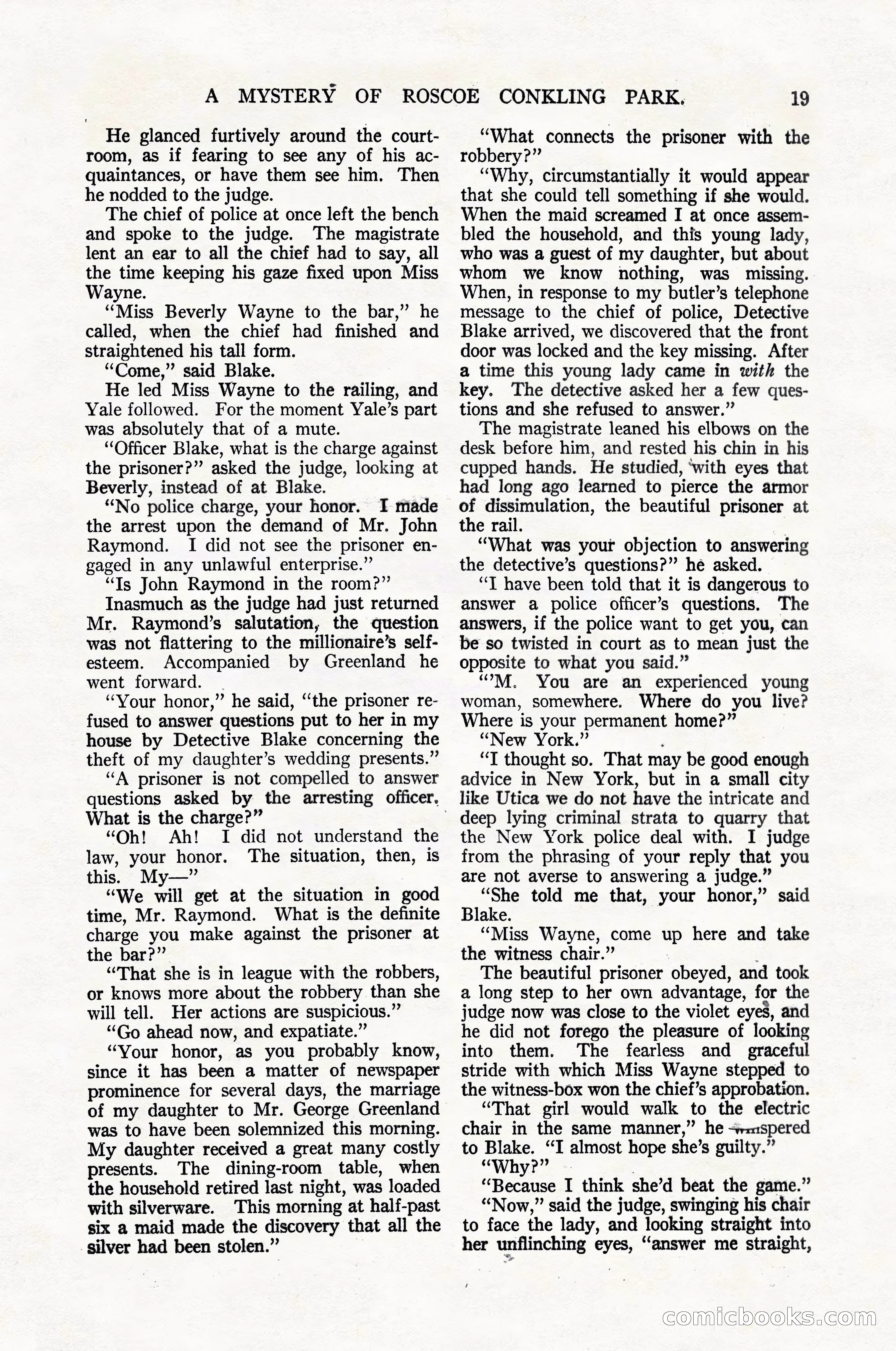
A restored page from Pulp Fiction, 1916. Page through the whole issue in the reader above.
📄 Transcribed text from this page (OCR, searchable)
Machine-transcribed from the original scan — historical spelling and the odd misread are preserved.
A MYSTERY OF ROSCOE CONKLING PARK. He glanced furtively around the court- room, as if fearing to see any of his ac- quaintances, or have them see him. Then he nodded to the judge. The chief of police at once left the bench and spoke to the judge. The magistrate lent an ear to all the chief had to say, all the time keeping his gaze fixed upon Miss Wayne. ‘“‘Miss Beverly Wayne to the bar,” he called, when the chief had finished and straightened his tall form. “Come,” said Blake. He led Miss Wayne to the railing, and Yale followed. For the moment Yale’s part was absolutely that of a mute. “Officer Blake, what is the charge against the prisoner?’”’ asked the judge, looking at Beverly, instead of at Blake. “No police charge, your honor. I made the arrest upon the demand of Mr. John Raymond. I did not see the prisoner en- gaged in any unlawful enterprise.” “Ts John Raymond in the room?” Inasmuch as the judge had just returned Mr. Raymond’s salutation, the question was not flattering to the millionaire’s self- esteem. Accompanied by Greenland he went forward. . “Vour honor,’ he said, ‘‘the prisoner re- fused to answer questions put to her in my house by Detective Blake concerning the theft of my daughter’s wedding presents.” ‘A prisoner is not compelled to answer questions asked by the arresting officer. What is the charge?” “Oh! Ah! I did not understand the law, your honor. The situation, then, is this. My—” “We will get at the situation in good time, Mr. Raymond. What is the definite charge you make against the prisoner at the bar?” “That she is in league with the robbers, or knows more about the robbery than she will tell. Her actions are suspicious.” “Go ahead now, and expatiate.” “Vour honor, as you probably know, since it has been a matter of newspaper prominence for several days, the marriage of my daughter to Mr. George Greenland was to have been solemnized this morning. My daughter received a great many costly presents. The dining-room table, when the household retired last night, was loaded with silverware. This morning at half-past six a maid made the discovery that all the silver had been stolen.” | 19 “What connects the prisoner with the robbery?” ‘Why, circumstantially it would appear that she could tell something if she would. When the maid screamed I at once assem- bled the household, and this young lady, who was a guest of my daughter, but about whom we know nothing, was missing. When, in response to my butler’s telephone message to the chief of police, Detective Blake arrived, we discovered that the front door was locked and the key missing. After a time this young lady came in with the key. The detective asked her a few ques- tions and she refused to answer.” The magistrate leaned his elbows on the desk before him, and rested his chin in his cupped hands. He studied, ‘with eyes that had long ago learned to pierce the armor of dissimulation, the beautiful prisoner at the rail. = ‘“‘What was your objection to answering the detective’s questions?” he asked. “YT have been told that it is dangerous to answer a police officer’s questions. The answers, if the police want to get you, can be so twisted in court as to mean just the opposite to what you said.” ‘“°M. You are an experienced young woman, somewhere. Where do you live? Where is your permanent home?” “New York.” “T thought so. That may be good enough advice in New York, but in a small city like Utica we do not have the intricate and deep lying criminal strata to quarry that the New York police deal with. I judge from the phrasing of your reply that you are not averse to answering a judge.” “She told me that, your honor,” said Blake. “Miss Wayne, come up here and take the witness chair.” . The beautiful prisoner obeyed, and took a long step to her own advantage, for the judge now was close to the violet eyes, and he did not forego the pleasure of looking into them. The fearless and graceful stride with which Miss Wayne stepped to the witness-box won the chief’s approbation. “That girl would walk to the electric chair in the same manner,” he ~wenspered to Blake. “I almost hope she’s guilty.” “Because I think she’d beat the game.” “Now,” said the judge, swinging his chair to face the lady, and looking straight into her unflinching eyes, “answer me straight, COMmIGDOO Cc cS C@©