
Pulp Fiction, 1916 · page 41 of 220
The Argosy, April 1916 — page 41: what you’re looking at
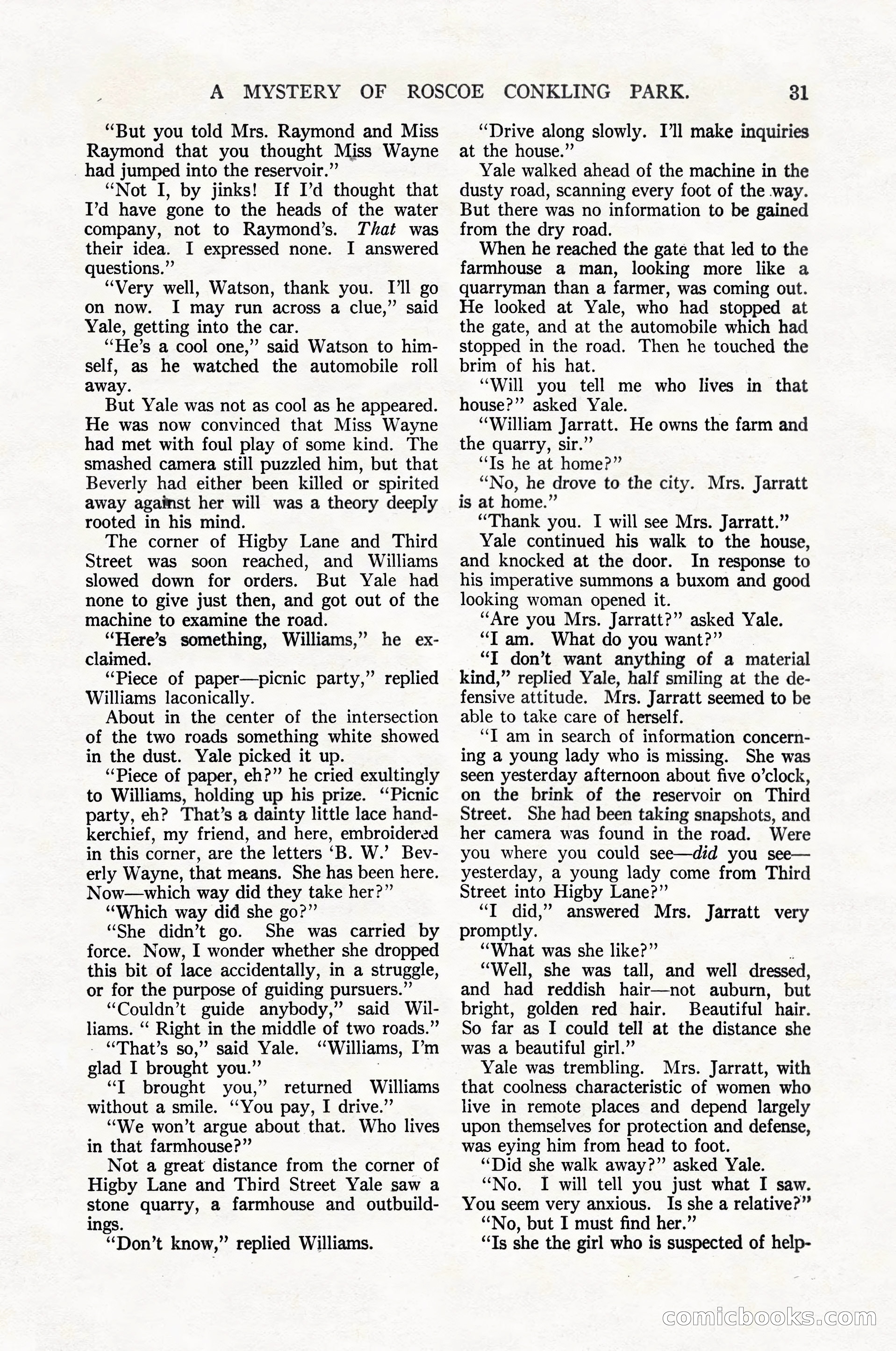
A restored page from Pulp Fiction, 1916. Page through the whole issue in the reader above.
📄 Transcribed text from this page (OCR, searchable)
Machine-transcribed from the original scan — historical spelling and the odd misread are preserved.
A MYSTERY OF ROSCOE CONKLING PARK. “But you told Mrs. Raymond and Miss Raymond that you thought Miss Wayne _ had jumped into the reservoir.” “Not I, by jinks! If I’d thought that I’d have gone to the heads of the water company, not to Raymond’s. That was their idea. I expressed none. I answered questions.” “Very well, Watson, thank you. I'll go on now. I may run across a clue,” said Yale, getting into the car. ‘““He’s a cool one,” said Watson to him- self, as he watched the automobile roll away. But Yale was not as cool as he appeared. He was now convinced that Miss Wayne had met with foul play of some kind. The smashed camera still puzzled him, but that Beverly had either been killed or spirited away against her will was a theory deeply rooted in his mind. The corner of Higby Lane and Third Street was soon reached, and Williams slowed down for orders. But Yale had none to give just then, and got out of the machine to examine the road. “Here’s something, Williams,” he ex- claimed. “Piece of paper—picnic party,” replied Williams laconically. About in the center of the intersection of the two roads something white showed in the dust. Yale picked it up. “Piece of paper, eh?”’ he cried exultingly to Williams, holding up his prize. “Picnic party, eh? That’s a dainty little lace hand- kerchief, my friend, and here, embroidered in this corner, are the letters ‘B. W.’ Bev- erly Wayne, that means. She has been here. Now—which way did they take her?” ‘“‘Which way did she go?” “She didn’t go. She was carried by force. Now, I wonder whether she dropped this bit of lace accidentally, in a struggle, or for the purpose of guiding pursuers.” “Couldn’t guide anybody,” said Wil- liams. ‘‘ Right in the middle of two roads.” - “That’s so,” said Yale. “Williams, I’m glad I brought you.” “IT brought you,” returned Williams without a smile. ‘‘You pay, I drive.”’ “We won’t argue about that. Who lives in that farmhouse?” Not a great distance from the corner of Higby Lane and Third Street Yale saw a stone quarry, a farmhouse and outbuild- ings. “Don’t know,” replied Williams. 31 “Drive along slowly. Ill make inquiries at the house.” Yale walked ahead of the machine in the dusty road, scanning every foot of the way. But there was no information to be gained from the dry road. When he reached the gate that led to the farmhouse a man, looking more like a quarryman than a farmer, was coming out. He looked at Yale, who had stopped at the gate, and at the automobile which had stopped in the road. Then he touched the brim of his hat. “Will you tell me who lives in that house?” asked Yale. “William Jarratt. He owns the farm and the quarry, sir.” “Ts he at home?” “No, he drove to the city. Mrs. Jarratt is at home.” “Thank you. I will see Mrs. Jarratt.” Yale continued his walk to the house, and knocked at the door. In response to his imperative summons a buxom and good looking woman opened it. “Are you Mrs. Jarratt?” asked Yale. “Tam. What do you want?” “I don’t want anything of a material kind,” replied Yale, half smiling at the de- fensive attitude. Mrs. Jarratt seemed to be able to take care of herself. | ‘“‘T am in search of information concern- ing a young lady who is missing. She was seen yesterday afternoon about five o’clock, on the brink of the reservoir on Third Street. She had been taking snapshots, and her camera was found in the road. Were you where you could see—did you see— yesterday, a young lady come from Third Street into Higby Lane?”’ “T did,” answered Mrs. Jarratt very promptly. ‘““‘What was she like?” : “Well, she was tall, and well dressed, and had reddish hair—not auburn, but bright, golden red hair. Beautiful hair. So far as I could tell at the distance she was a beautiful girl.” Yale was trembling. Mrs. Jarratt, with that coolness characteristic of women who live in remote places and depend largely upon themselves for protection and defense, was eying him from head to foot. “Did she walk away?” asked Yale. “No. I will tell you just what I saw. You seem very anxious. Is she a relative?” “No, but I must find her.” “Ts she the girl who is suspected of help- MICLOOOK C©