
Pulp Fiction, 1916 · page 47 of 220
The Argosy, April 1916 — page 47: what you’re looking at
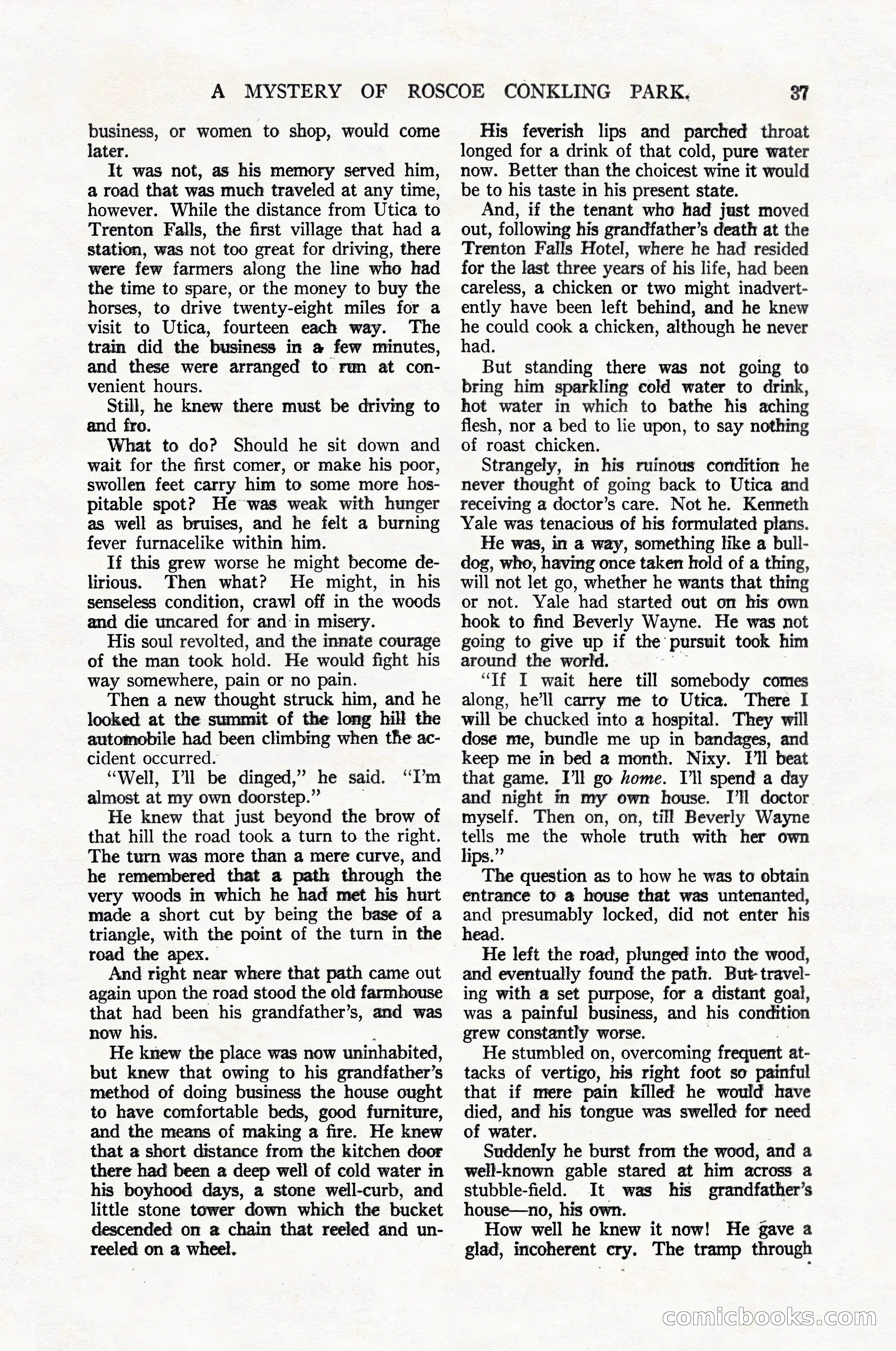
A restored page from Pulp Fiction, 1916. Page through the whole issue in the reader above.
📄 Transcribed text from this page (OCR, searchable)
Machine-transcribed from the original scan — historical spelling and the odd misread are preserved.
A MYSTERY OF ROSCOE CONKLING PARK. 37 business, or women to shop, would come later. It was not, as his memory served him, a road that was much traveled at any time, however. While the distance from Utica to Trenton Falls, the first village that had a station, was not too great for driving, there were few farmers along the line who had the time to spare, or the money to buy the horses, to drive twenty-eight miles for a visit to Utica, fourteen each way. The train did the business in @ few minutes, and these were arranged to run at con- venient hours. Still, he knew there must be driving to and fro. What to do? Should he sit down and wait for the first comer, or make his poor, swollen feet carry him to some more hos- pitable spot? He was weak with hunger as well as bruises, and he felt a burning fever furnacelike within him. If this grew worse he might become de- lirious. Then what? He might, in his senseless condition, crawl off in the woods and die uncared for and in misery. His soul revolted, and the innate courage of the man took hold. He would fight his way somewhere, pain or no pain. Then a new thought struck him, and he looked at the summit of the long hill the automobile had been climbing when the ac- cident occurred. “Well, Ill be dinged,” he said. “I’m almost at my own doorstep.” He knew that just beyond the brow of that hill the road took a turn to the right. The turn was more than a mere curve, and he remembered that a path through the very woods in which he had met his hurt made a short cut by being the base of a triangle, with the point of the turn in the road the apex. And right near where that path came out again upon the road stood the old farmhouse that had been his grandfather’s, and was now his. He knew the place was now uninhabited, but knew that owing to his grandfather’s method of doing business the house ought to have comfortable beds, good furniture, and the means of making a fire. He knew that a short distance from the kitchen door there had been a deep well of cold water in his boyhood days, a stone well-curb, and little stone tower down which the bucket descended on a chain that reeled and un- reeled on a wheel. His feverish lips and parched throat longed for a drink of that cold, pure water now. Better than the choicest wine it would be to his taste in his present state. And, if the tenant who had just moved out, following his grandfather’s death at the Trenton Falls Hotel, where he had resided for the last three years of his life, had been careless, a chicken or two might inadvert- ently have been left behind, and he knew he could cook a chicken, although he never had. But standing there was not going to bring him sparkling cold water to drink, hot water in which to bathe his aching flesh, nor a bed to lie upon, to say nothing of roast chicken. Strangely, in his ruinous cortdition he never thought of going back to Utica and receiving a doctor’s care. Not he. Kenneth Yale was tenacious of his formulated plans. He was, in a way, something like a bull- dog, who, having once taken hold of a thing, will not let go, whether he wants that thing or not. Yale had started out on his own hook to find Beverly Wayne. He was not going to give up if the: pursuit took him around the world. “Tf I wait here till somebody comes along, he’ll carry me to Utica. There I will be chucked into a hospital. They will dose me, bundle me up in bandages, and keep me in bed a month. Nixy. Pll beat that game. Ill go home. I'll spend a day and night in my own house. I'll doctor. myself. Then on, on, tifl Beverly Wayne tells me the whole truth with her own lips.” The question as to how he was to obtain entrance to a house that was untenanted, and presumably locked, did not enter his head. He left the road, plunged into the wood, and eventually found the path. But-travel- ing with @ set purpose, for a distant goal, was a painful business, and his condition grew constantly worse. He stumbled on, overcoming frequent at- tacks of vertigo, his right foot so painful that if mere pain killed he would have died, and his tongue was swelled for need of water. : Suddenly he burst from the wood, and a well-known gable stared at him across a stubble-field. It was his grandfather’s house—no, his own. How well he knew it now! He gave a glad, incoherent cry. The tramp through Comicoooks C@