
Pulp Fiction, 1916 · page 66 of 220
The Argosy, April 1916 — page 66: what you’re looking at
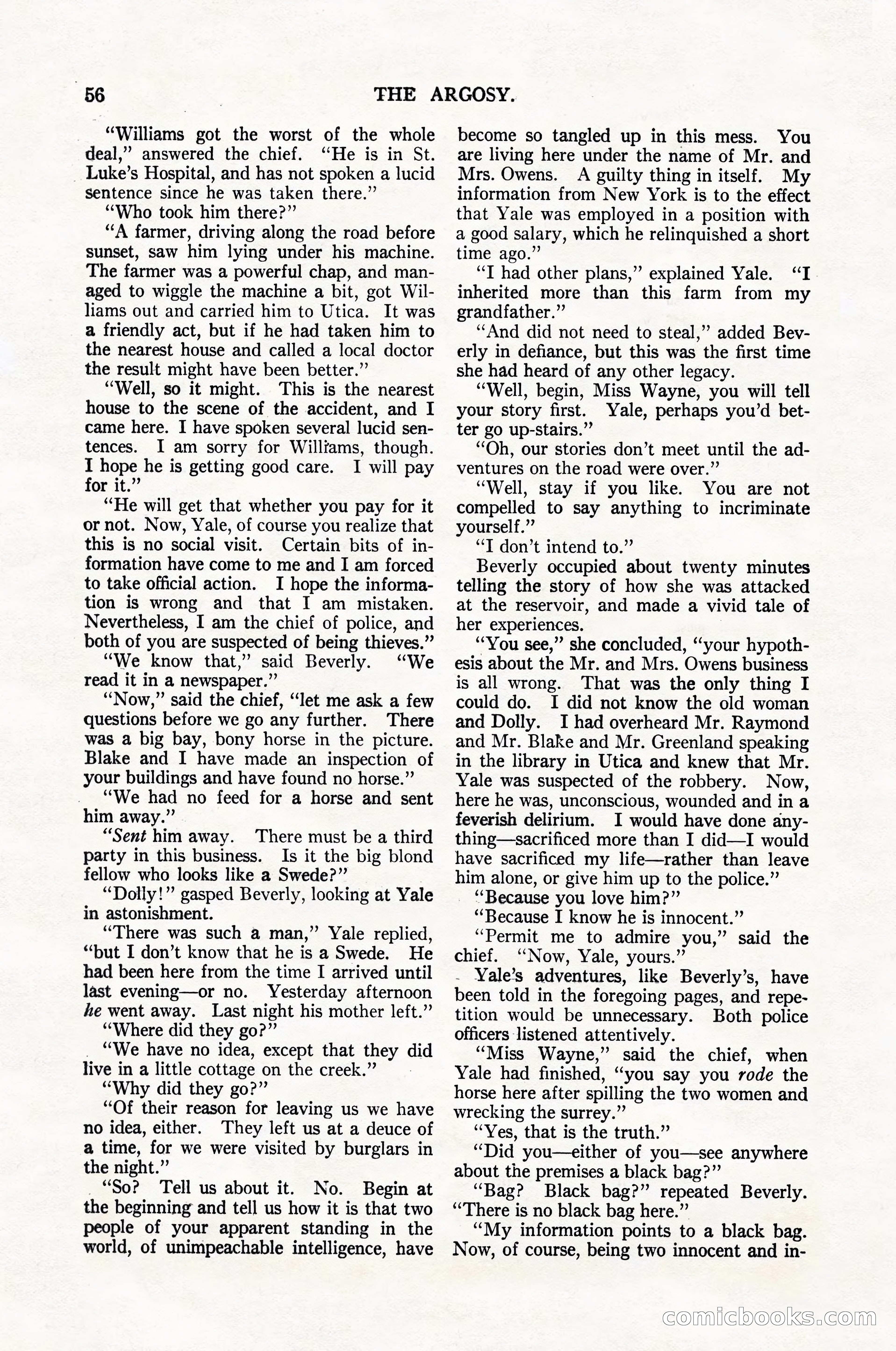
A restored page from Pulp Fiction, 1916. Page through the whole issue in the reader above.
📄 Transcribed text from this page (OCR, searchable)
Machine-transcribed from the original scan — historical spelling and the odd misread are preserved.
56 “Williams got the worst of the whole deal,” answered the chief. ‘He is in St. Luke’s Hospital, and has not spoken a lucid sentence since he was taken there.” “Who took him there?” “‘A farmer, driving along the road before sunset, saw him lying under his machine. The farmer was a powerful chap, and man- aged to wiggle the machine a bit, got Wil- liams out and carried him to Utica. It was a friendly act, but if he had taken him to the nearest house and called a local doctor the result might have been better.” “Well, so it might. This is the nearest house to the scene of the accident, and I came here. I have spoken several lucid sen- tences. I am sorry for Williams, though. I hope he is getting good care. I will pay for it.” “He will get that whether you pay for it or not. Now, Yale, of course you realize that this is no social visit. Certain bits of in- formation have come to me and I am forced to take official action. I hope the informa- tion is wrong and that I am mistaken. Nevertheless, I am the chief of police, and both of you are suspected of being thieves.” ‘We know that,” said Beverly. “We read it in a newspaper.” “Now,” said the chief, “let me ask a few questions before we go any further. There was a big bay, bony horse in the picture. Blake and I have made an inspection of your buildings and have found no horse.” ‘We had no feed for a horse and sent him away.” “Sent him away. There must be a third party in this business. Is it the big blond fellow who looks like a Swede?” “Dolly!” gasped Beverly, looking at Yale in astonishment. ‘“‘There was such a man,” Yale replied, “but I don’t know that he is a Swede. He had been here from the time I arrived until last evening—or no. Yesterday afternoon he went away. Last night his mother left.” ‘Where did they go?” _ “We have no idea, except that they did live in a little cottage on the creek.” “Why did they go?” “Of their reason for leaving us we have no idea, either. They left us at a deuce of a time, for we were visited by burglars in the night.” “So? Tell us about it. No. Begin at the beginning and tell us how it is that two people of your apparent standing in the world, of unimpeachable intelligence, have FHE ARGOSY. become so tangled up in this mess. You are living here under the name of Mr. and Mrs. Owens. A guilty thing in itself. My information from New York is to the effect that Yale was employed in a position with a good salary, which he relinquished a short time ago.” “YT had other plans,” explained Yale. inherited more than this farm from my grandfather.” ‘“‘And did not need to steal,’’ added Bev- erly in defiance, but this was the first time she had heard of any other legacy. “Well, begin, Miss Wayne, you will tell your story first. Yale, perhaps you’d bet- ter go up-stairs.”’ “Oh, our stories don’t meet until the ad- ventures on the road were over.” ‘Well, stay if you like. You are not compelled to say anything to incriminate yourself.” “T don’t intend to.” Beverly occupied about twenty minutes telling the story of how she was attacked at the reservoir, and made a vivid tale of her experiences. ‘You see,” she concluded, ‘your hypoth- esis about the Mr. and Mrs. Owens business is all wrong. That was the only thing I could do. I did not know the old woman and Dolly. I had overheard Mr. Raymond and Mr. Blake and Mr. Greenland speaking in the library in Utica and knew that Mr. Yale was suspected of the robbery. Now, here he was, unconscious, wounded and in a feverish delirium. I would have done any- thing—sacrificed more than I did—I would have sacrificed my life—rather than leave him alone, or give him up to the police.” _ “Because you love him?” “Because I know he is innocent.” ‘Permit me to admire you,” said the chief. ‘Now, Yale, yours.” - Yale’s adventures, like Beverly’s, have been told in the foregoing pages, and repe- tition would be unnecessary. Both police officers listened attentively. “Miss Wayne,” said the chief, when Yale had finished, “you say you rode the horse here after spilling the two women and wrecking the surrey.” “Yes, that is the truth.” “Did you—either of you—see anywhere about the premises a black bag?” ‘Bag? Black bag?” repeated Beverly. ‘There is no black bag here.” “My information points to a black bag. Now, of course, being two innocent and in- COmiclboo oT S ©