
Pulp Fiction, 1916 · page 74 of 220
The Argosy, April 1916 — page 74: what you’re looking at
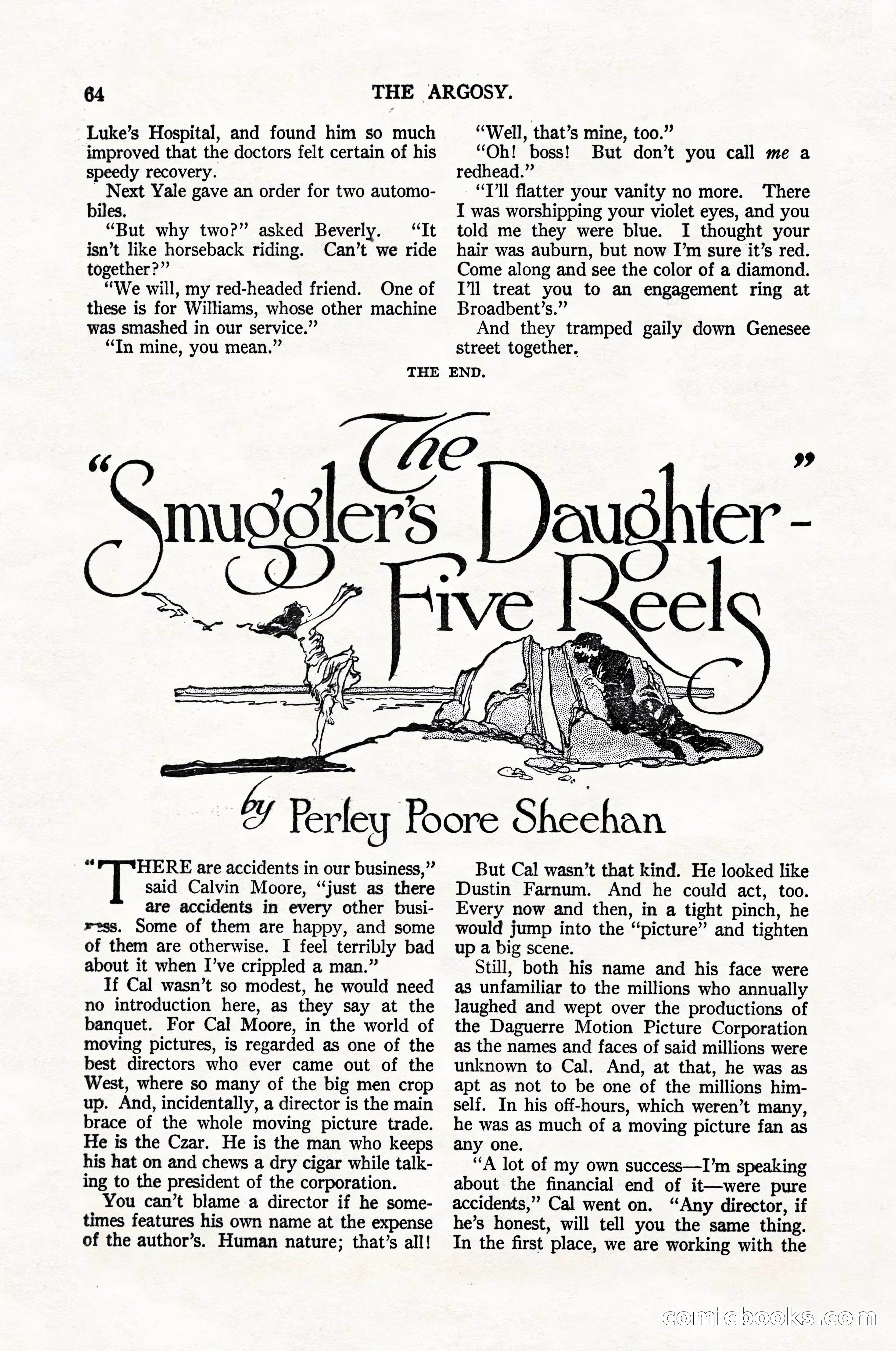
A restored page from Pulp Fiction, 1916. Page through the whole issue in the reader above.
📄 Transcribed text from this page (OCR, searchable)
Machine-transcribed from the original scan — historical spelling and the odd misread are preserved.
64 Luke’s Hospital, and found him so much improved that the doctors felt certain of his speedy recovery. - Next Yale gave an order for two automo- biles, “But why two?” asked Beverly. “It isn’t like horseback riding. Can’t we ride together ?”’ “We will, my red-headed friend. One of these is for Williams, whose other machine was smashed in our service.” “In mine, you mean.” a — THE ers 4b 9 on Pi. BP ee eS a, ae said Calvin Moore, “just as there are accidents in every other busi- xess. Some of them are happy, and some of them are otherwise. I feel terribly bad about it when I’ve crippled a man.” If Cal wasn’t so modest, he would need no introduction here, as they say at the banquet. For Cal Moore, in the world of moving pictures, is regarded as one of the best directors who ever came out of the West, where so many of the big men crop up. And, incidentally, a director is the main brace of the whole moving picture trade. He is the Czar. He is the man who keeps his hat on and chews a dry cigar while talk- ing to the president of the corporation. You can’t blame.a director if he some- times features his own name at the expense of the author’s. Human nature; that’s all! “ | ae are accidents in our business,” TVE THE ARGOSY. “Well, that’s mine, too.” “Oh! boss! But don’t you call me a redhead.” “Tl flatter your vanity no more. ‘There I was worshipping your violet eyes, and you told me they were blue. I thought your hair was auburn, but now I’m sure it’s red. Come along and see the color of a diamond. I'll treat you to an engagement ring at Broadbent’s.” And they tramped gaily down Genesee street together. END. But Cal wasn’t that kind. He looked like Dustin Farnum. And he could act, too. Every now and then, in a tight pinch, he would jump into the “picture” and tighten up a big scene. Still, both his name and his face were as unfamiliar to the millions who annually laughed and wept over the productions of the Daguerre Motion Picture Corporation as the names and faces of said millions were unknown to Cal, And, at that, he was as apt as not to be one of the millions him- self. In his off-hours, which weren’t many, he was as much of a moving picture fan as any one. ‘‘A lot of my own success—I’m speaking about the financial end of it—were pure accidents,” Cal went on. “Any director, if he’s honest, will tell you the same thing. In the first place, we are working with the MICLOOOK C@