
Pulp Fiction, 1916 · page 78 of 220
The Argosy, April 1916 — page 78: what you’re looking at
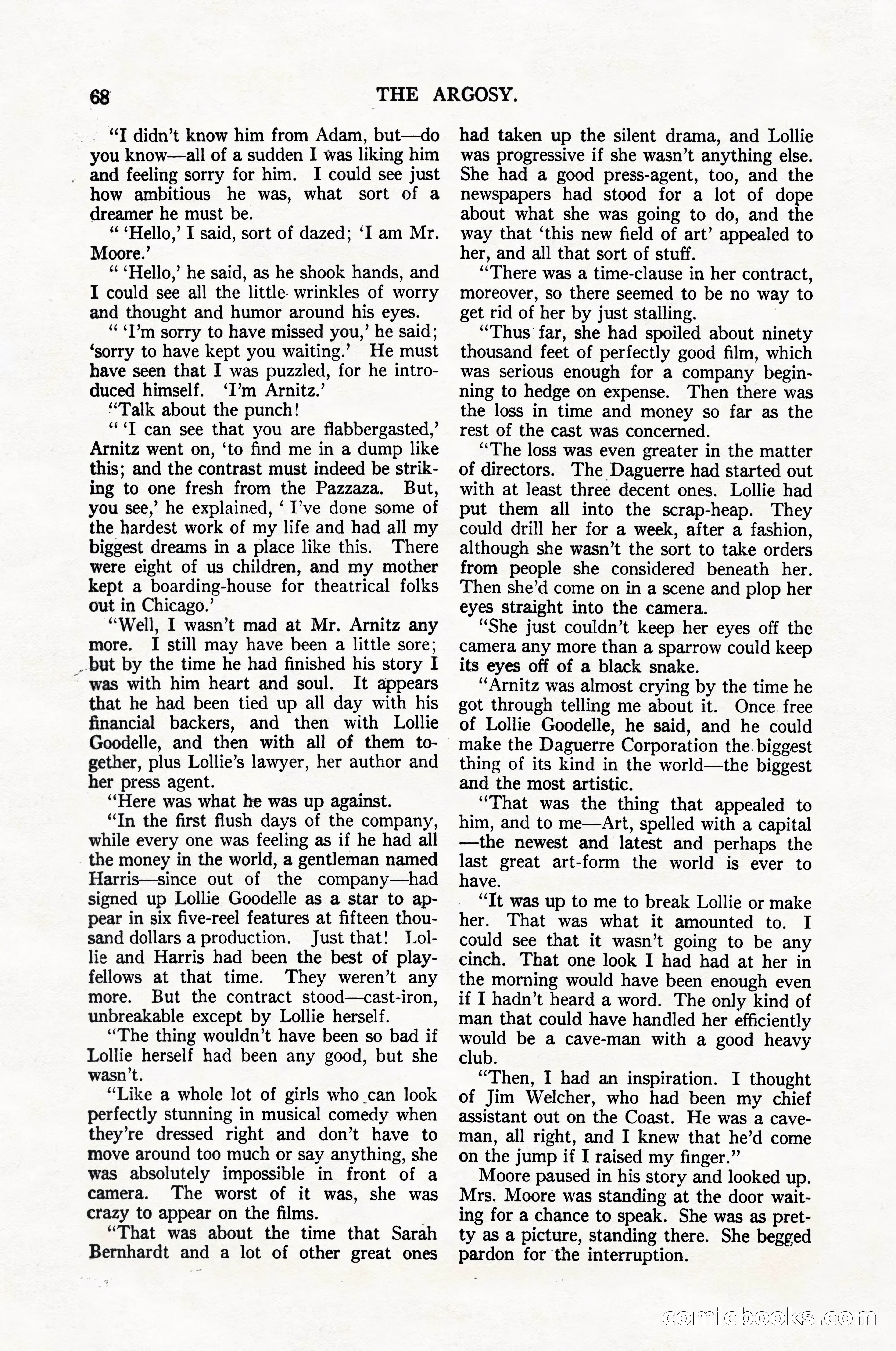
A restored page from Pulp Fiction, 1916. Page through the whole issue in the reader above.
📄 Transcribed text from this page (OCR, searchable)
Machine-transcribed from the original scan — historical spelling and the odd misread are preserved.
68 _. “T didn’t know him from Adam, but—do you know—all of a sudden I was liking him . and feeling sorry for him. I could see just how ambitious he was, what sort of a dreamer he must be. “ ‘Hello,’ I said, sort of dazed; ‘I am Mr. Moore.’ “ ‘Hello,’ he said, as he shook hands, and I could see all the little wrinkles of worry and thought and humor around his eyes. “‘<T’m sorry to have missed you,’ he said; ‘sorry to have kept you waiting.’ He must have seen that I was puzzled, for he intro- duced himself. ‘I’m Arnitz.’ “Talk about the punch! ‘“‘*T can see that you are flabbergasted,’ Arnitz went on, ‘to find me in a dump like this; and the contrast must indeed be strik- ing to one fresh from the Pazzaza. But, you see,’ he explained, ‘ I’ve done some of the hardest work of my life and had all my biggest dreams in a place like this. There were eight of us children, and my mother kept a boarding-house for theatrical folks out in Chicago.’ “Well, I wasn’t mad at Mr. Arnitz any more. I still may have been a little sore; _but by the time he had finished his story I ~ was with him heart and soul. It appears that he had been tied up all day with his financial backers, and then with Lollie Goodelle, and then with all of them to- gether, plus Lollie’s lawyer, her author and her press agent. ‘“‘Here was what he was up against. “In the first flush days of the company, while every one was feeling as if he had all the money in the world, a gentleman named Harris—since out of the company—had signed up Lollie Goodelle as a star to ap- pear in six five-reel features at fifteen thou- sand dollars a production. Just that! Lol- lie and Harris had been the best of play- fellows at that time. They weren’t any more. But the contract stood—cast-iron, unbreakable except by Lollie herself. “The thing wouldn’t have been so bad if Lollie herself had been any good, but she wasn’t. “Like a whole lot of girls who can look perfectly stunning in musical comedy when they’re dressed right and don’t have to move around too much or say anything, she was absolutely impossible in front of a camera. The worst of it was, she was crazy to appear on the films. : “That was about the time that Sarah Bernhardt and a lot of other great ones THE ARGOSY. had taken up the silent drama, and Lollie was progressive if she wasn’t anything else. She had a good press-agent, too, and the newspapers had stood for a lot of dope about what she was going to do, and the way that ‘this new field of art’ appealed to her, and all that sort of stuff. ‘‘There was a time-clause in her contract, moreover, so there seemed to be no way to get rid of her by just stalling. : ‘Thus far, she had spoiled about ninety thousand feet of perfectly good film, which was serious enough for a company begin- ning to hedge on expense. Then there was the loss in time and money so far as the rest of the cast was concerned. ‘The loss was even greater in the matter of directors. The Daguerre had started out with at least three decent ones. Lollie had put them all into the scrap-heap. They could drill her for a week, after a fashion, although she wasn’t the sort to take orders from people she considered beneath her. Then she’d come on in a scene and plop her eyes straight into the camera. ‘She just couldn’t keep her eyes off the camera any more than a sparrow could keep its eyes off of a black snake. ‘“Arnitz was almost crying by the time he got through telling me about it. Once free of Lollie Goodelle, he said, and he could make the Daguerre Corporation the. biggest thing of its kind in the world—the biggest and the most artistic. ‘That was the thing that appealed to him, and to me—Art, spelled with a capital —the newest and latest and perhaps the last great art-form the world is ever to have. “Tt was up to me to break Lollie or make her. That was what it amounted to. I could see that it wasn’t going to be any cinch. That one look I had had at her in the morning would have been enough even if I hadn’t heard a word. The only kind of man that could have handled her efficiently would be a cave-man with a good heavy club. “Then, I had an inspiration. I thought of Jim Welcher, who had been my chief assistant out on the Coast. He was a cave- man, all right, and I knew that he’d come on the jump if I raised my finger.”’ Moore paused in his story and looked up. Mrs. Moore was standing at the door wait- ing for a chance to speak. She was as pret- ty as a picture, standing there. She begged pardon for the interruption. comiclooo (C©