
Pulp Fiction, 1917 · page 50 of 200
The Argosy, Vol. 90 No. 1 — page 50: what you’re looking at
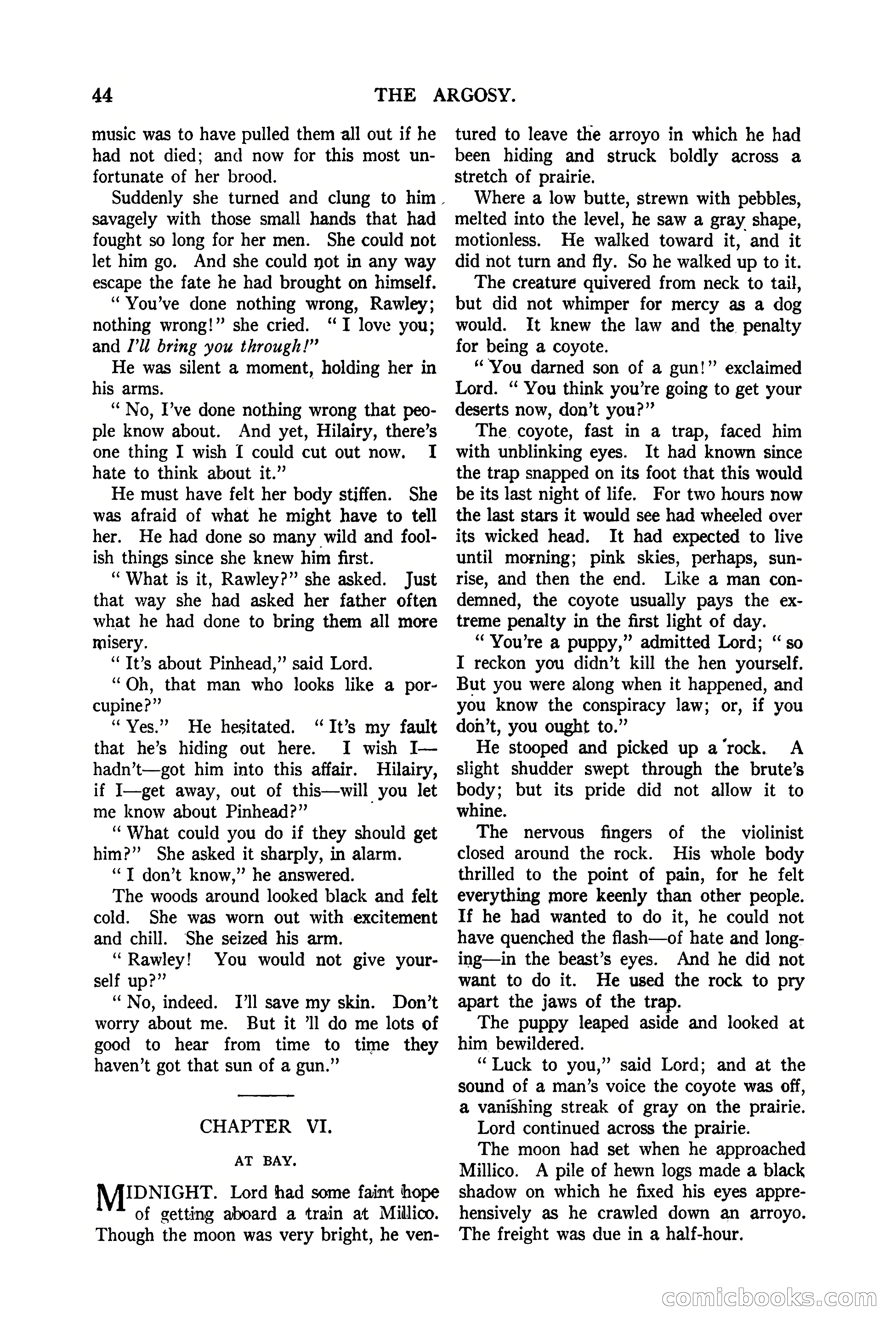
A restored page from Pulp Fiction, 1917. Page through the whole issue in the reader above.
📄 Transcribed text from this page (OCR, searchable)
Machine-transcribed from the original scan — historical spelling and the odd misread are preserved.
44 music was to have pulled them all out if he had not died; and now for this most un- fortunate of her brood. Suddenly she turned and clung to him. savagely with those small hands that had fought so long for her men. She could not let him go. And she could not in any way escape the fate he had brought on himself. ‘““You’ve done nothing wrong, Rawley; nothing wrong!” she cried. “TI love you; and I'll bring you through!”’ He was silent a moment, holding her in his arms. ‘No, I’ve done nothing wrong that peo- ple know about. And yet, Hilairy, there’s one thing I wish [ could cut out now. I hate to think about it.” He must have felt her body stiffen. She was afraid of what he might have to tell her. He had done so many wild and fool- ish things since she knew him first. ‘What is it, Rawley?” she asked. Just that way she had asked her father often what he had done to bring them all more misery. “It’s about Pinhead,” said Lord. ‘“Oh, that man who looks like a por- cupine?” “Yes.” He hesitated. “It’s my fault that he’s hiding out here. I wish I— hadn’t—got him into this affair. Hilairy, if I—get away, out of this—will you let me know about Pinhead?” . ‘What could you do if they should get him?” She asked it sharply, in alarm. “I don’t know,” he answered. The woods around looked black and felt cold. She was worn out with excitement and chill. She seized his arm. ‘““Rawley! You would not give your- self up?” “No, indeed. I'll save my skin. Don’t worry about me. But it ‘Il do me lots of good to hear from time to time they haven’t got that sun of a gun.” CHAPTER VI. AT BAY. IDNIGHT. Lord had some faint hope of getting aboard a train at Millico. Though the moon was very bright, he ven- THE ARGOSY. tured to leave the arroyo in which he had been hiding and struck boldly across a stretch of prairie. Where a low butte, strewn with pebbles, melted into the level, he saw a gray shape, motionless. He walked toward it, and it did not turn and fly. So he walked up to it. The creature quivered from neck to tail, but did not whimper for mercy as a dog would. It knew the law and the penalty for being a coyote. “You darned son of a gun!” exclaimed Lord. “ You think you’re going to get your deserts now, don’t you?” The coyote, fast in a trap, faced him with unblinking eyes. It had known since the trap snapped on its foot that this would be its last night of life. For two hours now the last stars it would see had wheeled over its wicked head. It had expected to live until morning; pink skies, perhaps, sun- rise, and then the end. Like a man con- demned, the coyote usually pays the ex- treme penalty in the first light of day. ‘“‘'You’re a puppy,” admitted Lord; “so I reckon you didn’t kill the hen yourself. But you were along when it happened, and you know the conspiracy law; or, if you don’t, you ought to.” He stooped and picked up a‘rock. A slight shudder swept through the brute’s body; but its pride did not allow it to whine. The nervous fingers of the violinist closed around the rock. His whole body thrilled to the point of pain, for he felt everything more keenly than other people. If he had wanted to do it, he could not have quenched the flash—of hate and long- ing—in the beast’s eyes. And he did not want to do it. He used the rock to pry apart the jaws of the trap. The puppy leaped aside and looked at him_ bewildered. “Luck to you,” said Lord; and at the sound of a man’s voice the coyote was off, a vanishing streak of gray on the prairie. Lord continued across the prairie. The moon had set when he approached Millico. A pile of hewn logs made a black shadow on which he fixed his eyes appre- hensively as he crawled down an arroyo. The freight was due in a half-hour. oO comicbool< CO