
Pulp Fiction, 1917 · page 51 of 200
The Argosy, Vol. 90 No. 1 — page 51: what you’re looking at
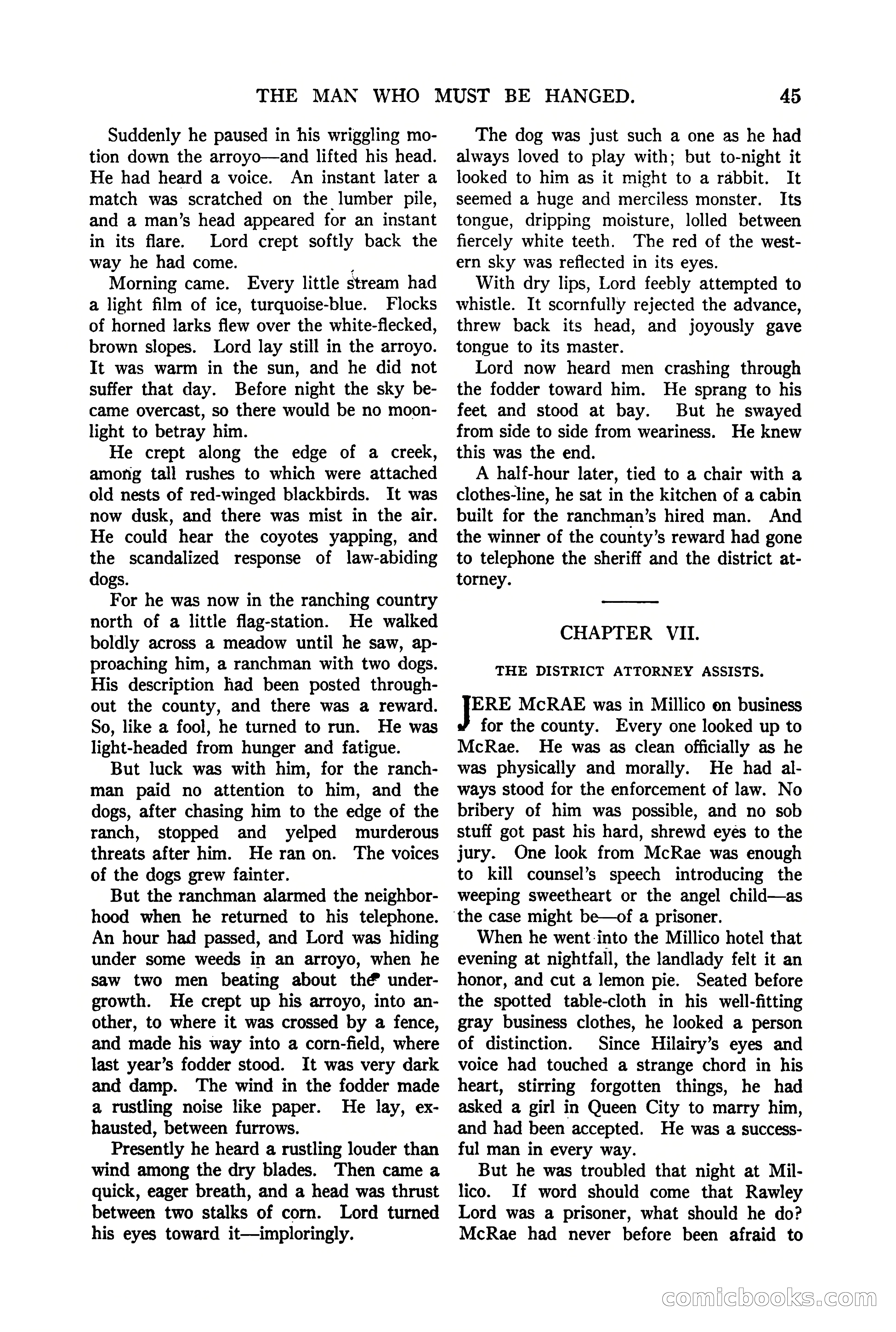
A restored page from Pulp Fiction, 1917. Page through the whole issue in the reader above.
📄 Transcribed text from this page (OCR, searchable)
Machine-transcribed from the original scan — historical spelling and the odd misread are preserved.
THE MAN WHO MUST BE HANGED. Suddenly he paused in his wriggling mo- tion down the arroyo—and lifted his head. He had heard a voice. An instant later a match was scratched on the lumber pile, and a man’s head appeared for an instant in its flare. Lord crept softly back the way he had come. Morning came. Every little stream had a light film of ice, turquoise-blue. Flocks of horned larks flew over the white-flecked, brown slopes. Lord lay still in the arroyo. It was warm in the sun, and he did not suffer that day. Before night the sky be- came overcast, so there would be no moon- light to betray him. He crept along the edge of a creek, among tall rushes to which were attached old nests of red-winged blackbirds. It was now dusk, and there was mist in the air. He could hear the coyotes yapping, and the scandalized response of law-abiding dogs. For he was now in the ranching country north of a little flag-station. He walked boldly across a meadow until he saw, ap- proaching him, a ranchman with two dogs. His description had been posted through- out the county, and there was a reward. So, like a fool, he turned to run. He was light-headed from hunger and fatigue. But luck was with him, for the ranch- man paid no attention to him, and the dogs, after chasing him to the edge of the ranch, stopped and yelped murderous threats after him. He ranon. The voices of the dogs grew fainter. But the ranchman alarmed the neighbor- hood when he returned to his telephone. An hour had passed, and Lord was hiding under some weeds in an arroyo, when he saw two men beating about thé under- erowth. He crept up his arroyo, into an- other, to where it was crossed by a fence, and made his way into a corn-field, where last year’s fodder stood. It was very dark and damp. The wind in the fodder made a rustling noise like paper. He lay, ex- hausted, between furrows. Presently he heard a rustling louder than wind among the dry blades. Then came a quick, eager breath, and a head was thrust between two stalks of corn. Lord turned his eyes toward it—imploringly. 45 The dog was just such a one as he had always loved to play with; but to-night it looked to him as it might to a rabbit. It seemed a huge and merciless monster. Its tongue, dripping moisture, lolled between fiercely white teeth. The red of the west- ern sky was reflected in its eyes. With dry lips, Lord feebly attempted to whistle. It scornfully rejected the advance, threw back its head, and joyously gave tongue to its master. Lord now heard men crashing through the fodder toward him. He sprang to his feet and stood at bay. But he swayed from side to side from weariness. He knew this was the end. A half-hour later, tied to a chair with a clothes-line, he sat in the kitchen of a cabin built for the ranchman’s hired man. And the winner of the county’s reward had gone to telephone the sheriff and the district at- torney. CHAPTER VII. THE DISTRICT ATTORNEY ASSISTS. ERE McRAE was in Millico on business for the county. Every one looked up to McRae. He was as clean officially as he was physically and morally. He had al- ways stood for the enforcement of law. No bribery of him was possible, and no sob stuff got past his hard, shrewd eyes to the jury. One look from McRae was enough to kill counsel’s speech introducing the weeping sweetheart or the angel child—as ‘the case might be—of a prisoner. When he went into the Millico hotel that evening at nightfall, the landlady felt it an honor, and cut a lemon pie. Seated before the spotted table-cloth in his well-fitting gray business clothes, he looked a person of distinction. Since Hilairy’s eyes and voice had touched a strange chord in his heart, stirring forgotten things, he had asked a girl in Queen City to marry him, and had been accepted. He was a success- ful man in every way. But he was troubled that night at Mil- lico. If word should come that Rawley Lord was a prisoner, what should he do? McRae had never before been afraid to oO Comicbooe S CO