
Pulp Fiction, 1920 · page 20 of 164
Argosy, Vol. 122, No. 1 — page 20: what you’re looking at
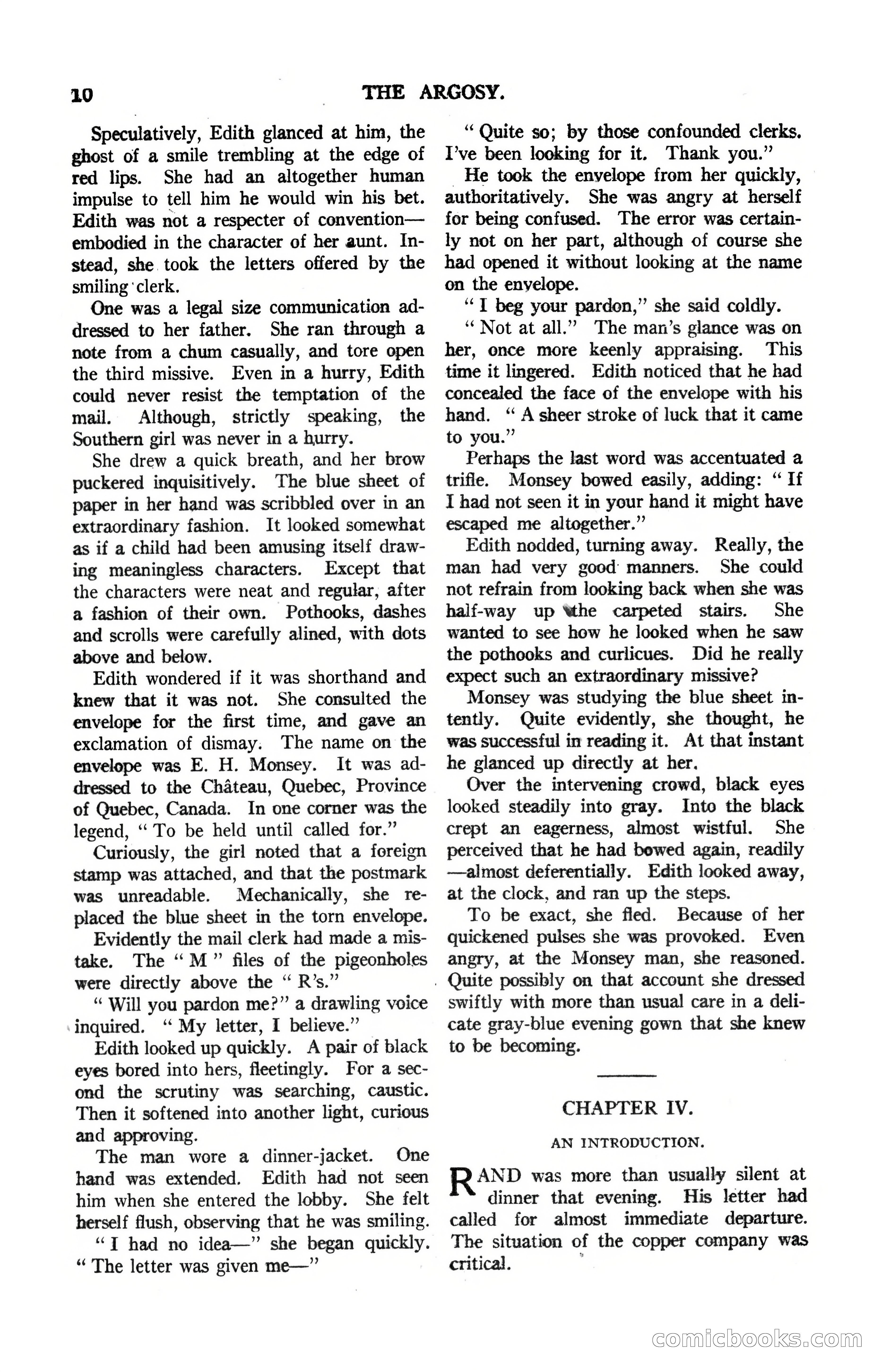
A restored page from Pulp Fiction, 1920. Page through the whole issue in the reader above.
📄 Transcribed text from this page (OCR, searchable)
Machine-transcribed from the original scan — historical spelling and the odd misread are preserved.
10 Speculatively, Edith glanced at him, the ghost of a smile trembling at the edge of red lips. She had an altogether human impulse to tell him he would win his bet. Edith was not a respecter of convention— embodied in the character of her aunt. In- stead, she took the letters offered by the smiling ‘clerk. One was a legal size communication ad- dressed to her father. She ran through a note from a chum casually, and tore open the third missive. Even in a hurry, Edith could never resist the temptation of the mail. Although, strictly speaking, the Southern girl was never in a hurry. She drew a quick breath, and her brow puckered inquisitively. The blue sheet of paper in her hand was scribbled over in an extraordinary fashion. It looked somewhat as if a child had been amusing itself draw- ing meaningless characters. Except that the characters were neat and regular, after a fashion of their own. Pothooks, dashes and scrolls were carefully alined, with dots above and below. Edith wondered if it was shorthand and knew that it was not. She consulted the envelope for the first time, and gave an exclamation of dismay: The name on the envelope was E. H. Monsey. It was ad- dressed to the Chateau, Quebec, Province of Quebec, Canada. In one corner was the legend, ‘“‘ To be held until called for.” Curiously, the girl noted that a foreign stamp was attached, and that the postmark was unreadable. Mechanically, she re- placed the blue sheet in the torn envelope. Evidently the mail clerk had made a mis- take. The ‘“M” files of the pigeonholes were directly above the “ R’s.” “ Will you pardon me?” a drawling voice inquired. ‘“ My letter, I believe.” Edith looked up quickly. A pair of black eyes bored into hers, fleetingly. For a sec- ond the scrutiny was searching, caustic. Then it softened into another light, curious and approving. The man wore a dinner-jacket. One hand was extended. Edith had not seen him when she entered the lobby. She felt herself flush, observing that he was smiling. “T had no idea—” she began quickly. “The letter was given me—” THE ARGOSY. ‘‘ Quite so; by those confounded clerks. I’ve been looking for it. Thank you.” _ He took the envelope from her quickly, authoritatively. She was angry at herself for being confused. The error was certain- ly not on her part, although of course she had opened it without looking at the name on the envelope. ‘‘T beg your pardon,” she said coldly. ‘“‘ Not at all.” The man’s glance was on her, once more keenly appraising. This time it lingered. Edith noticed that he had concealed the face of the envelope with his hand. ‘ A sheer stroke of luck that it came to you.” Perhaps the last word was accentuated a trifle. Monsey bowed easily, adding: “ If I had not seen it in your hand it might have escaped me altogether.” Edith nodded, turning away. Really, the man had very good manners. She could not refrain from looking back when she was half-way up “the carpeted stairs. She wanted to see how he looked when he saw the pothooks and curlicues. Did he really expect such an extraordinary missive? Monsey was studying the blue sheet in- tently. Quite evidently, she thought, he was successful in reading it. At that instant he glanced up directly at her. Over the intervening crowd, black eyes looked steadily into gray. Into the black crept an eagerness, almost wistful. She perceived that he had bowed again, readily —almost deferentially. Edith looked away, at the clock, and ran up the steps. To be exact, she fled. Because of her quickened pulses she was provoked. Even angry, at the Monsey man, she reasoned. . Quite possibly on that account she dressed swiftly with more than usual care in a deli- cate gray-blue evening gown that she knew to be becoming. CHAPTER IV. AN INTRODUCTION. AND was more than usually silent at dinner that evening. His letter had called for almost immediate departure. The situation of the copper company was critical. cComiclbooks.com