
Pulp Fiction, 1920 · page 22 of 164
Argosy, Vol. 122, No. 1 — page 22: what you’re looking at
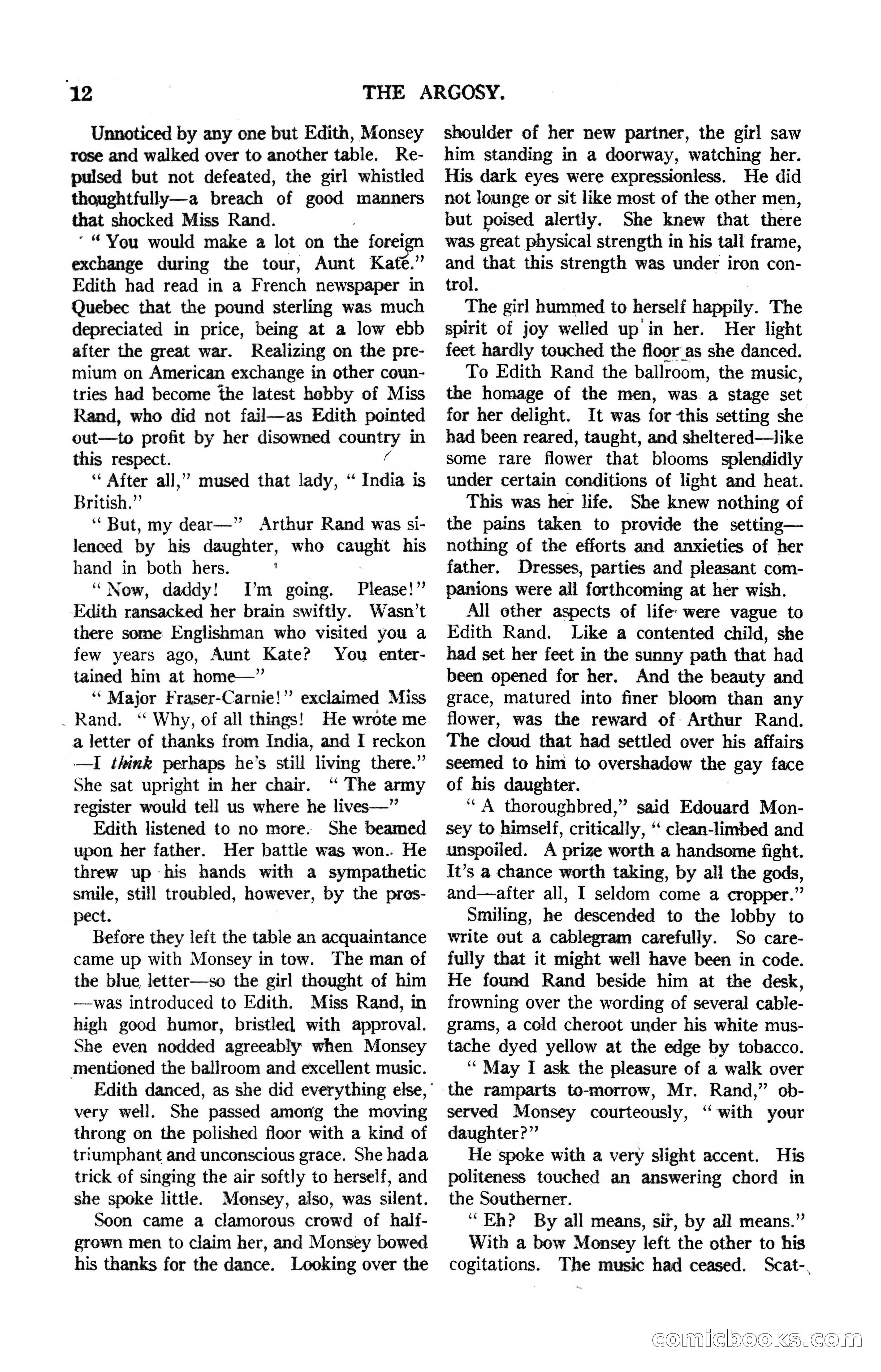
A restored page from Pulp Fiction, 1920. Page through the whole issue in the reader above.
📄 Transcribed text from this page (OCR, searchable)
Machine-transcribed from the original scan — historical spelling and the odd misread are preserved.
12 Unnoticed by any one but Edith, Monsey rose and walked over to another table. Re- pulsed but not defeated, the girl whistled thoughtfully—a breach of good manners that shocked Miss Rand. . ‘“ You would make a lot on the foreign exchange during the tour, Aunt Kafe.” Edith had read in a French newspaper in Quebec that the pound sterling was much depreciated in price, being at a low ebb after the great war. Realizing on the pre- mium on American exchange in other coun- tries had become the latest hebby of Miss Rand, who did not fail—as Edith pointed out—to profit by her disowned country in this respect. c ‘“‘ After all,” mused that lady, “ India is British.” ‘““ But, my dear—” Arthur Rand was si- lenced by his daughter, who caught his hand in both hers. ‘ “Now, daddy! I’m going. Please!” Edith ransacked her brain swiftly. Wasn’t there some Englishman who visited you a few years ago, Aunt Kate? You enter- tained him at home—” ‘““ Major Fraser-Carnie!”’ exclaimed Miss _ Rand. ‘“ Why, of all things! He wrote me a letter of thanks from India, and I reckon —I think perhaps he’s still living there.” She sat upright in her chair. ‘“ The army register would tell us where he lives—” Edith listened to no more. She beamed upon her father. Her battle was won.. He threw up his hands with a sympathetic smile, still troubled, however, by the pros- pect. Before they left the table an acquaintance came up with Monsey in tow. The man of the blue letter—so the girl thought of him —was introduced to Edith. Miss Rand, in high good humor, bristled with approval. She even nodded agreeably when Monsey mentioned the ballroom and excellent music. Edith danced, as she did everything else,’ very well. She passed among the moving throng on the polished floor with a kind of triumphant and unconscious grace. She hada trick of singing the air softly to herself, and she spoke little. Monsey, also, was silent. Soon came a clamorous crowd of half- grown men to claim her, and Monsey bowed his thanks for the dance. Looking over the THE ARGOSY. shoulder of her new partner, the girl saw him standing in a doorway, watching her. His dark eyes were expressionless. He did not lounge or sit like most of the other men, but poised alertly. She knew that there was great physical strength in his tall frame, and that this strength was under iron con- trol. The girl hummed to herself happily. The spirit of joy welled up in her. Her light feet hardly touched the floor as she danced. To Edith Rand the ballroom, the music, the homage of the men, was a stage set for her delight. It was for this setting she had been reared, taught, and sheltered—like some rare flower that blooms splendidly under certain conditions of light and heat. This was her life. She knew nothing of the pains taken to provide the setting— nothing of the efforts and anxieties of her father. Dresses, parties and pleasant com- panions were all forthcoming at her wish. All other aspects of life: were vague to Edith Rand. Like a contented child, she had set her feet in the sunny path that had been opened for her. And the beauty and grace, matured into finer bloom than any flower, was the reward of- Arthur Rand. The cloud that had settled over his affairs seemed to him to overshadow the gay face of his daughter. ‘A thoroughbred,” said Edouard Mon- sey to himself, critically, ‘‘ clean-limbed and unspoiled. A prize worth a handsome fight. It’s a chance worth taking, by all the gods, and—after all, I seldom come a cropper.” Smiling, he descended to the lobby to write out a cablegram carefully. So care- fully that it might well have been in code. He found Rand beside him at the desk, frowning over the wording of several cable- grams, a cold cheroot under his white mus- tache dyed yellow at the edge by tobacco. ‘“ May I ask the pleasure of a walk over the ramparts to-morrow, Mr. Rand,” ob- served Monsey courteously, “with your daughter?” He spoke with a very slight accent. His politeness touched an answering chord in the Southerner. ‘“Eh? By all means, sir, by all means.” With a bow Monsey left the other to his cogitations. The music had ceased. Scat-, cComiclbooks.com