
Pulp Fiction, 1920 · page 34 of 164
Argosy, Vol. 122, No. 1 — page 34: what you’re looking at
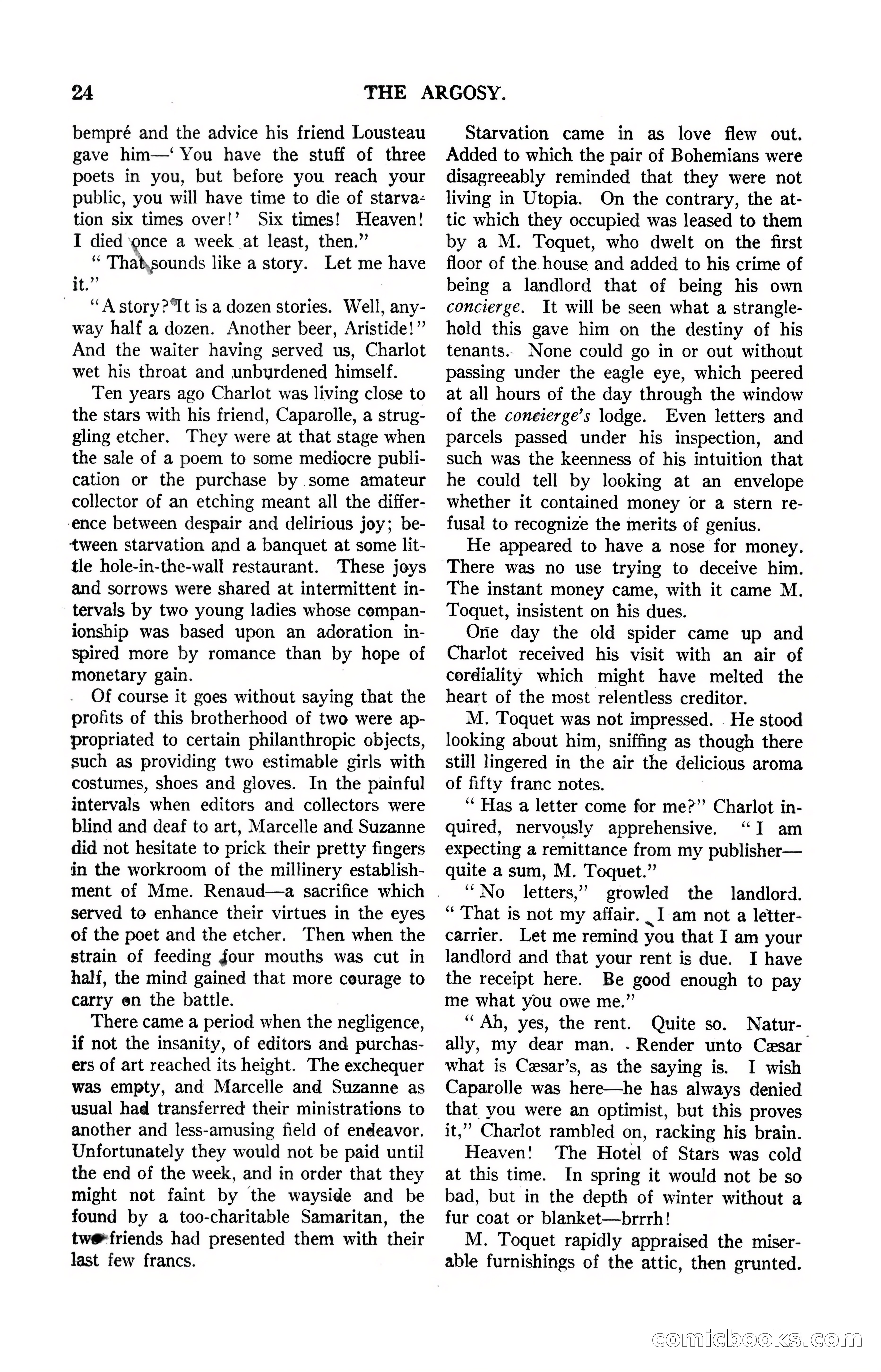
A restored page from Pulp Fiction, 1920. Page through the whole issue in the reader above.
📄 Transcribed text from this page (OCR, searchable)
Machine-transcribed from the original scan — historical spelling and the odd misread are preserved.
24 bempré and the advice his friend Lousteau gave him—‘ You have the stuff of three poets in you, but before you reach your public, you will have time to die of starva- tion six times over!’ Six times! Heaven! I died ‘once a week at least, then.” “ Thatsounds like a story. Let me have ad : ‘““A story? It is a dozen stories. Well, any- way half a dozen. Another beer, Aristide!” And the waiter having served us, Charlot wet his throat and unbyrdened himself. Ten years ago Charlot was living close to the stars with his friend, Caparolle, a strug- gling etcher. They were at that stage when the sale of a poem to some mediocre publi- cation or the purchase by some amateur collector of an etching meant all the differ- ence between despair and delirious joy; be- tween starvation and a banquet at some lit- tle hole-in-the-wall restaurant. These joys and sorrows were shared at intermittent in- tervals by two young ladies whose compan- ionship was based upon an adoration in- spired more by romance than by hope of monetary gain. Of course it goes without saying that the profits of this brotherhood of two were ap- propriated to certain philanthropic objects, such as providing two estimable girls with costumes, shoes and gloves. In the painful intervals when editors and collectors were blind and deaf to art, Marcelle and Suzanne did not hesitate to prick their pretty fingers in the workroom of the millinery establish- ment of Mme. Renaud—a sacrifice which . served to enhance their virtues in the eyes of the poet and the etcher. Then when the strain of feeding four mouths was cut in half, the mind gained that more ceurage to carry en the battle. There came a period when the negligence, if not the insanity, of editors and purchas- ers of art reached its height. The exchequer was empty, and Marcelle and Suzanne as usual had transferred their ministrations to another and less-amusing field of endeavor. Unfortunately they would not be paid until the end of the week, and in order that they might not faint by the wayside and be found by a too-charitable Samaritan, the twe@ friends had presented them with their last few francs. THE ARGOSY. Starvation came in as love flew out. Added to which the pair of Bohemians were disagreeably reminded that they were not living in Utopia. On the contrary, the at- tic which they occupied was leased to them by a M. Toquet, who dwelt on the first floor of the house and added to his crime of being a landlord that of being his own concierge. It will be seen what a strangle- hold this gave him on the destiny of his tenants.. None could go in or out without passing under the eagle eye, which peered at all hours of the day through the window of the coneierge’s lodge. Even letters and parcels passed under his inspection, and such was the keenness of his intuition that he could tell by looking at an envelope whether it contained money or a stern re- fusal to recognize the merits of genius. He appeared to have a nose for money. There was no use trying to deceive him. The instant money came, with it came M. Toquet, insistent on his dues. One day the old spider came up and Charlot received his visit with an air of coerdiality which might have melted the heart of the most relentless creditor. M. Toquet was not impressed. . He stood looking about him, sniffing as though there still lingered in the air the delicious aroma of fifty franc notes. ‘‘ Has a letter come for me?’ Charlot in- quired, nervously apprehensive. “I am expecting a remittance from my publisher— quite a sum, M. Toquet.”’ ‘No letters,” growled the landlord. “That is not my affair. I am not a letter- carrier. Let me remind you that I am your landlord and that your rent is due. I have the receipt here. Be good enough to pay me what you owe me.” ‘““ Ah, yes, the rent. Quite so. Natur- ally, my dear man. - Render unto Cesar what is Cesar’s, as the saying is. I wish Caparolle was here—he has always denied that you were an optimist, but this proves it,”’ Charlot rambled on, racking his brain. Heaven! The Hotel of Stars was cold at this time. In spring it would not be so bad, but in the depth of winter without a fur coat or blanket—brrrh! M. Toquet rapidly appraised the miser- able furnishings of the attic, then grunted. cComiclbooks.com