
Pulp Fiction, 1920 · page 35 of 164
Argosy, Vol. 122, No. 1 — page 35: what you’re looking at
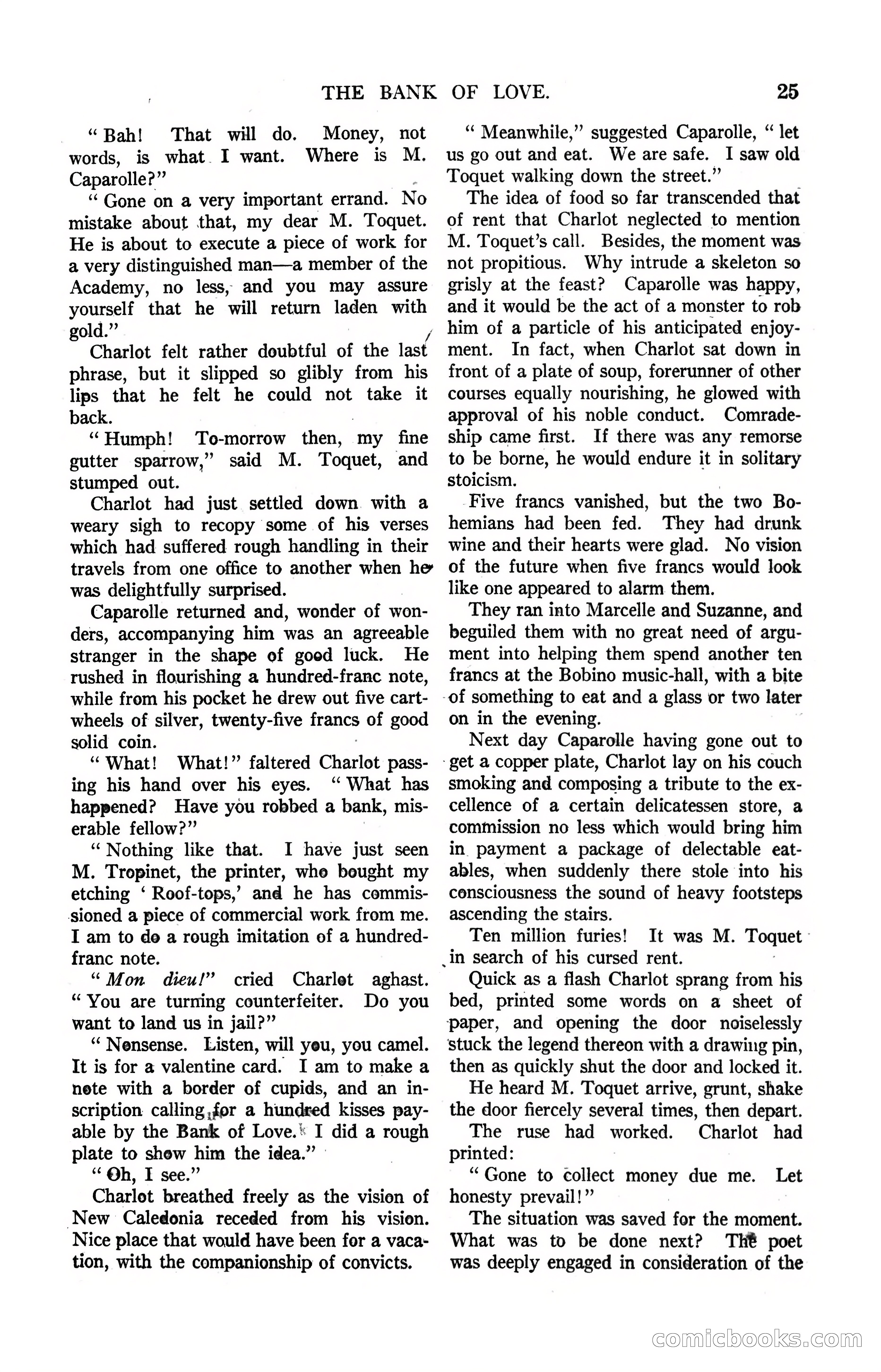
A restored page from Pulp Fiction, 1920. Page through the whole issue in the reader above.
📄 Transcribed text from this page (OCR, searchable)
Machine-transcribed from the original scan — historical spelling and the odd misread are preserved.
THE BANK OF LOVE. 29 “Bah! That will do. Money, not words, is what I want. Where is M. Caparolle? ” ‘Gone on a very important errand. No mistake about that, my dear M. Toquet. He is about to execute a piece of work for a very distinguished man—a member of the Academy, no less, and you may assure yourself that he will return laden with gold.” Charlot felt rather doubtful of the last phrase, but it slipped so glibly from his lips that he felt he could not take it back. 7 “ Humph! To-morrow then, my fine gutter sparrow,” said M. Toquet, and stumped out. Charlot had just settled down with a weary sigh to recopy some of his verses which had suffered rough handling in their travels from one office to another when he was delightfully surprised. Caparolle returned and, wonder of won- ders, accompanying him was an agreeable stranger in the shape of good luck. He rushed in flourishing a hundred-franc note, while from his pocket he drew out five cart- wheels of silver, twenty-five ene of good solid coin. “What! What!” faltered Charlot pass- ing his hand over his eyes. ‘“ What has happened? Have you robbed a bank, mis- erable fellow?” ‘‘ Nothing like that. I have just seen M. Tropinet, the printer, whe bought my etching ‘ Roof-tops,’ and he has cemmis- sioned a piece of commercial work from me. I am to do a rough imitation of a hundred- franc note. “Mon dieu!” cried Charlet aghast. “ You are turning counterfeiter. Do you want to land us in jail?” ‘‘ Nensense. Listen, will yeu, you camel. It is for a valentine card. I am to make a nete with a border of cupids, and an in- scription calling for a hundred kisses pay- able by the Bank of Love.* I did a rough plate to show him the idea.” - ‘“‘ Oh, I see.” Charlot breathed freely as the vision of New Caledonia receded from his vision. Nice place that would have been for a vaca- tion, with the companionship of convicts. ‘“ Meanwhile,” suggested Caparolle, “ let us go out and eat. We are safe. I saw old Toquet walking down the street.” The idea of food so far transcended that of rent that Charlot neglected to mention M. Toquet’s call. Besides, the moment was not propitious. Why intrude a skeleton so grisly at the feast? Caparolle was happy, and it would be the act of a monster to rob him of a particle of his anticipated enjoy- ment. In fact, when Charlot sat down in front of a plate of soup, forerunner of other courses equally nourishing, he glowed with approval of his noble conduct. Comrade- ship came first. If there was any remorse to be borne, he would endure it in solitary stoicism. | -Five francs vanished, but the two Bo- hemians had been fed. They had drunk wine and their hearts were glad. No vision of the future when five francs would look like one appeared to alarm them. They ran into Marcelle and Suzanne, and beguiled them with no great need of argu- ment into helping them spend another ten francs at the Bobino music-hall, with a bite -of something to eat and a glass or two later on in the evening. Next day Caparolle having gone out to ‘get a copper plate, Charlot lay on his couch smoking and composing a tribute to the ex- cellence of a certain delicatessen store, a commission no less which would bring him in payment a package of delectable eat- ables, when suddenly there stole into his consciousness the sound of heavy footsteps ascending the stairs. Ten million furies! It was M. Toquet: _in search of his cursed rent. Quick as a flash Charlot sprang from his bed, printed some words on a sheet of paper, and opening the door noiselessly stuck the legend thereon with a drawing pin, then as quickly shut the door and locked it. He heard M. Toquet arrive, grunt, shake the door fiercely several times, then depart. The ruse had worked. Charlot had printed: “Gone to collect money due me. Let honesty prevail!” . The situation was saved for the moment. What was to be done next? Th poet was deeply engaged in consideration of the cComiclbooks.com