
Pulp Fiction, 1920 · page 69 of 164
Argosy, Vol. 122, No. 1 — page 69: what you’re looking at
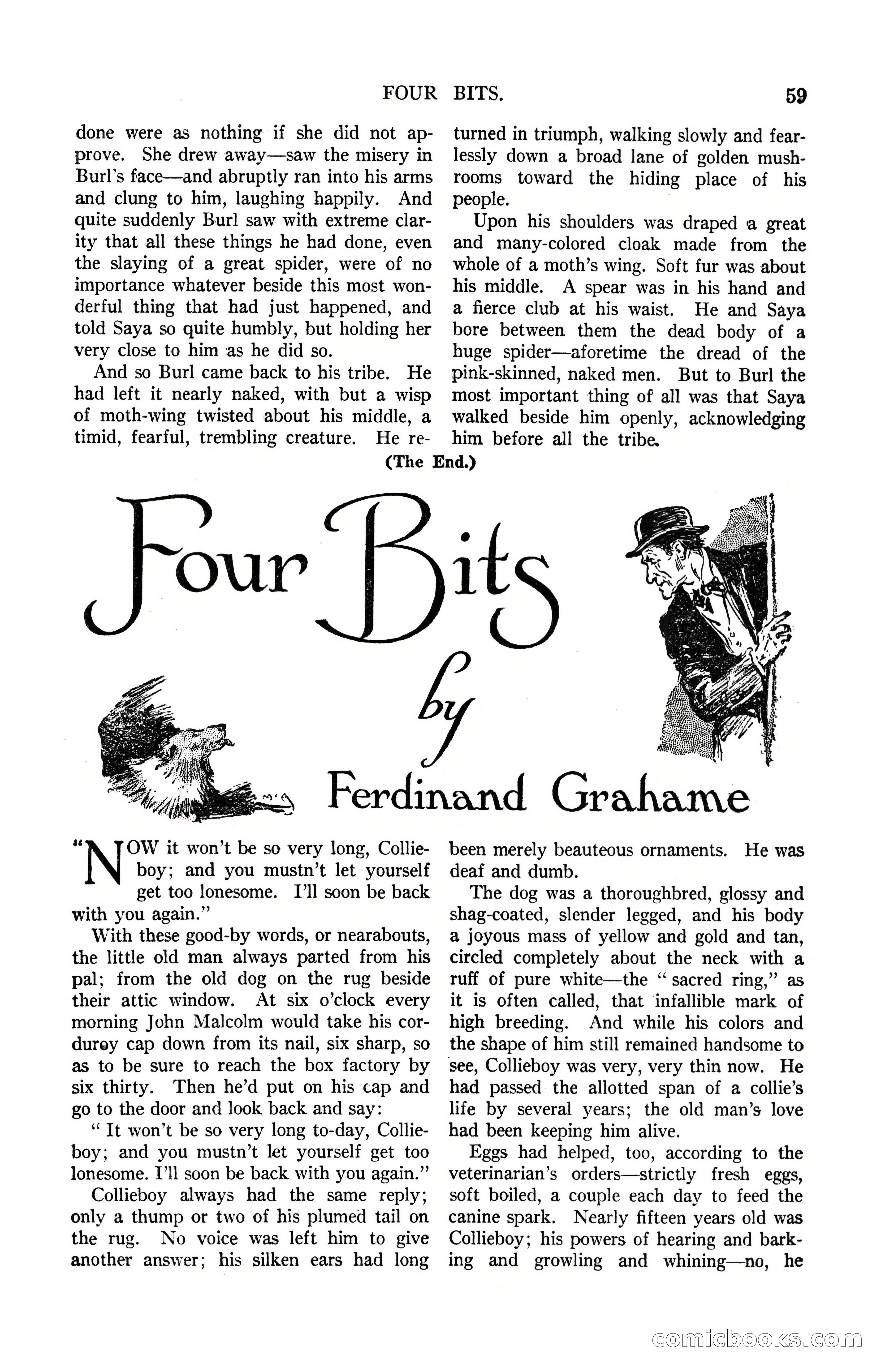
A restored page from Pulp Fiction, 1920. Page through the whole issue in the reader above.
📄 Transcribed text from this page (OCR, searchable)
Machine-transcribed from the original scan — historical spelling and the odd misread are preserved.
FOUR done were as nothing if she did not ap- prove. She drew away—saw the misery in Burl’s face—and abruptly ran into his arms and clung to him, laughing happily. And quite suddenly Burl saw with extreme clar- ity that all these things he had done, even the slaying of a great spider, were of no importance whatever beside this most won- derful thing that had just happened, and told Saya so quite humbly, but holding her very close to him as he did so. And so Burl came back to his tribe. He had left it nearly naked, with but a wisp of moth-wing twisted about his middle, a timid, fearful, trembling creature. He re- BITS. 59 turned in triumph, walking slowly and fear- lessly down a broad lane of golden mush- rooms toward the hiding place of his people. . Upon his shoulders was draped a great and many-colored cloak made from the whole of a moth’s wing. Soft fur was about his middle. A spear was in his hand and a fierce club at his waist. He and Saya bore between them the dead body of a huge spider—aforetime the dread of the pink-skinned, naked men. But to Burl the most important thing of all was that Saya walked beside him openly, acknowledging him before all the tribe. (The End.) ‘6 OW it won’t be so very long, Collie- boy; and you mustn’t let yourself get too lonesome. I'll soon be back with you again.” With these good-by words, or nearabouts, the little old man always parted from his pal; from the old dog on the rug beside their attic window. At six o’clock every morning John Malcolm would take his cor- durey cap down from its nail, six sharp, so as to be sure to reach the box factory by six thirty. Then he’d put on his cap and go to the door and look back and say: “It won’t be so very long to-day, Collie- boy; and you mustn’t let yourself get too lonesome. I’ll soon be back with you again.”’ Collieboy always had the same reply; only a thump or two of his plumed tail on the rug. No voice was left him to give another answer; his silken ears had long it been merely beauteous ornaments. He was deaf and dumb. The dog was a thoroughbred, glossy and shag-coated, slender legged, and his body a joyous mass of yellow and gold and tan, circled completely about the neck with a ruff of pure white—the ‘sacred ring,” as it is often called, that infallible mark of high breeding. And while his colors and the shape of him still remained handsome to see, Collieboy was very, very thin now. He had passed the allotted span of a collie’s life by several years; the old man’s love had been keeping him alive. Eggs had helped, too, according to the veterinarian’s orders—strictly fresh eggs, soft boiled, a couple each day to feed the canine spark. Nearly fifteen years old was Collieboy; his powers of hearing and bark- ing and growling and whining—no, he cComiclbooks.com