
Pulp Fiction, 1920 · page 70 of 164
Argosy, Vol. 122, No. 1 — page 70: what you’re looking at
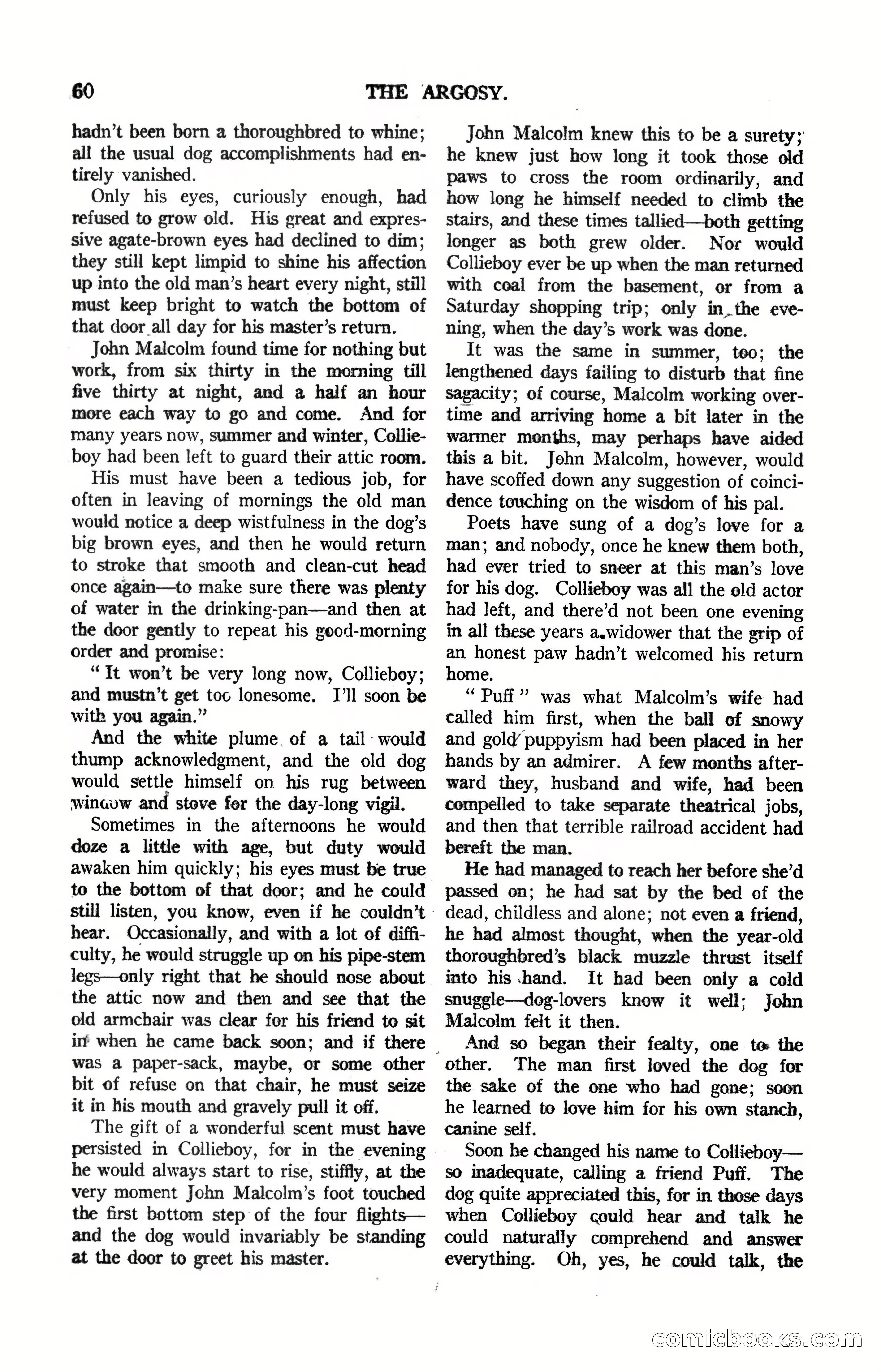
A restored page from Pulp Fiction, 1920. Page through the whole issue in the reader above.
📄 Transcribed text from this page (OCR, searchable)
Machine-transcribed from the original scan — historical spelling and the odd misread are preserved.
60 hadn’t been born a thoroughbred to whine; all the usual dog accomplishments had en- tirely vanished. Only his eyes, curiously enough, had refused to grow old. His great and expres- sive agate-brown eyes had declined to dim; they still kept limpid to shine his affection up into the old man’s heart every night, still must keep bright to watch the bottom of that door all day for his master’s return. John Malcolm found time for nothing but work, from six thirty in the morning till five thirty at night, and a half an hour more each way to go and come. And for many years now, summer and winter, Collie- boy had been left to guard their attic room. His must have been a tedious job, for often in leaving of mornings the old man would notice a deep wistfulness in the dog’s big brown eyes, and then he would return to stroke that smooth and clean-cut head once again—to make sure there was plenty of water in the drinking-pan—and then at the door gently to repeat his good-morning order and promise: “It won’t be very long now, Collieboy; and mustn’t get toc lonesome. I’ll soon be with you again.” And the white plume of a tail would thump acknowledgment, and the old dog would settle himself on his rug between winavw and stove fer the day-long vigil. Sometimes in the afternoons he would doze a little with age, but duty would awaken him quickly; his eyes must be true to the bottom of that door; and he could still listen, you know, even if he couldn’t | hear. Occasionally, and with a lot of diffi- culty, he would struggle up on his pipe-stem legs—only right that he should nose about the attic now and then and see that the old armchair was clear for his friend to sit uy when he came back soon; and if there was a paper-sack, maybe, or some other bit of refuse on that chair, he must seize it in his mouth and gravely pull it off. The gift of a wonderful scent must have persisted in Collieboy, for in the evening | he would always start to rise, stiffly, at the very moment John Malcolm’s foot touched the first bottom step of the four flights— and the dog would invariably be standing at the door to greet his master. other. THE ARGOSY. John Malcolm knew this to be a surety; he knew just how long it took those old paws to cross the room ordinarily, and how long he himself needed to climb the stairs, and these times tallied—both getting longer as both grew older. Nor would Collieboy ever be up when the man returned with coal from the basement, or from a Saturday shopping trip; only in, the eve- ning, when the day’s work was done. It was the same in summer, teo; the lengthened days failing to disturb that fine Sagacity; of course, Malcolm working over- time and arriving home a bit later in the warmer months, may perhaps have aided this a bit. John Malcolm, however, would have scoffed down any suggestion of coinci- dence touching on the wisdom of his pal. Poets have sung of a dog’s love for a man; and nobody, once he knew them both, had ever tried to sneer at this man’s love for his dog. Collieboy was all the old actor had left, and there’d not been one evening in all these years a.widower that the grip of an honest paw hadn’t welcomed his return home. “Puff”? was what Malcolm’s wife had called him first, when the ball of snowy and gold’ puppyism had been placed in her hands by an admirer. A few months after- ward they, husband and wife, had been compelled to take separate theatrical jobs, and then that terrible railroad accident had bereft the man. He had managed to reach her before she’d passed on; he had sat by the bed of the dead, childless and alone; not even a friend, he had almost thought, when the year-old thoroughbred’s black muzzle thrust itself into his hand. It had been only a cold snugele—dog-lovers know it well; John Malcolm felt it then. And so began their fealty, one te the The man first loved the dog for the sake of the one who had gone; soon he learned to love him for his own stanch, canine self. Soon he changed his name to Collieboy— so inadequate, calling a friend Puff. The dog quite appreciated this, for in those days when Collieboy could hear and talk he could naturally comprehend and answer everything. Oh, yes, he could talk, the cComiclbooks.com