
Pulp Fiction, 1920 · page 133 of 156
Argosy, Vol. 123, No. 1 — page 133: what you’re looking at
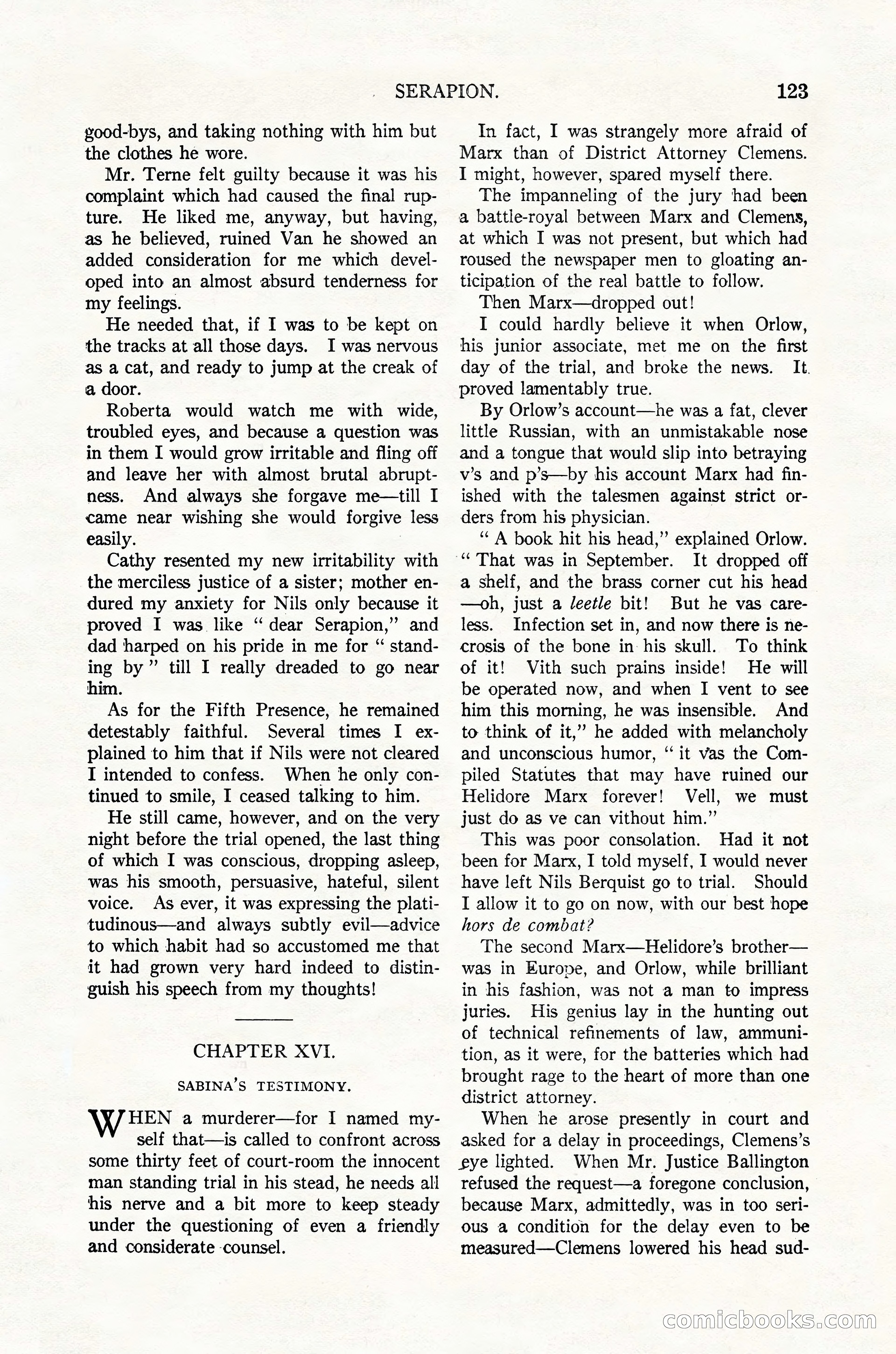
A restored page from Pulp Fiction, 1920. Page through the whole issue in the reader above.
📄 Transcribed text from this page (OCR, searchable)
Machine-transcribed from the original scan — historical spelling and the odd misread are preserved.
SERAPION. yood-bys, and taking nothing with him but the clothes he wore. Mr. Terne felt guilty because it was his complaint which had caused the final rup- ture. He liked me, anyway, but having, as he believed, ruined Van he showed an added consideration for me which devel- oped into an almost absurd tenderness for my feelings. He needed that, if I was to be kept on the tracks at all those days. I was nervous as a cat, and ready to jump at the creak of a door. Roberta would watch me with wide, troubled eyes, and because a question was in them I would grow irritable and fling off and leave her with almost brutal abrupt- ness. And always she forgave me—till I came near wishing she would forgive less easily. | Cathy resented my new irritability with the merciless justice of a sister; mother en- dured my anxiety for Nils only because it proved I was like ‘‘ dear Serapion,” and dad harped on his pride in me for “ stand- ing by” till I really dreaded to go near him. As for the Fifth Presence, he remained detestably faithful. Several times I ex- plained to him that if Nils were not cleared I intended to confess. When he only con- tinued to smile, I ceased talking to him. He still came, however, and on the very night before the trial opened, the last thing of which I was conscious, dropping asleep, was his smooth, persuasive, hateful, silent voice. As ever, it was expressing the plati- tudinous—and always subtly evil—advice to which habit had so accustomed me that it had grown very hard indeed to distin- guish his speech from my thoughts! CHAPTER XVI. SABINA’S TESTIMONY. W/ HEN a murderer—for I named my- self that—is called to confront across some thirty feet of court-room the innocent man standing trial in his stead, he needs all his nerve and a bit more to keep steady under the questioning of even a friendly and considerate -counsel. “ That was in September. 123 In fact, I was strangely more afraid of Marx than of District Attorney Clemens. I might, however, spared myself there. The impanneling of the jury had been a battle-royal between Marx and Clemens, at which I was not present, but which had roused the newspaper men to gloating an- ticipation of the real battle to follow. Then Marx—dropped out! I could hardly believe it when Orlow, his junior associate, met me on the first day of the trial, and broke the news. It. proved lamentably true. By Orlow’s account—he was a fat, clever little Russian, with an unmistakable nose and a tongue that would slip into betraying v’s and p’s—by his account Marx had fin- ished with the talesmen against strict or- ders from his physician. ‘“‘ A book hit his head,” explained Orlow. It dropped off a shelf, and the brass corner cut his head —oh, just a leetle bit! But he vas care- less. Infection set in, and now there is ne- crosis of the bone in his skull. To think of it! Vith such prains inside! He will be operated now, and when I vent to see him this morning, he was insensible. And to think of it,” he added with melancholy and unconscious humor, “ it vas the Com- piled Statutes that may have ruined our Helidore Marx forever! Vell, we must just do as ve can vithout him.” This was poor consolation. Had it not been for Marx, I told myself, I would never have left Nils Berquist go to trial. Should I allow it to go on now, with our best hope hors de combat? The second Marx—Helidore’s brother— was in Europe, and Orlow, while brilliant in his fashion, was not a man to impress juries. His genius lay in the hunting out of technical refinements of law, ammuni- tion, as it were, for the batteries which had brought rage to the heart of more than one district attorney. When he arose presently in court and asked for a delay in proceedings, Clemens’s gye lighted. When Mr. Justice Ballington refused the request—a foregone conclusion, because Marx, admittedly, was in too seri- ous a condition for the delay even to be measured—Clemens lowered his head sud- DOOLK C@