
Pulp Fiction, 1920 · page 134 of 156
Argosy, Vol. 123, No. 1 — page 134: what you’re looking at
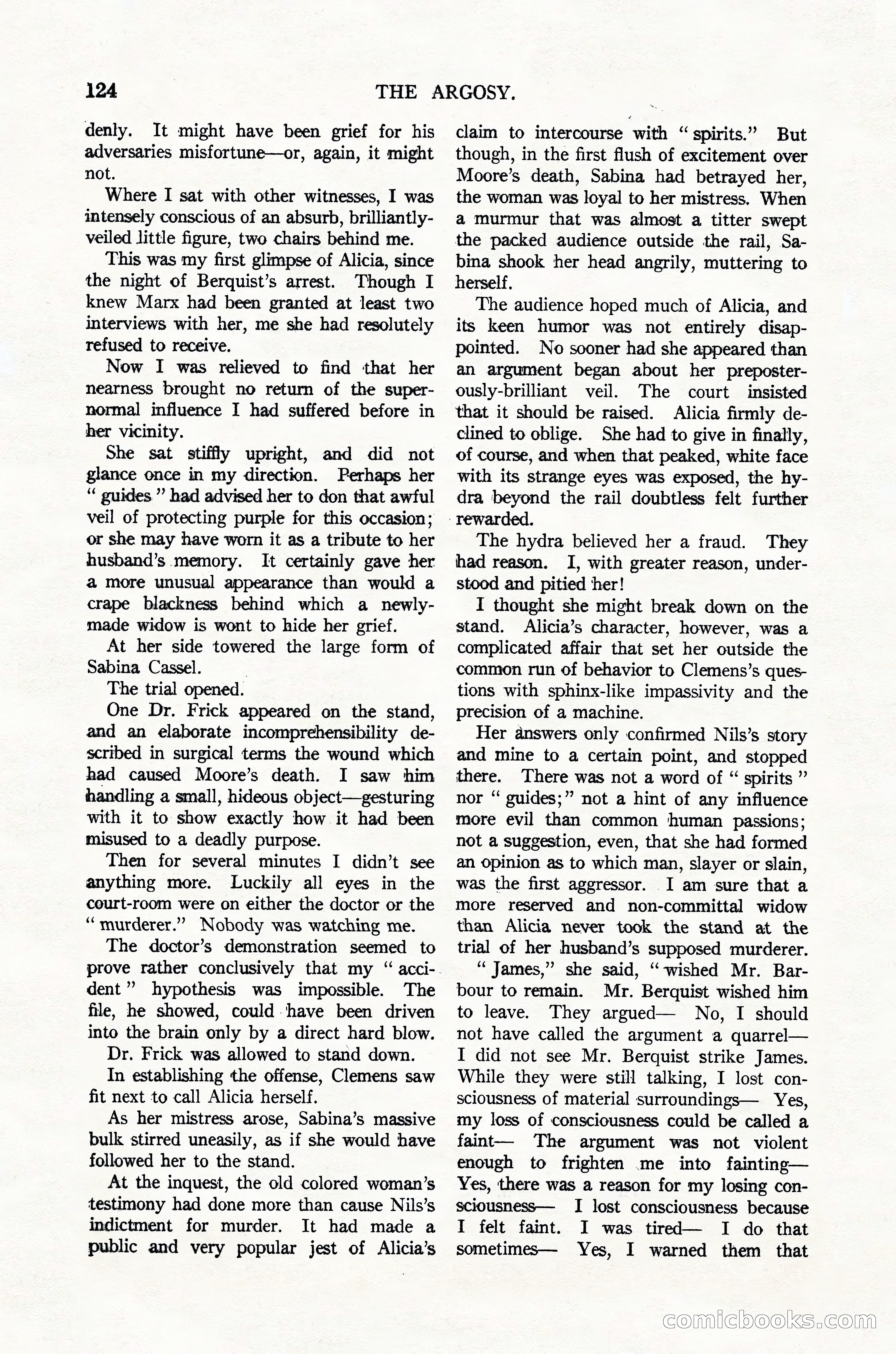
A restored page from Pulp Fiction, 1920. Page through the whole issue in the reader above.
📄 Transcribed text from this page (OCR, searchable)
Machine-transcribed from the original scan — historical spelling and the odd misread are preserved.
124 denly. It might have been grief for his adversaries misfortune—or, again, it might not. Where I sat with other witnesses, I was intensely conscious of an absurb, brilliantly- veiled little figure, two chairs behind me. This was my first glimpse of Alicia, since the night of Berquist’s arrest. Though I knew Marx had been granted at least two interviews with her, me she had resolutely refused to receive. Now I was relieved to find that her nearness brought no return of the super- normal influence I had suffered before in her vicinity. She sat stiffly upright, and did not glance once in my direction. Perhaps her ‘“ guides ” had advised her to don that awful veil of protecting purple for this occasion; or she may have worn it as a tribute to her husband’s memory. It certainly gave her. a more unusual appearance than would a crape blackness behind which a newly- made widow is wont to hide her grief. At her side towered the large form of Sabina Cassel. ! The trial opened. One Dr. Frick appeared on the stand, and an elaborate incomprehensibility de- scribed in surgical terms the wound which had caused Moore’s death. I saw him handling a small, hideous object—gesturing with it to show exactly how it had been misused to a deadly purpose. Then for several minutes I didn’t see anything more. Luckily all eyes in the court-room were on either the doctor or the “murderer.”” Nobody was watching me. The doctor’s demonstration seemed to prove rather conclusively that my “ acci-. dent’ hypothesis was impossible. The file, he showed, could have been driven into the brain only by a direct hard blow. Dr. Frick was allowed to stand down. In establishing the offense, Clemens saw fit next to call Alicia herself. As her mistress arose, Sabina’s massive bulk stirred uneasily, as if she would have followed her to the stand. At the inquest, the old colored woman’s testimony had done more than cause Nils’s indictment for murder. It had made a public and very popular jest of Alicia’s THE ARGOSY. claim to intercourse with “ spirits.” But though, in the first flush of excitement over Moore’s death, Sabina had betrayed her, the woman was loyal to her mistress. When a murmur that was almost a titter swept the packed audience outside the rail, Sa- bina shook her head angrily, muttering to herself. The audience hoped much of Alicia, and its keen humor was not entirely disap- pointed. No sooner had she appeared than an argument began about her preposter- ously-brilliant veil. The court insisted that it should be raised. Alicia firmly de- clined to oblige. She had to give in finally, of course, and when that peaked, white face with its strange eyes was exposed, the hy- dra beyond the rail doubtless felt further - rewarded. The hydra believed her a fraud. They had reason. I, with greater reason, under- stood and pitied ‘her! I thought she might break down on the stand. Alicia’s character, however, was a complicated affair that set her outside the common run of behavior to Clemens’s ques- tions with sphinx-like impassivity and the precision of a machine. Her answers only confirmed Nils’s story and mine to a certain point, and stopped there. There was not a word of “ spirits ” nor “ guides;” not a hint of any influence more evil than common human passions; not a suggestion, even, that she had formed an Opinion as to which man, slayer or slain, was the first aggressor. I am sure that a more reserved and non-committal widow than Alicia never took the stand at the trial of her husband’s supposed murderer. ‘‘ James,” she said, “wished Mr. Bar- bour to remain. Mr. Berquist wished him to leave. They argued— No, I should not have called the argument a quarrel— I did not see Mr. Berquist strike James. While they were still talking, I lost con- sciousness of material surroundings— Yes, my loss of consciousness could be called a faint— The argument was not violent enough to frighten me into fainting— Yes, there was a reason for my losing con- sciousness— I lost consciousness because I felt faint. I was tired— I do that sometimes— Yes, I warned them that comiclboool C©