
Pulp Fiction, 1920 · page 35 of 156
Argosy, Vol. 123, No. 1 — page 35: what you’re looking at
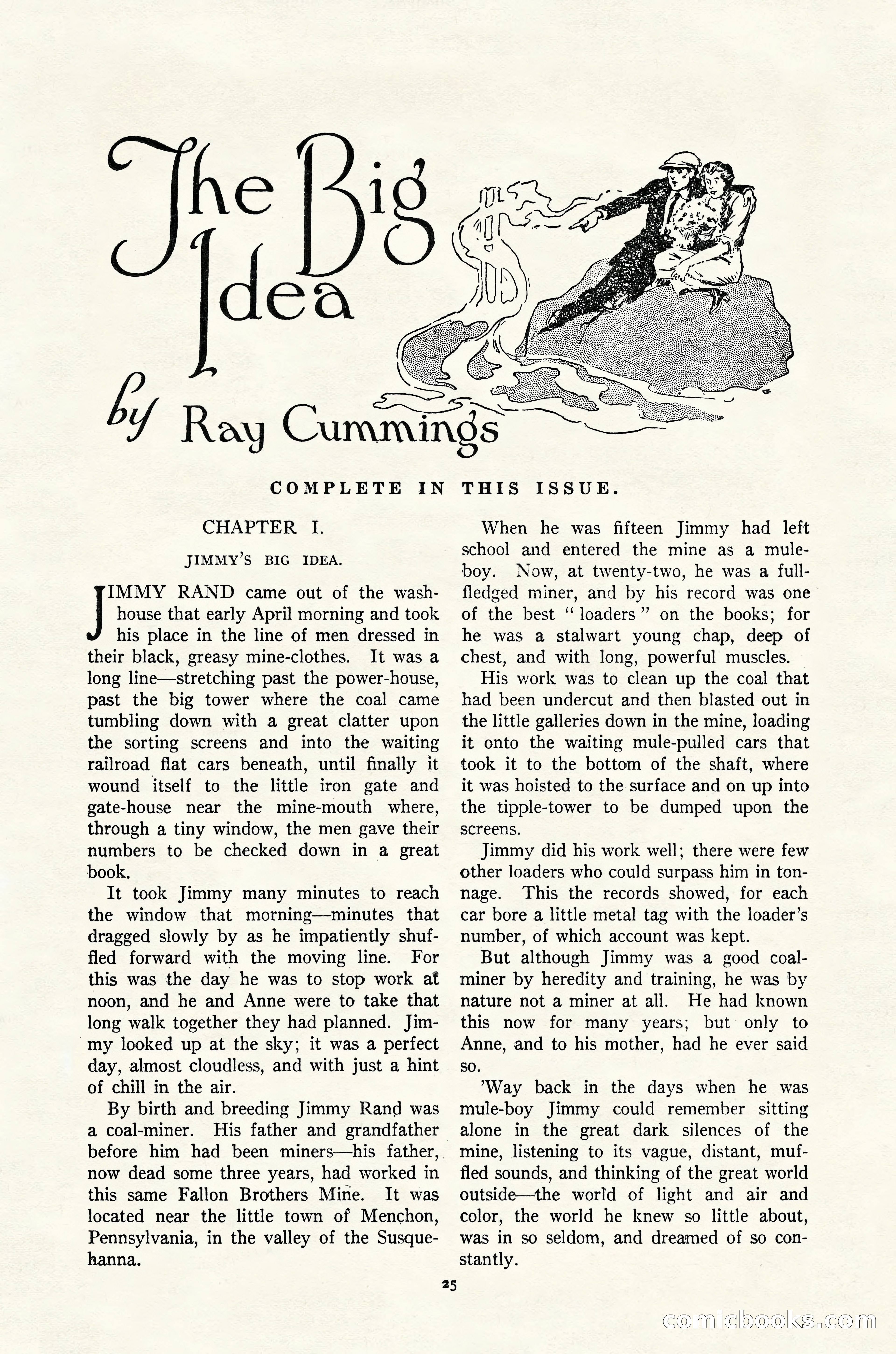
A restored page from Pulp Fiction, 1920. Page through the whole issue in the reader above.
📄 Transcribed text from this page (OCR, searchable)
Machine-transcribed from the original scan — historical spelling and the odd misread are preserved.
by Ray Cunmin COMPLETE IN CHAPTER I. JIMMY’S BIG IDEA. IMMY RAND came out of the wash- J house that early April morning and took his place in the line of men dressed in their black, greasy mine-clothes. It was a long line—stretching past the power-house, past the big tower where the coal came tumbling down with a great clatter upon the sorting screens and into the waiting railroad flat cars beneath, until finally it wound itself to the little iron gate and gate-house near the mine-mouth where, through a tiny window, the men gave their numbers to be checked down in a great book. It took Jimmy many minutes to reach the window that morning—minutes that dragged slowly by as he impatiently shuf- fled forward with the moving line. For this was the day he was to stop work at noon, and he and Anne were to take that long walk together they had planned. Jim- -my looked up at the sky; it was a perfect day, almost cloudless, and with just a hint © of chill in the air. By birth and breeding Jimmy Rand was a coal-miner. His father and grandfather ~ before him had been miners—his father, | now dead some three years, had worked in this same Fallon Brothers Mine. It was located near the little town of Menchon, Pennsylvania, in the valley of the Susque- hanna. 25 BREET ae" < 5 SST 6 o ete. Qe SENSE ns So eS hse SUNS ye S THIS ISSUE. When he was fifteen Jimmy had left school and entered the mine as a mule- boy. Now, at twenty-two, he was a full- fledged miner, and by his record was one> of the best ‘‘ loaders” on the books; for he was a stalwart young chap, deep of chest, and with long, powerful muscles. — His work was to clean up the coal that had been undercut and then blasted out in the little galleries down in the mine, loading it onto the waiting mule-pulled cars that took it to the bottom of the shaft, where it was hoisted to the surface and on up into the tipple-tower to be dumped upon the screens. Jimmy did his work well; there were few other loaders who could surpass him in ton- nage. This the records showed, for each car bore a little metal tag with the loader’s number, of which account was kept. But although Jimmy was a good coal- miner by heredity and training, he was by nature not a miner at all. He had known this now for many years; but only to Anne, and to his mother, had he ever said SO. "Way back in the days when he was mule-boy Jimmy could remember sitting alone in the great dark silences of the mine, listening to its vague, distant, muf- fled sounds, and thinking of the great world outside—the world of light and air and color, the world he knew so little about, was in so seldom, and dreamed of so con- stantly. O@OOLK (©