
Pulp Fiction, 1920 · page 36 of 156
Argosy, Vol. 123, No. 1 — page 36: what you’re looking at
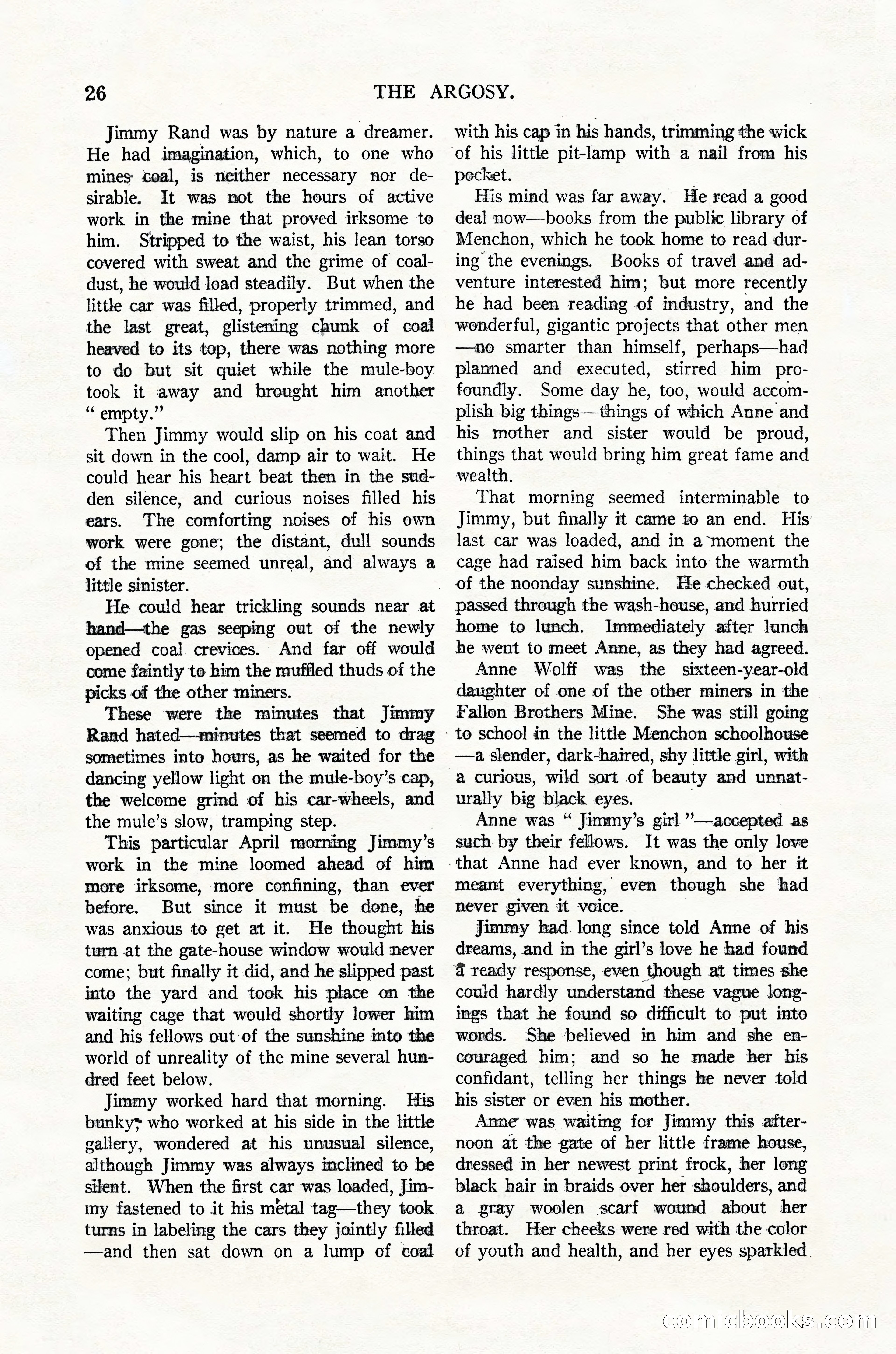
A restored page from Pulp Fiction, 1920. Page through the whole issue in the reader above.
📄 Transcribed text from this page (OCR, searchable)
Machine-transcribed from the original scan — historical spelling and the odd misread are preserved.
26 Jimmy Rand was by nature a dreamer. He had imagination, which, to one who mines: coal, is neither necessary nor de- sirable. It was not the hours of active work in the mine that proved irksome to him. Stripped to the waist, his lean torso covered with sweat and the grime of coal- dust, he would load steadily. But when the little car was filled, properly trimmed, and the last great, glistening chunk of coal heaved to its top, there was nothing more to do but sit quiet while the mule-boy took it away and brought him another “empty.” Then Jimmy would slip on his coat and sit down in the cool, damp air to wait. He could hear his heart beat then in the sud- den silence, and curious noises filled his ears. The comforting noises of his own work were gone; the distant, dull sounds of the mine seemed unreal, and always a little sinister. He could hear trickling sounds near at hand—the gas seeping out of the newly opened coal. crevices. And far off would come faintly to him the muffled thuds of the picks of the other miners. These were the minutes that Jimmy Rand hated—-minutes that seemed to drag sometimes into hours, as he waited for the dancing yellow light on the mule-boy’s cap, the welcome grind of his car-wheels, and the mule’s slow, tramping step. This particular April morning Jimmy’s work in the mine loomed ahead of him more irksome, more confining, than ever before. But since it must be done, he was anxious to get at it. He thought his turn at the gate-house window would never come; but finally it did, and he slipped past into the yard and took his place on the waiting cage that would shortly lower him. and his fellows out-of the sunshine into the world of unreality of the mine several hun- dred feet below. Jimmy worked hard that morning. His bunky* who worked at his side in the ttle gallery, wondered at his unusual silence, although Jimmy was always mclined to be silent. When the first car was loaded, Jim- my fastened to it his metal tag—they took turns in labeling the cars they jointly filled —and then sat down on a lump of coal THE ARGOSY. with his cap in his hands, trimming the wick of his little pit-lamp with a nail from his pocket. His mind was far away. He read a good deal now—books from the public library of Menchon, which he took home to read dur- ing the evenings. Books of travel and ad- venture interested him; but more recently he had been reading of industry, and the wonderful, gigantic projects that other men —no smarter than himself, perhaps—had planned and executed, stirred him pro- foundly. Some day he, too, would accom- plish big things—things of which Anne and his mother and sister would be proud, things that would bring him great fame and wealth. That morning seemed interminable to Jimmy, but finally 1t came to an end. His last car was loaded, and in a‘moment the cage had raised him back into the warmth _ of the noonday sunshine. He checked out, passed through the wash-house, and hurried home to lunch. Immediately after lunch he went to meet Anne, as they had agreed. Anne Wolff was the sixteen-year-old daughter of one of the other miners in the | Fallon Brothers Mine. She was still going - te school in the litthke Menchon schoolhouse —a slender, dark-haired, shy little girl, with a curious, wild sort of beauty and unnat- urally big black eyes. Anne was “ Jimmy’s girl ”__accepted as such by their fellows. meant everything, even though she had never given it voice. Jimmy had long since told Anne of his dreams, and in the girl’s love he had found a rencty response, even though at times she could hardly understand these vague long- ings that he found so difficult to put into words. She believed in him and she en- couraged him; and so he made her his confidant, telling her things he never told his sister or even his mother. Anne was waiting for Jimmy this after- noon at the gate of her little frame house, dressed in her newest print frock, her long black hair in braids over her shoulders, and a gray woolen scarf wound about her throat. Her cheeks were red with the color of youth and health, and her eyes sparkled. COmiclbooks It was the only love | that Anne had ever known, and to her it C@