
Pulp Fiction, 1920 · page 38 of 156
Argosy, Vol. 123, No. 1 — page 38: what you’re looking at
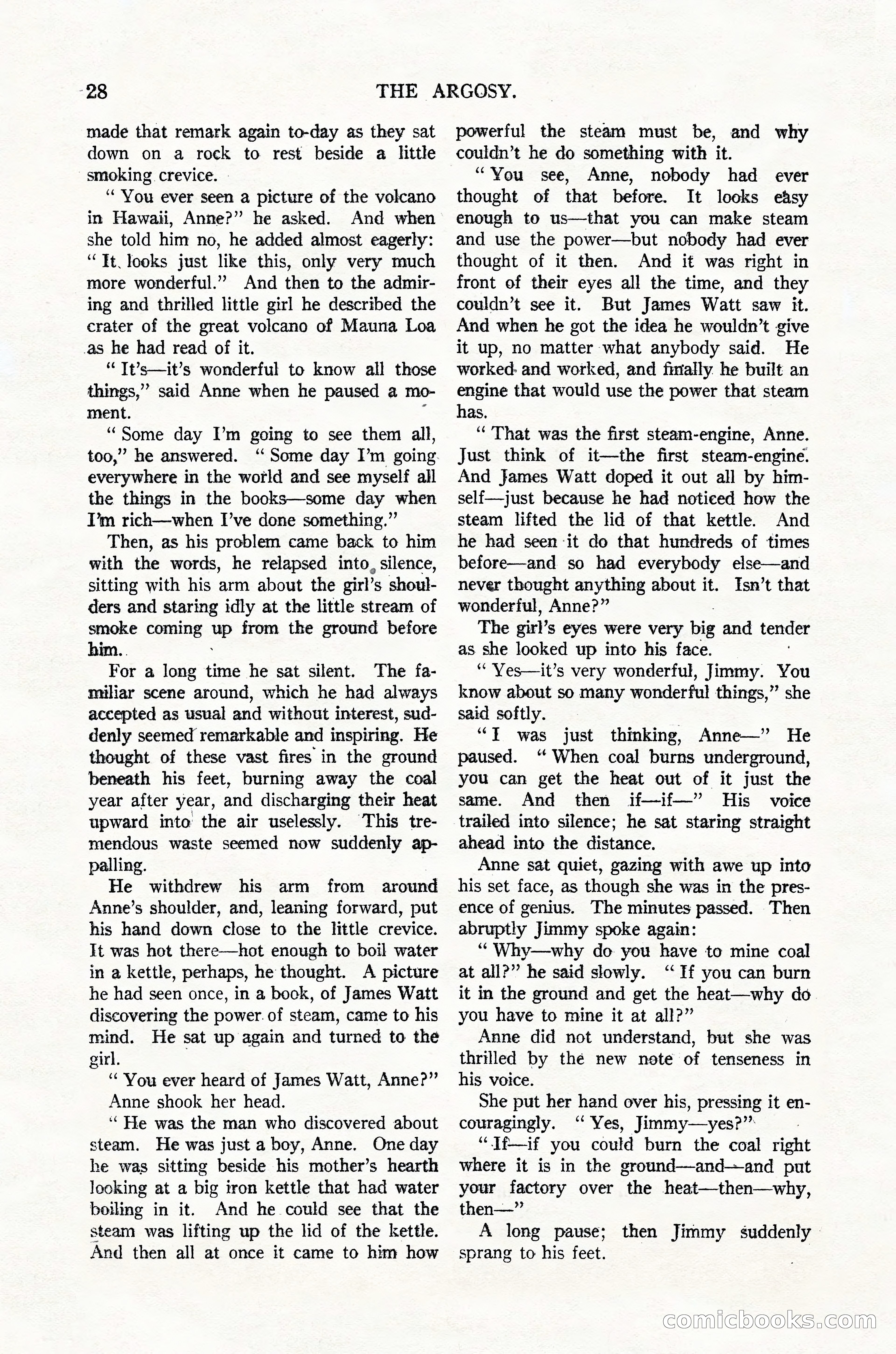
A restored page from Pulp Fiction, 1920. Page through the whole issue in the reader above.
📄 Transcribed text from this page (OCR, searchable)
Machine-transcribed from the original scan — historical spelling and the odd misread are preserved.
made that remark again to-day as they sat down on a rock to rest beside a little smoking crevice. - ‘““ You ever seen a picture of the volcano in Hawaii, Anne?” he asked. And when she told him no, he added almost eagerly: ‘It. looks just like this, only very much more wonderful.” And then to the admir- ing and thrilled little girl he described the crater of the great volcano of Mauna Loa as he had read of it. “ Tt’s—it’s wonderful to know all those things,”’ said Anne when he paused a mo- ment. ; ‘““Some day I’m going to see them all, too,” he answered. everywhere in the world and see myself all the things in the books—some day when I’m rich—when I’ve done something.” Then, as his problem came back to him with the words, he relapsed into, silence, sitting with his arm about the girl’s shoul- ders and staring idly at the little stream of smoke coming » from the ground before him.. For a long time he sat silent. The fa- muliar scene around, which he had always accepted as usual and without interest, sud- denly seemed remarkable and inspiring. He thought of these vast fires in the ground beneath his feet, burning away the coal year after year, and discharging their heat upward into’ the air uselessly. This tre- mendous waste seemed now suddenly ap- palling. He withdrew his arm from around Anne’s shoulder, and, leaning forward, put his hand down close to the little crevice. It was hot there—hot enough to boil water in a kettle, perhaps, he thought. A picture he had seen once, in a book, of James Watt discovering the power. of steam, came to his mind. He sat up again and turned to the girl. “You ever heard of James Watt, Anne?” Anne shook her head. ‘“ Ye was the man who discovered about steam. He was just a boy, Anne. One day he was sittmg beside his mother’s hearth locking at a big iron kettle that had water boiling in it. And he could see that the steam was lifting up the lid of the kettle. And then all at once it came to him how ‘Some day I’m going. THE ARGOSY. powerful the steam must be, and why couldn’t he do something with it. “You see, Anne, nobody had _ ever thought of that before. It looks ef&sy enough to us—that you can make steam and use the power—but nobody had ever thought of it then. And it was right in front of their eyes all the time, and they couldn’t see it. But James Watt saw it. And when he got the idea he wouldn’t give It up, no matter what anybody said. He worked: and worked, and fitally. he built an engine that would use the power that steam has. ‘That was the first steam-engine, Anne. Just think of it—the first steam-engine. And James Watt doped it out all by him- self—just because he had noticed how the steam lifted the lid of that kettle. And he had seen it do that hundreds of times before—and so had everybody else—and never thought anything about it. Isn’t that wonderful, Anne?” The girl’ S eyes were very big and tender as she looked up into his face. “Yes—it’s very wonderful, Jimmy. You know about so many wonderful things,” she said softly. “¥ was just thinking, Anne—” He paused. ‘“ When coal burns underground, you can get the heat out of it just the same. And then if—if—” His voice trailed into silence; he sat staring straight ahead into the distance. Anne sat quiet, gazing with awe up into his set face, as though she was in the pres- ence of genius. The minutes passed. Then abruptly Jimmy spoke again: 7 ‘“‘ Why—why do you have to mine coal at all?” he said slowly. “If you can burn it in the ground and get the heat—why do. you have to mine it at all?” Anne did not understand, but she was thrilled by thé new note of tenseness in his voice. She put her hand over his, pressing it en- couragingly. ‘‘ Yes, Jimmy—yes?”’ “If—if you could burn the coal right where it is in the ground—and—and put your factory over the heat—then—why, then—” A long pause; sprang to his feet. DOOK then Jimmy suddenly C©