
Pulp Fiction, 1920 · page 37 of 156
Argosy, Vol. 123, No. 1 — page 37: what you’re looking at
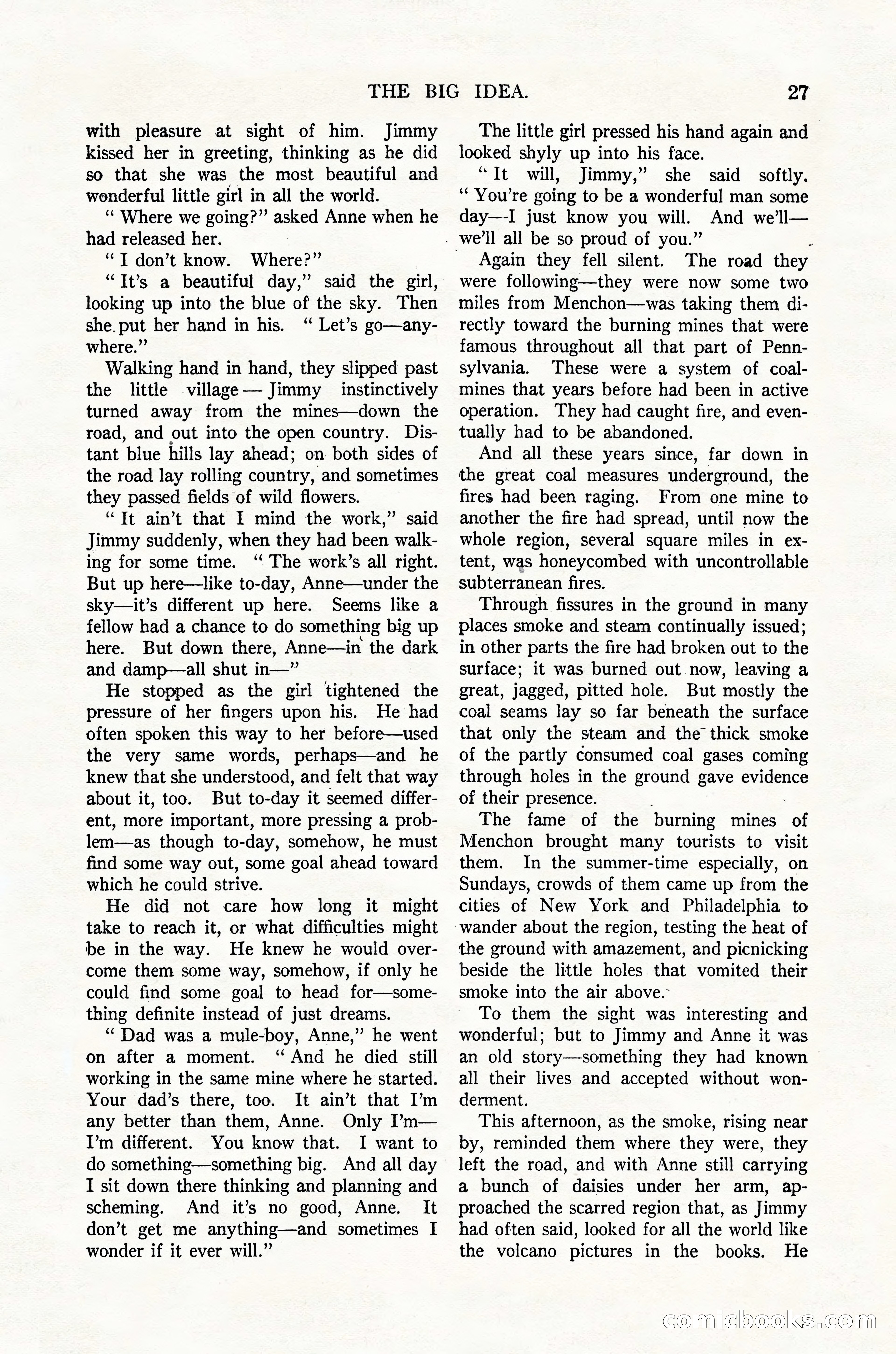
A restored page from Pulp Fiction, 1920. Page through the whole issue in the reader above.
📄 Transcribed text from this page (OCR, searchable)
Machine-transcribed from the original scan — historical spelling and the odd misread are preserved.
THE BIG IDEA. with pleasure at sight of him. Jimmy kissed her in greeting, thinking as he did so that she was the most beautiful and wonderful little girl in all the world. ‘“‘ Where we going?” asked Anne when he had released her. “TI don’t know. Where?” “It’s a beautiful day,” said the girl, looking up into the blue of the sky. Then she. put her hand in his. ‘ Let’s go—any- where.” Walking hand in hand, they slipped past the little village— Jimmy instinctively turned away from the mines—down the road, and out into the open country. Dis- tant blue hills lay ahead; on both sides of the road lay rolling country, and sometimes they passed fields of wild flowers. “Tt ain’t that I mind the work,” said Jimmy suddenly, when they had been walk- ing for some time. ‘‘ The work’s all right. But up here—like to-day, Anne—under the sky—it’s different up here. Seems like a fellow had a chance to do something big up here. But down there, Anne—in the ane and damp—all shut in—” He stopped as the girl tightened the pressure of her fingers upon his. He had often spoken this way to her before—used the very same words, perhaps—and he knew that she understood, and felt that way about it, too. But to-day it seemed differ- ent, more important, more pressing a prob- lem—as though to-day, somehow, he must find some way out, some goal ahead toward which he could strive. He did not care how long it might take to reach it, or what difficulties might be in the way. He knew he would over- come them some way, somehow, if only he could find some goal to head for—some- thing definite instead of just dreams. ‘Dad was a mule-boy, Anne,” he went on after a moment. ‘“ And he died still working in the same mine where he started. Your dad’s there, too. It ain’t that I’m any better than them, Anne. Only I’m— I’m different. You know that. I want to do something—something big. And all day I sit down there thinking and planning and scheming. And it’s no good, Anne, It don’t get me anything—and sometimes I wonder if it ever will.” . we'll all be so proud of you.” 27 The little girl pressed his hand again and looked shyly up into his face. “It will, Jimmy,” she said softly. ‘You're going to be a wonderful man some day—-I just know you will. And we’ll— Again they fell silent. The road they were following—they were now some two miles from Menchon—was taking them di- rectly toward the burning mines that were famous throughout all that part of Penn- sylvania. These were a system of coal- mines that years before had been in active operation. They had caught fire, and even- tually had to be abandoned. And all these years since, far down in the great coal measures underground, the fires had been raging. From one mine to another the fire had spread, until now the whole region, several square miles in ex- tent, was honeycombed with uncontrollable subterranean fires. Through fissures in the ground in many places smoke and steam continually issued; in other parts the fire had broken out to the surface; it was burned out now, leaving a great, jagged, pitted hole. But mostly the coal seams lay so far beneath the surface that only the steam and the thick smoke of the partly consumed coal gases coming through holes in the ground gave evidence of their presence. The fame of the burning mines of Menchon brought many tourists to visit them. In the summer-time especially, on Sundays, crowds of them came up from the cities of New York and Philadelphia to wander about the region, testing the heat of the ground with amazement, and picnicking beside the little holes that vomited their smoke into the air above. To them the sight was interesting and wonderful; but to Jimmy and Anne it was an old story—something they had known all their lives and accepted without won- derment. This afternoon, as the smoke, rising near by, reminded them where they were, they left the road, and with Anne still carrying a bunch of daisies under her arm, ap- proached the scarred region that, as Jimmy had often said, looked for all the world like the volcano pictures in the books. He comiclboool C©