
Pulp Fiction, 1920 · page 35 of 164
Argosy All-Story Weekly, November 13, 1920 — page 35: what you’re looking at
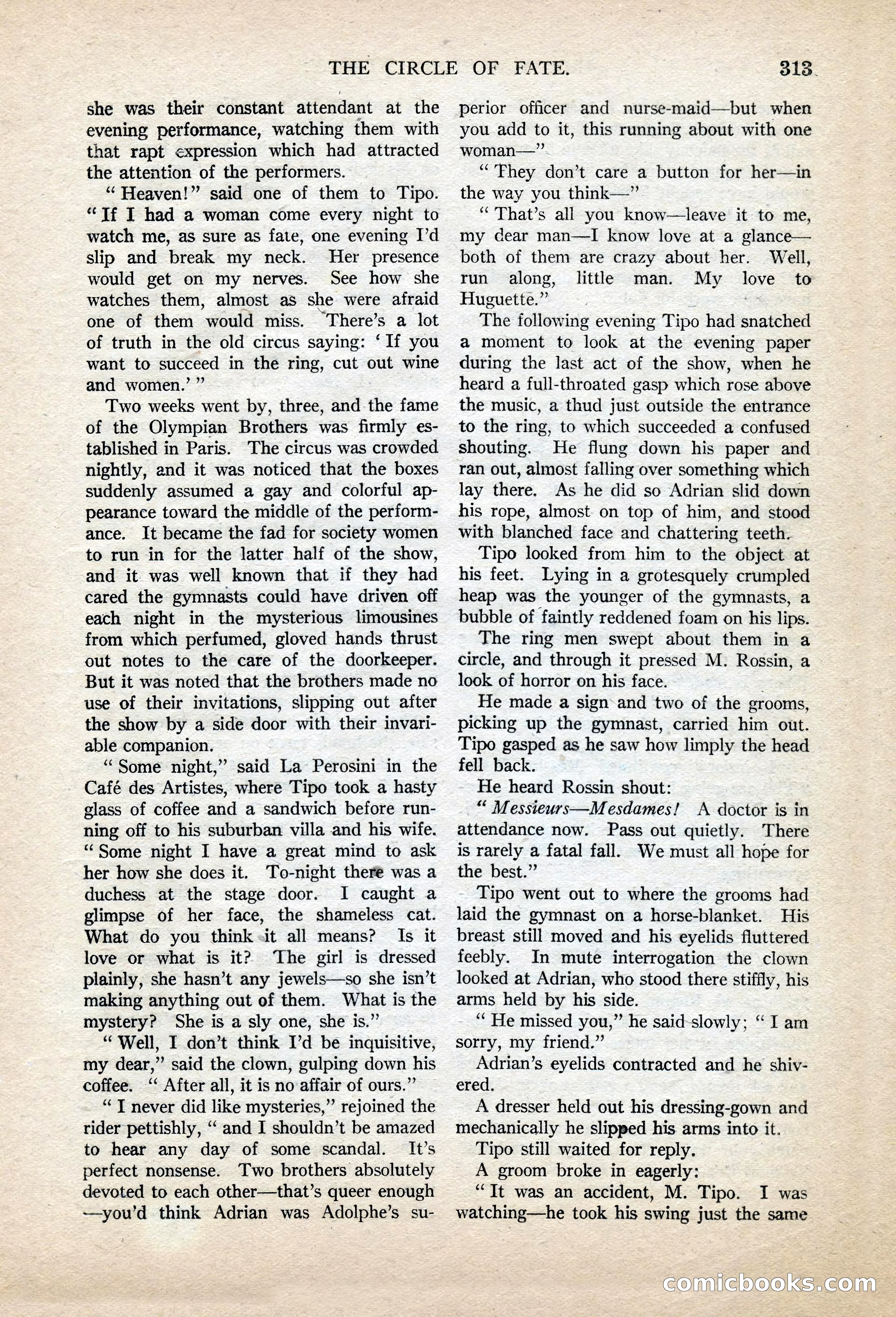
A restored page from Pulp Fiction, 1920. Page through the whole issue in the reader above.
📄 Transcribed text from this page (OCR, searchable)
Machine-transcribed from the original scan — historical spelling and the odd misread are preserved.
THE CIRCLE OF FATE. she was their constant attendant at the evening performance, watching them with that rapt expression which had attracted the attention of the performers. “‘ Heaven!” said one of them to Tipo. “Tf I had a woman come every night to watch me, as sure as fate, one evening I’d slip and break my neck. Her presence would get on my nerves. See how she watches them, almost as she were afraid one of them would miss. There’s a lot of truth in the old circus saying: ‘ If you want to succeed in the ring, cut out wine and women.’ ”’ Two weeks went by, three, and the fame of the Olympian Brothers was firmly es- tablished in Paris. The circus was crowded nightly, and it was noticed that the boxes suddenly assumed a gay and colorful ap- pearance toward the middle of the perform- ance. It became the fad for society women to run in for the latter half of the show, and it. was well known that if they had cared the gymnasts could have driven off each night in the mysterious limousines from which perfumed, gloved hands thrust out notes to the care of the doorkeeper. But it was noted that the brothers made no use of their invitations, slipping out after the show by a side door with their invari- able companion. “Some night,” said La Perosini in the Café des Artistes, where Tipo took a hasty glass of coffee and a sandwich before run- ning off to his suburban villa and his wife. ‘Some night I have a great mind to ask her how she does it. To-night there was a duchess at the stage door. I caught a glimpse of her face, the shameless cat. What do you think «it all means? Is it love or what is it? ‘The girl is dressed plainly, she hasn’t any jewels—so she isn’t making anything out of them. What is the mystery? She is a sly one, she is.” “Well, I don’t think I’d be inquisitive, my dear,” said the clown, gulping down his coffee. ‘‘ After all, it is no affair of ours.” “‘T never did like mysteries,” rejoined the rider pettishly, ‘‘ and I shouldn’t be amazed to hear any day of some scandal. It’s perfect nonsense. Two brothers absolutely devoted to each other—that’s queer enough —you’d think Adrian was Adolphe’s su- perior officer and nurse-maid—but when you add to it, this running about with one woman—”’ “Fhey don’t care a button for her—in the way you think—” ‘“That’s all you know—leave it to me, my dear man—I know love at a glance— both of them are crazy about her. Well, run along, littl man. My love to Huguette.” : : The following evening Tipo had snatched a moment to look at the evening paper during the last act of the show, when he heard a full-throated gasp which rose above the music, a thud just outside the entrance to the ring, to which succeeded a confused shouting. He flung down his paper and ran out, almost falling over something which lay there. As he did so Adrian slid down his rope, almost on top of him, and stood with blanched face and chattering teeth. Tipo looked from him to the object at his feet. Lying in a grotesquely crumpled heap was the younger of the gymnasts, a bubble of faintly reddened foam on his lips. The ring men swept about them in a circle, and through it pressed M. Rossin, a look of horror on his face. He made a sign and two of the grooms, picking up the gymnast, carried him out. Tipo gasped as he saw how limply the head fell back. He heard Rossin shout: “ Messieurs—Mesdames! A doctor is in attendance now. Pass out quietly. There is rarely a fatal fall. We must all hope for the best.” Tipo went out to where the grooms had laid the gymnast on a horse-blanket. His breast still moved and his eyelids fluttered feebly. In mute interrogation the clown looked at Adrian, who stood there stiffly, his arms held by his side. “He missed you,” he said-slowly; “ I am sorry, my friend.” Adrian’s eyelids contracted and he shiv- ered. A dresser held out his dressing-gown and mechanically he slipped his arms into it. Tipo still waited for reply. A groom broke in eagerly: “It was an accident, M. Tipo. I was watching—he took his swing just the same GEomichoo 313. Ss) (Eo)