
Pulp Fiction, 1920 · page 36 of 164
Argosy All-Story Weekly, November 13, 1920 — page 36: what you’re looking at
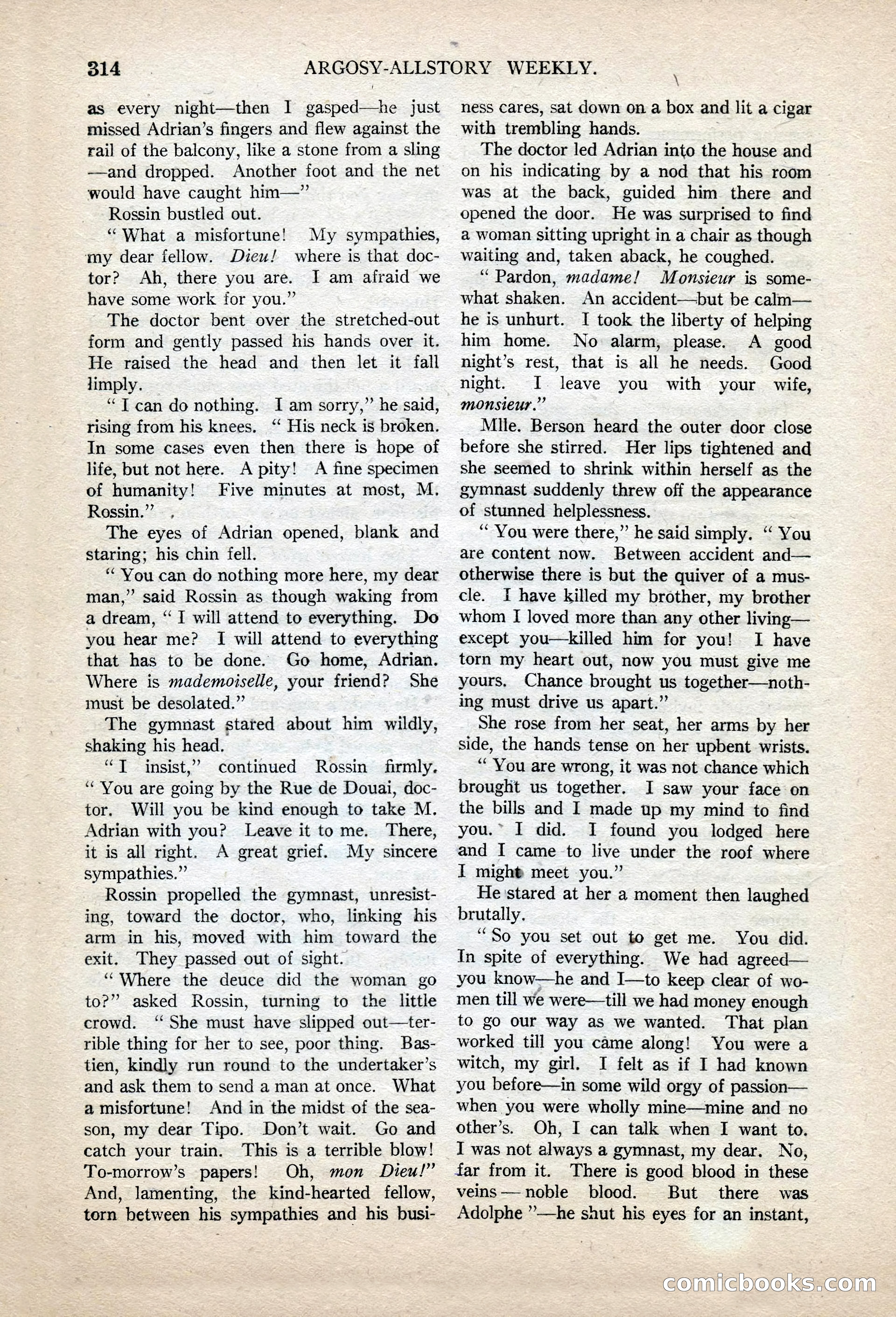
A restored page from Pulp Fiction, 1920. Page through the whole issue in the reader above.
📄 Transcribed text from this page (OCR, searchable)
Machine-transcribed from the original scan — historical spelling and the odd misread are preserved.
314 as every night—then I gasped—he just missed Adrian’s fingers and flew against the rail of the balcony, like a stone from a sling —and dropped. Another foot and the net would have caught him—”’ Rossin bustled out. “What a misfortune! my dear fellow. Dieu! tor? Ah, there you are. have some work for you.” The doctor bent over the stretched-out form and gently passed his hands over it. He raised the head and then let it fall limply. “J can do nothing. I am sorry,” he said, rising from his knees. “ His neck is broken. In some cases even then there is hope of life, but not here. A pity! A fine specimen of humanity! Five minutes at most, M. Rossin.” , The eyes of Adrian opened, blank and staring; his chin fell. ‘You can do nothing more here, my dear man,” said Rossin as though waking from a dream, “1 will attend to everything. Do you hear me? I will attend to everything that has to be done. Go home, Adrian. Where is mademoiselle, your friend? She must be desolated.” The gymnast stared about him wildly, shaking his head. “TJ insist,” continued Rossin firmly. “You are going by the Rue de Douai, doc- tor. Will you be kind enough to take M. Adrian with you? Leave it tome. There, it is all right. A great grief. My sincere sympathies.” Rossin propelled the gymnast, unresist- ing, toward the doctor, who, linking his arm in his, moved with him toward the exit. They passed out of sight. ‘““Where the deuce did the woman go to?” asked Rossin, turning to the little crowd. ‘ She must have slipped out—ter- rible thing for her to see, poor thing. Bas- tien, kindly run round to the undertaker’s and ask them to send a man at once. What a misfortune! And in the midst of the sea- son, my dear Tipo. Don’t wait. Go and catch your train. This is a terrible blow! To-morrow’s papers! Oh, mon Dieu!” And, lamenting, the kind-hearted fellow, torn between his sympathies and his busi- My sympathies, where is that doc- I am afraid we ARGOSY-ALLSTORY WEEKLY. \ ness Cares, sat down on a box and lit a cigar with trembling hands. 2 The doctor led Adrian into the house and on his indicating by a nod that his room was at the back, guided him there and opened the door. He was surprised to find a woman sitting upright in a chair as though waiting and, taken aback, he coughed. ‘“ Pardon, madame! Monsieur is some- what shaken. An accident—but be calm— he is unhurt. I took the liberty of helping him home. No alarm, please. night’s rest, that is all he needs. Good night. I leave you with your wife, monsieur.” Mile. Berson heard the outer door close before she stirred. Her lips tightened and she seemed to shrink within herself as the gymnast suddenly threw off the appearance of stunned helplessness. ‘You were there,” he said simply. “ You are content now. Between accident and— otherwise there is but the quiver of a mus- cle. I have killed my brother, my brother whom I loved more than any other living— except you—killed him for you! I have torn my heart out, now you must give me yours, Chance brought us together—noth- ing must drive us apart.” She rose from her seat, her arms by her side, the hands tense on her upbent wrists. “You are wrong, it was not chance which brought us together. I saw your face on the bills and I made up my mind to find you.” I did. I found you lodged here and I came to live under the roof where I might meet you.” He'stared at her a moment then laughed brutally, “So you set out to get me. You did. In spite of everything. We had agreed— you know—he and I—to keep clear of wo- men till we were—till we had money enough to go our way as we wanted. That plan worked till you came along! You were a witch, my girl. I felt as if I had known you before—in some wild orgy of passion— when you were wholly mine—mine and no other’s. Oh, I can talk when I want to. I was not always a gymnast, my dear. No, far from it. There is good blood in these veins — noble blood. But there was Adolphe ”—he shut his eyes for an instant, A good — JOO (Q) com <S (E@