
Pulp Fiction, 1921 · page 108 of 157
Argosy All-Story Weekly, April 16, 1921 — page 108: what you’re looking at
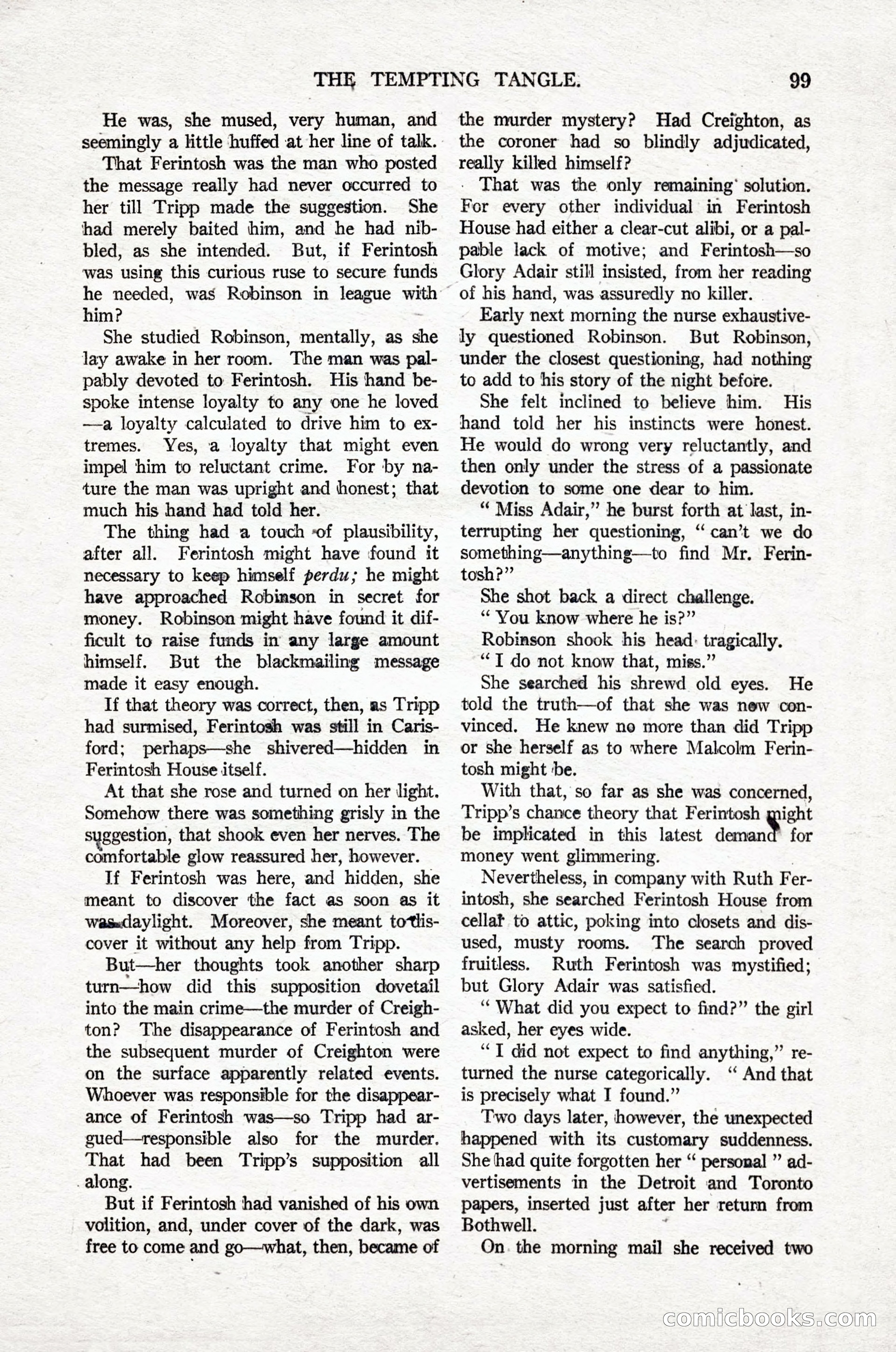
A restored page from Pulp Fiction, 1921. Page through the whole issue in the reader above.
📄 Transcribed text from this page (OCR, searchable)
Machine-transcribed from the original scan — historical spelling and the odd misread are preserved.
THRE TEMPTING TANGLE. He was, she mused, very human, and seemingly a little huffed at her line of talk. That Ferintosh was the man who posted the message really had never occurred to her till Tripp made the suggestion. She had merely baited him, and he had nib- bled, as she intended. But, if Ferintosh was using this curious ruse to secure funds he needed, was Robinson in league wi him? 3 She studied Robinson, mentally, as she lay awake in her room. The man was pal- pably devoted to Ferintosh. His hand be- spoke intense loyalty to any one he loved —a loyalty calculated to drive him to ex- tremes. Yes, a loyalty that might even impel him to reluctant crime. For by na- ture the man was upright and honest; that much his hand had told her. The thing had a touch of plausibility, after all. Ferintosh might have found it necessary to keep himself perdu; he might have approached Robinson in secret for money. Robinson might have found it dif- ficult to raise funds in any large amount himself. But the blackmailing message made it easy enough. If that theory was correct, then, as Tripp had surmised, Ferintosh was still in Caris- ford; perhaps—she shivered—hidden in Ferintosh House itself. At that she rose and turned on her light. Somehow there was something grisly in the suggestion, that shook even her nerves. The comfortable glow reassured her, however. If Ferintosh was here, and hidden, she meant to discover the fact as soon as it Wassdlaylight. Moreover, she meant totlis- cover it without any help from Tripp. But—her thoughts took another sharp turn—how did this supposition dovetail into the main crime—the murder of Creigh- ton? The disappearance of Ferintosh and the subsequent murder of Creighton were on the surface apparently related events. Whoever was responsible for the disappear- ance of Ferintosh was—so Tripp had ar- gued—responsible also for the murder. That had been Tripp’s supposition all . along. But if Ferintosh had vanished of his own volition, and, under cover of the dark, was free to come and go—what, then, became of 99 the murder mystery? Had Creighton, as the coroner had so blindly adjudicated, really killed himself? - That was the only remaining“ solution. For every other individual in Ferintosh House had either a clear-cut alibi, or a pal- pable lack of motive; and Ferintosh—so Glory Adair still insisted, from her reading - Of his hand, was assuredly no killer. Early next morning the nurse exhaustive- ly questioned Robinson. But Robinson, under the closest questioning, had nothing to add to his story of the night before. She felt inclined to believe him. His hand told her his instincts were honest. He would do wrong very reluctantly, and then only under the stress of a passionate devotion to some one dear to him. “‘ Miss Adair,” he burst forth at last, in- terrupting her questioning, “ can’t we do something—anything—to find Mr. Ferin- tosh?”’ She shot back a direct challenge. ‘You know where he is?” Robinson shook his head: tragically. ‘“‘T do not know that, miss.” She searched his shrewd old eyes. He told the truth—of that she was new con- vinced, He knew no more than did Tripp or she herself as to where Malcolm Ferin- tosh might ‘be. With that, so far as she was concerned, Tripp’s chance theory that Ferintosh might be implicated in this latest deceit for money went glimmering. | Nevertheless, in company with Ruth Fer- intosh, she searched Ferintosh House from cellaf to attic, poking into closets and dis- used, musty rooms. The search proved fruitless. Ruth Ferintosh was mystified; but Glory Adair was satisfied. ‘What did you expect to find?” the girl asked, her eyes wide. ‘““T did not expect to find anything,” re- turned the nurse categorically. ‘ And that is precisely what I found.” Two days later, however, the unexpected happened with its customary suddenness. She had quite forgotten her “ personal ” ad- vertisements in the Detroit and Toronto papers, inserted just after her return from Bothwell. : On. the morning mail she received two CORNICLOO® S (C@ 5}