
Pulp Fiction, 1921 · page 109 of 157
Argosy All-Story Weekly, April 16, 1921 — page 109: what you’re looking at
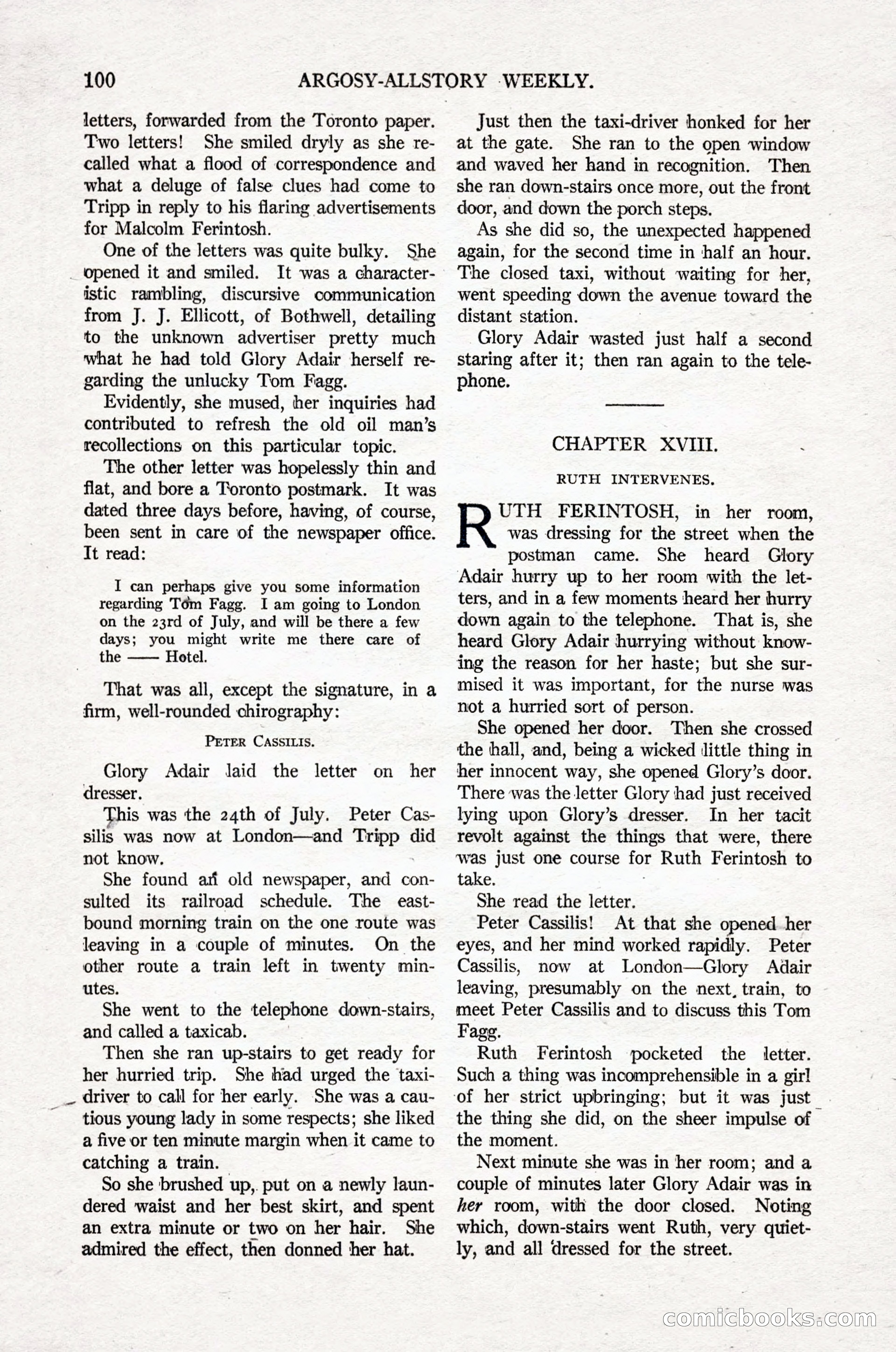
A restored page from Pulp Fiction, 1921. Page through the whole issue in the reader above.
📄 Transcribed text from this page (OCR, searchable)
Machine-transcribed from the original scan — historical spelling and the odd misread are preserved.
100 letters, forwarded from the Toronto paper. Two letters! She smiled dryly as she re- called what a flood of correspondence and what a deluge of false clues had come to Tripp in reply to his flaring advertisements for Malcolm Ferintosh. One of the letters was quite bulky. She _ opened it and smiled. It was a character- istic rambling, discursive communication from J. J. Ellicott, of Bothwell, detailing to the unknown advertiser pretty much what he had told Glory Adair herself re- garding the unlucky Tom Fagg. Evidently, she mused, her inquiries had contributed to refresh the old oil man’s recollections on this particular topic. The other letter was hopelessly thin and flat, and bore a Toronto postmark. It was dated three days before, having, of course, been sent in care of the newspaper office. It read: I can perhaps give you some information regarding Tém Fagg. I am going to London on the 23rd of July, and will be there a few days; you might write me there care of the —— Hotel. That was all, except the signature, in a firm, well-rounded chirography: PETER CASSILIS. Glory Adair laid the letter on her dresser. This was the 24th of July. Peter Cas- silis was now at London—and Tope did not know. She found ari old newspaper, and con- sulted its railroad schedule. The east- bound morning train on the one route was leaving in a couple of minutes. On the other route a train left in twenty min- utes. She went to the telephone down-stairs, and called a taxicab. Then she ran up-stairs to get ready for her hurried trip. She had urged the taxi- driver to call for her early. She was a cau- tious young lady in some respects; she liked a five or ten minute margin when it came to catching a train. | So she brushed up,. put on a newly laun- dered waist and her best skirt, and spent an extra minute or two on her hair. She admired the effect, then donned her hat. ARGOSY-ALLSTORY -WEEKLY. Just then the taxi-driver honked for her at the gate. She ran to the open window and waved her hand in recognition. Then she ran down-stairs once more, out the front door, and down the porch steps. As she did so, the unexpected happened again, for the second time in half an hour. The closed taxi, without waiting for her, went speeding down the avenue toward the distant station. Glory Adair wasted just half a second staring after it; then ran again to the tele- phone. CHAPTER XVIII. RUTH INTERVENES. UTH FERINTOSH, in her room, was dressing for the street when the postman came. She heard Glory Adair hurry up to her room with the let- ters, and in a few moments heard her hurry down again to the telephone. That is, she heard Glory Adair hurrying without know- ing the reason for her haste; but she sur- mised it was important, for the nurse was not a hurried sort of person. She opened her door. Then she crossed the hall, and, being a wicked little thing in her innocent way, she opened Glory’s door. There was the letter Glory had just received lying upon Glory’s dresser. In her tacit revolt against the things that were, there was just one course for Ruth Ferintosh to take. She read the letter. Peter Cassilis! At that she opened her eyes, and her mind worked rapidly. Peter Cassilis, now at London—Glory Adair leaving, presumably on the next, train, to meet Peter Cassilis and to discuss this Tom Fage. Ruth Ferintosh pocketed the letter. Such a thing was incomprehensible in a gir! of her strict upbringing; but it was just | the thing she did, on the sheer impulse of the moment. Next minute she was in her room; and a couple of minutes later Glory Adair was in her room, with the door closed. Noting which, down-stairs went Ruth, very quiet- ly, and all dressed for the street. CoOmiclbool< (C@ 5}