
Pulp Fiction, 1922 · page 20 of 172
Argosy All-Story Weekly, January 21, 1922 — page 20: what you’re looking at
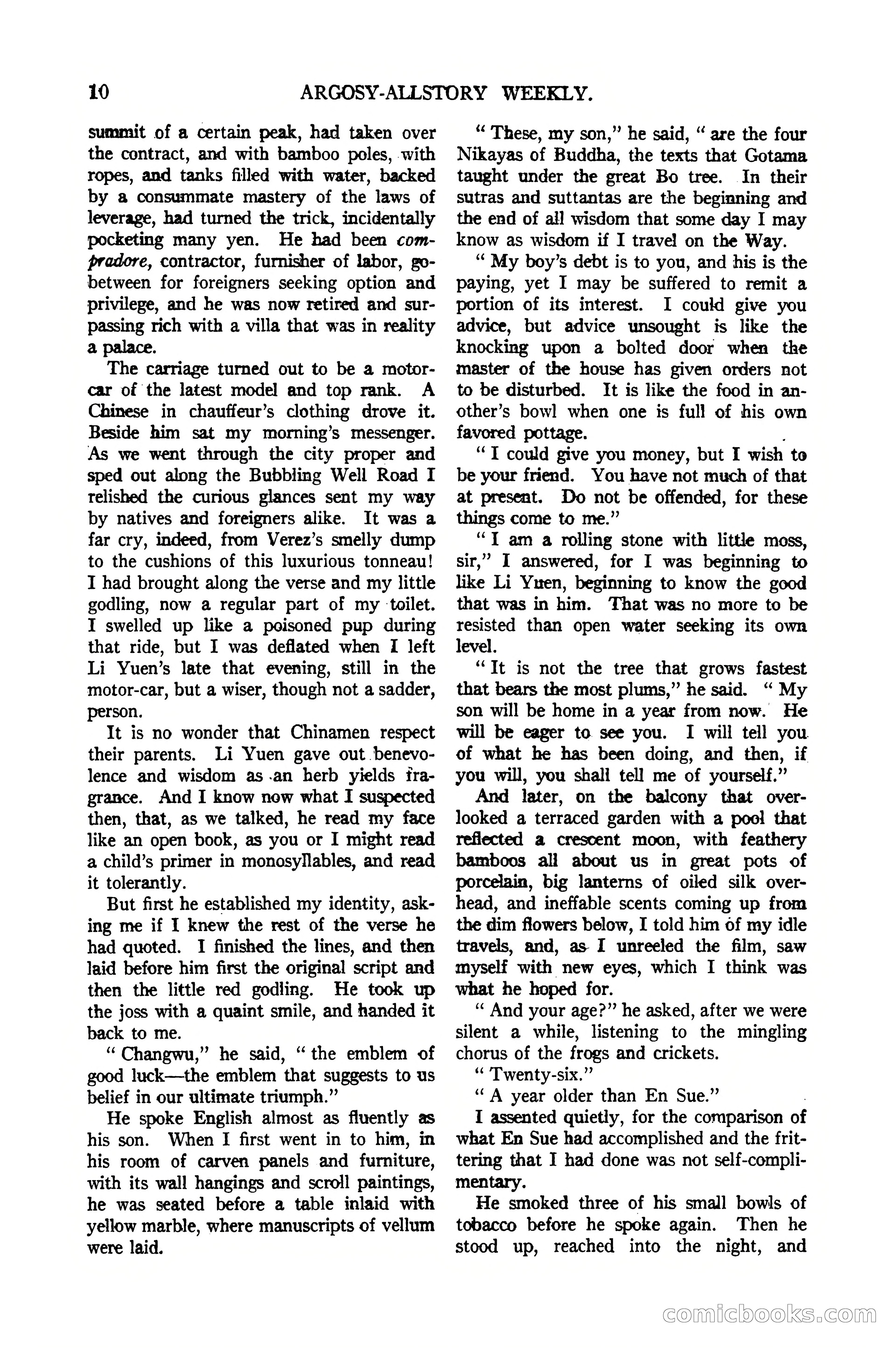
A restored page from Pulp Fiction, 1922. Page through the whole issue in the reader above.
📄 Transcribed text from this page (OCR, searchable)
Machine-transcribed from the original scan — historical spelling and the odd misread are preserved.
10 summit of a certain peak, had taken over the contract, and with bamboo poles, with ropes, and tanks filled with water, backed by a consummate mastery of the laws of leverage, had turned the trick, incidentally pocketing many yen. He had been com- pradore, contractor, furnisher of labor, go- between for foreigners seeking option and privilege, and he was now retired and sur- passing rich with a villa that was in reality a palace. The carriage turned out to be a motor- car of the latest model and top rank. A Chinese in chauffeur’s clothing drove it. Beside him sat my morning’s messenger. As we went through the city proper and sped out along the Bubbling Well Road I relished the curious glances sent my way by natives and foreigners alike. It was a far cry, indeed, from Verez’s smelly dump to the cushions of this luxurious tonneau! I had brought along the verse and my little godling, now a regular part of my ‘toilet. I swelled up like a poisoned pup during that ride, but I was deflated when [I left Li Yuen’s late that evening, still in the motor-car, but a wiser, though not a sadder, person. It is no wonder that Chinamen respect their parents. Li Yuen gave out benevo- lence and wisdom as.an herb yields tra- grance. And I know new what I suspected then, that, as we talked, he read my face like an open book, as you or I might read a child’s primer in monosyllables, and read it tolerantly. But first he established my identity, ask- ing me if I knew the rest of the verse he had quoted. I finished the lines, and then laid before him first the original script and then the little red godiing. He took up the joss with a quaint smile, and handed it back to me. ‘“ Changwu,” he said, “the emblem of good luck—the emblem that suggests to us belief in our ultimate tnumph.” He spoke English almost as fluently as his son. When I first went in to him, in his room of carven panels and furniture, with its wall hangings and scroll paintings, he was seated before a table inlaid with yellow marble, where manuscripts of vellum were laid. ARGOSY-ALLSTORY WEEKLY. “These, my son,” he said, “ are the four Nikayas of Buddha, the texts that Gotama taught under the great Bo tree. In their sutras and suttantas are the beginning and the end of all wisdom that some day I may know as wisdom if I travel on the Way. ““ My boy’s debt is to you, and his is the paying, yet I may be suffered to remit a portion of its interest. I could give you advice, but advice unsought is like the knocking upon a bolted door when the master of the house has given orders not to be disturbed. It is like the food in an- other’s bowl when one is full of his own favored pottage. “I could give you money, but I wish to be your friend. You have not much of that at present. Do not be offended, for these things come to me.” ‘IT am a rolling stone with little moss, sir,’ I answered, for I was beginning to like Li Yuen, beginning to know the good that was in him. That was no more to be resisted than open water seeking its own level. “It is not the tree that grows fastest that bears the most plums,” he said. “ My son will be home in a year from now. He will be eager to see you. I will tell you. of what he has been doing, and then, if you will, you shali tell me of yourself.” And later, on the balcony that over- looked a terraced garden with a pool that reflected a crescent moon, with feathery bamboos all about us in great pots of porcelain, big lanterns of oiled silk over- head, and ineffable scents coming up from the dim flowers below, I told him of my idle travels, and, as I unreeled the film, saw myself with new eyes, which I think was what he hoped for. ‘‘ And your age?” he asked, after we were silent a while, listening to the mingling chorus of the irogs and crickets. ‘* Twenty-six.” ‘“‘ A year older than En Sue.” I assented quietly, for the comparison of what En Sue had accomplished and the frit- tering that I had done was not self-compli- mentary. He smoked three of his small bowls of tobacco before he spoke again. Then he stood up, reached into the night, and comicloool C©