
Pulp Fiction, 1922 · page 21 of 172
Argosy All-Story Weekly, January 21, 1922 — page 21: what you’re looking at
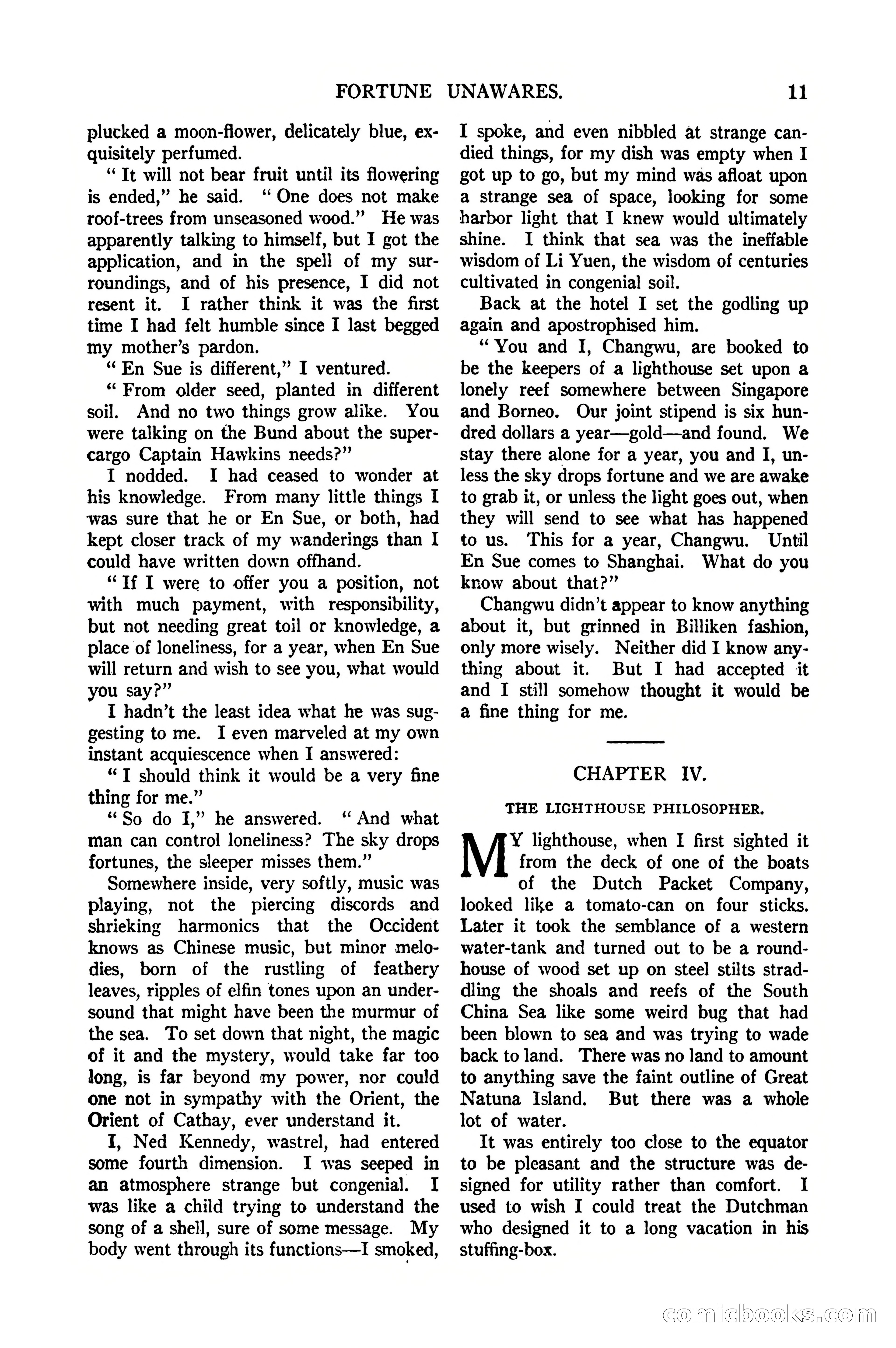
A restored page from Pulp Fiction, 1922. Page through the whole issue in the reader above.
📄 Transcribed text from this page (OCR, searchable)
Machine-transcribed from the original scan — historical spelling and the odd misread are preserved.
FORTUNE UNAWARES. plucked a moon-flower, delicately blue, ex- quisitely perfumed. “ Tt will not bear fruit until its flowering is ended,” he said. ‘‘ One does not make roof-trees from unseasoned wood.” He was apparently talking to himself, but I got the application, and in the spell of my sur- roundings, and of his presence, I did not resent it. I rather think it was the first time I had felt humble since I last begged my mother’s pardon. “En Sue is different,” I ventured. “From older seed, planted in different soil. And no two things grow alike. You were talking on the Bund about the super- cargo Captain Hawkins needs?”’ I nodded. I had ceased to wonder at his knowledge. From many little things I was sure that he or En Sue, or both, had kept closer track of my wanderings than I could have written down offhand. “If I were to offer you a position, not with much payment, with responsibility, but not needing great toil or knowledge, a place of loneliness, for a year, when En Sue will return and wish to see you, what would you say?”’ I hadn’t the least idea what he was sug- gesting to me. I even marveled at my own instant acquiescence when I answered: “T should think it would be a very fine thing for me.” “So do I,” he answered. ‘ And what man can control loneliness? The sky drops fortunes, the sleeper misses them.” Somewhere inside, very softly, music was playing, not the piercing discords and Shrieking harmonics that the Occident knows as Chinese music, but minor melo- dies, born of the rustling of feathery leaves, ripples of elfin tones upon an under- sound that might have been the murmur of the sea. To set down that night, the magic of it and the mystery, would take far too long, is far beyond my power, nor could one not in sympathy with the Orient, the Orient of Cathay, ever understand it. I, Ned Kennedy, wastrel, had entered some fourth dimension. I was seeped in an atmosphere strange but congenial. I was like a child trying to understand the song of a shell, sure of some message. My body went through its functions—I smoked, 11 I spoke, and even nibbled at strange can- died things, for my dish was empty when I got up to go, but my mind was afloat upon a strange sea of space, looking for some harbor light that I knew would ultimately shine. I think that sea was the ineffable wisdom of Li Yuen, the wisdom of centuries cultivated in congenial soil. Back at the hotel I set the godling up again and apostrophised him. ‘You and I, Changwu, are booked to be the keepers of a lighthouse set upon a lonely reef somewhere between Singapore and Borneo. Our joint stipend is six hun- dred dollars a year—gold—and found. We stay there alone for a year, you and I, un- less the sky drops fortune and we are awake to grab it, or unless the light goes out, when they will send to see what has happened to us. This for a year, Changwu. Until En Sue comes to Shanghai. What do you krow about that?” Changwu didn’t appear to know anything about it, but grinned in Billiken fashion, only more wisely. Neither did I know any- thing about it. But I had accepted it and I still somehow thought it would be a fine thing for me. CHAPTER IV. THE LIGHTHOUSE PHILOSOPHER. Y lighthouse, when I first sighted it Mi from the deck of one of the boats of the Dutch Packet Company, looked like a tomato-can on four sticks. Later it took the semblance of a western water-tank and turned out to be a round- house of wood set up on steel stilts strad- dling the shoals and reefs of the South China Sea like some weird bug that had been blown to sea and was trying to wade back to land. There was no land to amount to anything save the faint outline of Great Natuna Island. But there was a whole lot of water. It was entirely too close to the equator to be pleasant and the structure was de- signed for utility rather than comfort. I used to wish I could treat the Dutchman who designed it to a long vacation in his stuffing-box. comicloool C©