
Pulp Fiction, 1922 · page 33 of 172
Argosy All-Story Weekly, January 21, 1922 — page 33: what you’re looking at
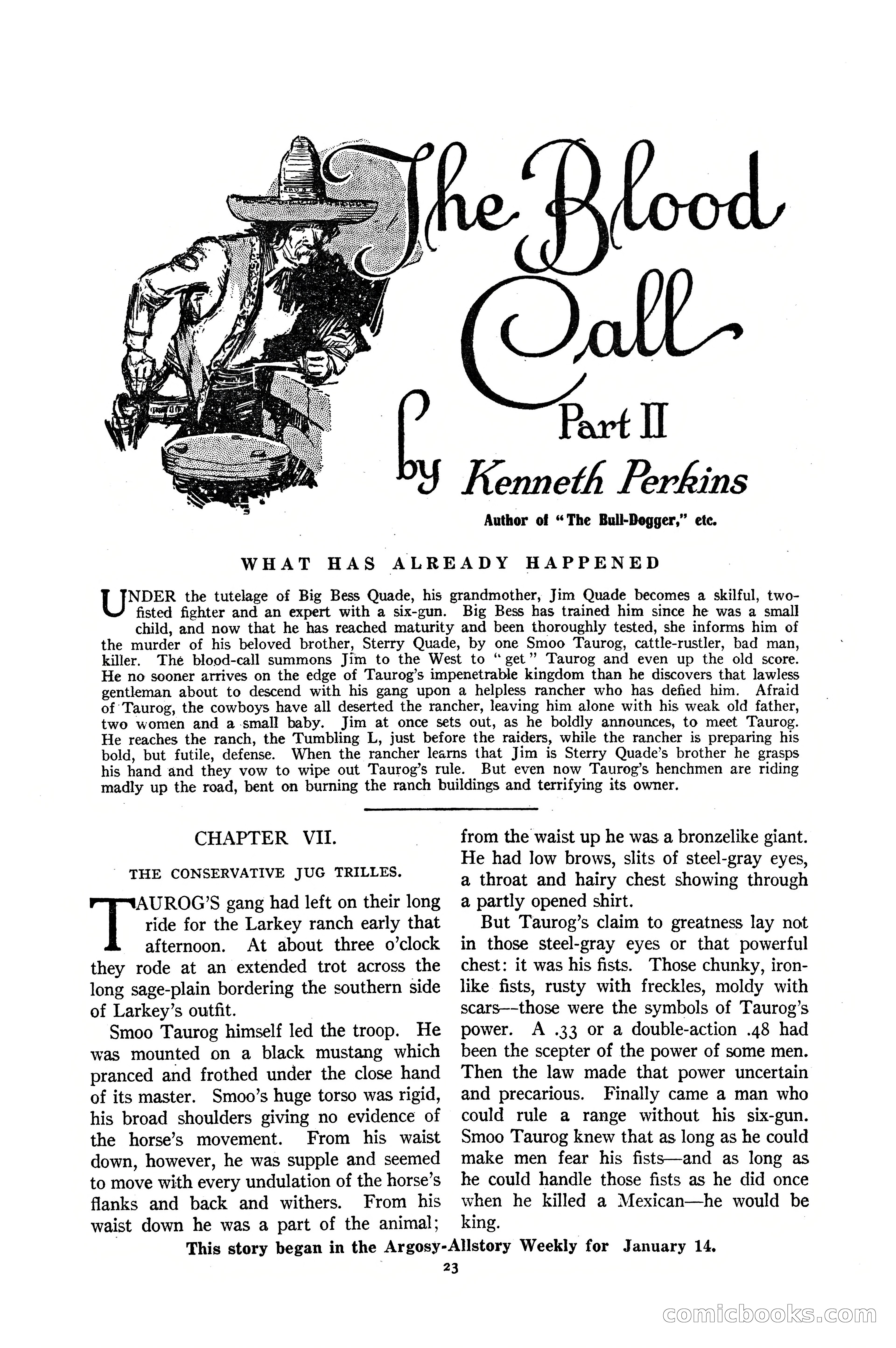
A restored page from Pulp Fiction, 1922. Page through the whole issue in the reader above.
📄 Transcribed text from this page (OCR, searchable)
Machine-transcribed from the original scan — historical spelling and the odd misread are preserved.
ath Y Kenneth Perkins Author of “The Bull-Dogger,” ete. WHAT HAS ALREADY HAPPENED NDER the tutelage of Big Bess Quade, his grandmother, Jim Quade becomes a skilful, two- fisted fighter and an expert with a six-gun. Big Bess has trained him since he was a small child, and now that he has reached maturity and been thoroughly tested, she informs him of the murder of his beloved brother, Sterry Quade, by one Smoo Taurog, cattle-rustler, bad man, killer. The blood-call summons Jim to the West to “get” Taurog and even up the old score. He no sooner arrives on the edge of Taurog’s impenetrable kingdom than he discovers that lawless gentleman about to descend with his gang upon a helpless rancher who has defied him. Afraid of Taurog, the cowboys have all deserted the rancher, leaving him alone with his weak old father, two women and a-small baby. Jim at once sets out, as he boldly announces, to meet Taurog. He reaches the ranch, the Tumbling L, just before the raiders, while the rancher is preparing his bold, but futile, defense. his hand and they vow to wipe out Taurog’s rule. When the rancher learns that Jim is Sterry Quade’s brother he grasps But even now Taurog’s henchmen are riding madly up the road, bent on burning the ranch buildings and ; Remtyine its owner. CHAPTER VII. | THE CONSERVATIVE JUG TRILLES. AUROG’S gang had left on their long ride for the Larkey ranch early that afternoon. At about three o’clock they rode at an extended trot across the long sage-plain bordering the southern side of Larkey’s outfit. Smoo Taurog himself led the troop. He was mounted on a black mustang which pranced and frothed under the close hand of its master. Smoo’s huge torso was rigid, his broad shoulders giving no evidence of the horse’s movement. From his waist down, however, he was supple and seemed to move with every undulation of the horse’s flanks and back and withers. From his waist down he was a part of the animal; from the waist up he was a bronzelike giant. He had low brows, slits of steel-gray eyes, a throat and hairy chest showing through a partly opened shirt. But Taurog’s claim to greatness lay not in those steel-gray eyes or that powerful chest: it was his fists. Those chunky, iron- like fists, rusty with freckles, moldy with scars—-those were the symbols of Taurog’s power. A .33 or a double-action .48 had been the scepter of the power of some men. Then the law made that power uncertain and precarious. Finally came a man who could rule a range without his six-gun. Smoo Taurog knew that as long as he could make men fear his fists—and as long as he could handle those fists as he did once when he killed a Mexican—he would be king. This story began in the Argosy-Allstory Weekly for January 14. 23 MICLOOOK C© inn