
Pulp Fiction, 1922 · page 132 of 172
Argosy All-Story Weekly, July 1, 1922 — page 132: what you’re looking at
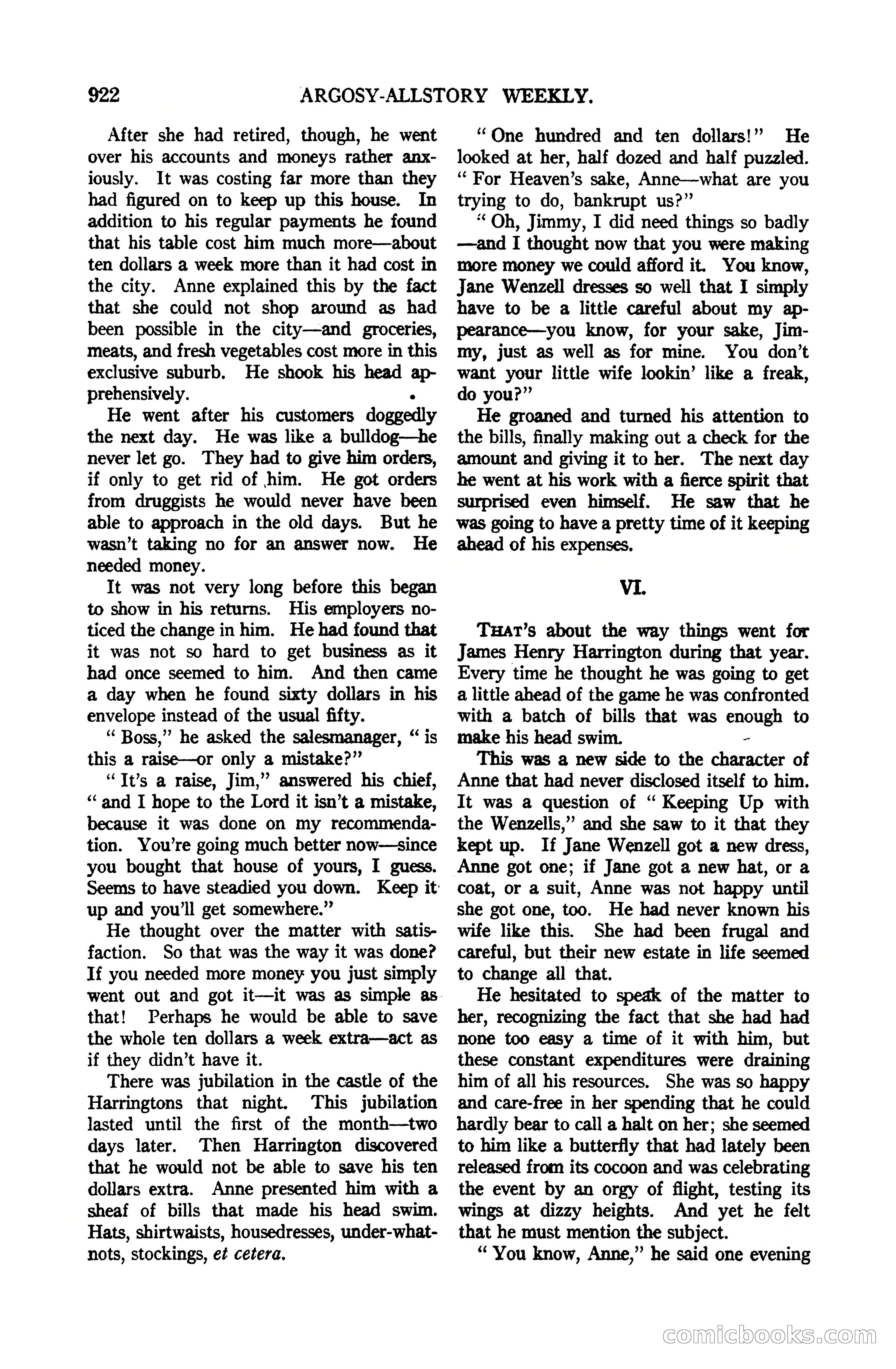
A restored page from Pulp Fiction, 1922. Page through the whole issue in the reader above.
📄 Transcribed text from this page (OCR, searchable)
Machine-transcribed from the original scan — historical spelling and the odd misread are preserved.
$22 After she had retired, though, he went over his accounts and moneys rather anx- iously. It was costing far more than they had figured on to keep up this house. In addition to his regular payments he found that his table cost him much more—about ten dollars a week more than it had cost in the city. Anne explained this by the fact that she could not shop around as had been possible in the city—and groceries, meats, and fresh vegetables cost more in this exclusive suburb. He shook his head ad prehensively. He went after his customers doggedly the next day. He was like a bulldog—he never let go. They had to give him orders, if only to get rid of him. He got orders from druggists he would never have been able to approach in the old days. But he wasn’t taking no for an answer now. He needed money. It was not very long before this began to show in his returns. His employers no- ticed the change in him. He had found that it was not so hard to get business as it had once seemed to him. And then came a day when he found sixty dollars in his envelope instead of the usual fifty. “Boss,” he asked the salesmanager, “‘ is this a raise—or only a mistake?” “It’s a raise, Jim,” answered his chief, “‘ and I hope to the Lord it isn’t a mistake, because it was done on my recommenda- tion. You’re going much better now—since you bought that house of yours, I guess. Seems to have steadied you down. Keep it: up and you'll get somewhere.” He thought over the matter with satis- faction. So that was the way it was done? If you needed more money you just simply went out and got it—it was as simple as. that! Perhaps he would be able to save the whole ten dollars a week extra—act as if they didn’t have it. There was jubilation in the castle of the Harringtons that night. This jubilation lasted until the first of the month—two days later. Then Harrington discovered that he would not be able to save his ten dollars extra. Anne presented him with a sheaf of bills that made his head swim. Hats, shirtwaists, housedresses, under-what- nots, stockings, e¢ cetera. ARGOSY-ALLSTORY WEEKLY. “One hundred and ten dollars!” He looked at her, half dozed and half puzzled. ‘For Heaven’s sake, Anne—what are you trying to do, bankrupt us?” “Oh, Jimmy, I did need things so badly —and I thought now that you were making more money we could afford it. You know, Jane Wenzell dresses so well that I simply have to be a little careful about my ap- pearance—you know, for your sake, Jim- my, just as well as for mine. You don’t want your little wife lookin’ like a freak, do you?” He groaned and turned his attention to the bills, finally making out a check for the amount and giving it to her. The next day he went at his work with a fierce spirit that surprised even himself. He saw that he was going to have a pretty time of it keeping ahead of his expenses, VI. TuHaT’s about the way things went for James Henry Harrington during that year. Every time he thought he was going to get a little ahead of the game he was confronted with a batch of bills that was enough to make his head swim. This was a new side to the character of Anne that had never disclosed itself to him. It was a question of ‘“ Keeping Up with the Wenzells,”” and she saw to it that they kept up. If Jane Wenzell got a new dress, Anne got one; if Jane got a new hat, or a coat, or a suit, Anne was not happy until she got one, too. He had never known his wife like this. She had been frugal and careful, but their new estate in life seemed to change all that. He hesitated to speak of the matter to her, recognizing the fact that she had had none too easy a time of it with him, but these constant expenditures were draining him of all his resources. She was so happy and care-free in her spending that he could hardly bear to call a halt on her; she seemed to him like a butterfly that had lately been released from its cocoon and was celebrating the event by an orgy of flight, testing its wings at dizzy heights. And yet he felt that he must mention the subject. “You know, Anne,”’ he said one evening comicloool C©