
Pulp Fiction, 1922 · page 133 of 172
Argosy All-Story Weekly, July 1, 1922 — page 133: what you’re looking at
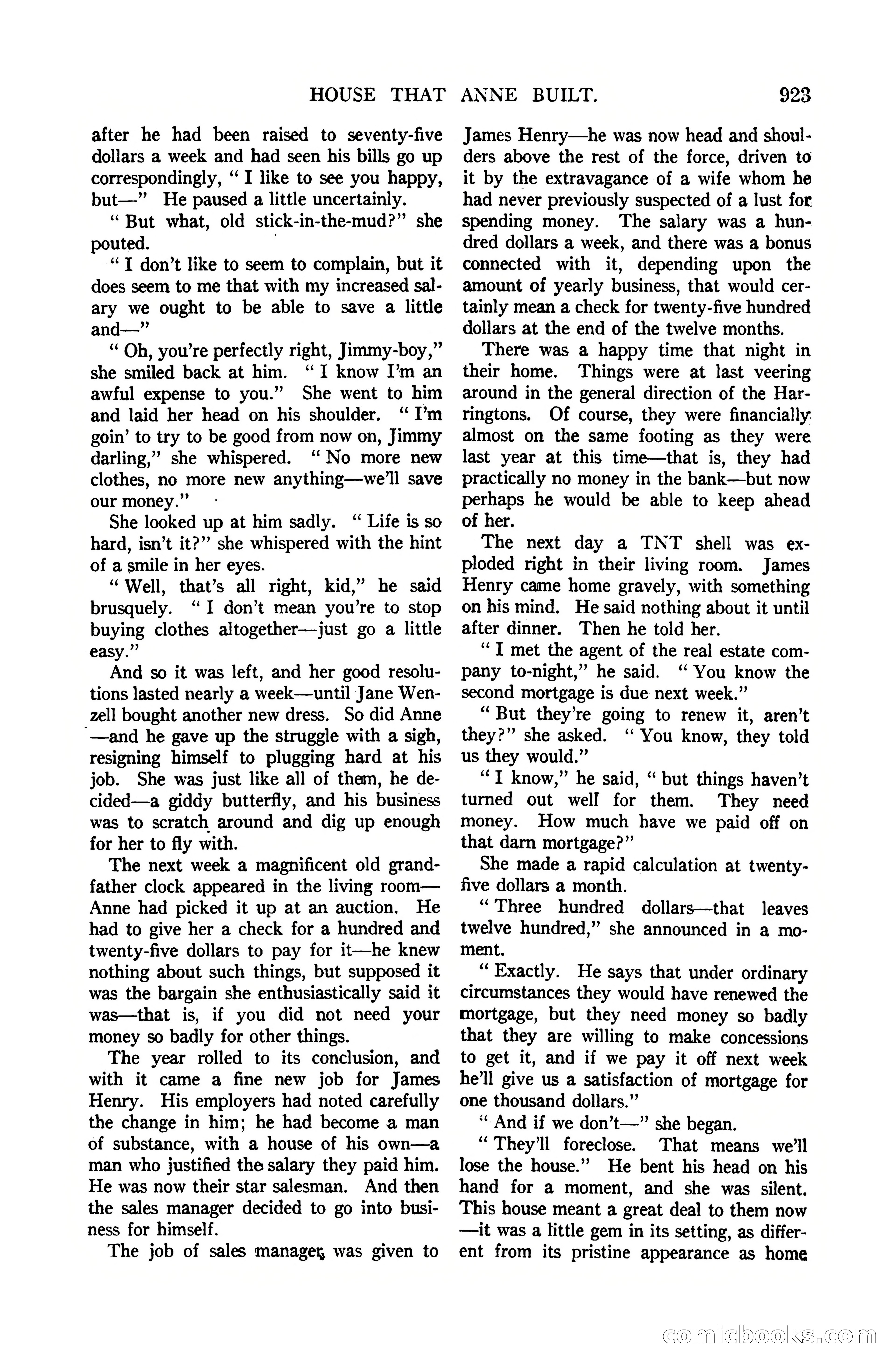
A restored page from Pulp Fiction, 1922. Page through the whole issue in the reader above.
📄 Transcribed text from this page (OCR, searchable)
Machine-transcribed from the original scan — historical spelling and the odd misread are preserved.
HOUSE THAT after he had been raised to seventy-five dollars a week and had seen his bills go up correspondingly, ‘‘I like to see you happy, but—” He paused a little uncertainly. “ But what, old stick-in-the-mud?” she pouted. “T don’t like to seem to complain, but it does seem to me that with my increased sal- ary we ought to be able to save a little and—”’ ‘Oh, you're perfectly right, Jimmy-boy,” she smiled back at him. “I know I’m an awful expense to you.” She went to him and laid her head on his shoulder. “ I’m goin’ to try to be good from now on, Jimmy darling,” she whispered. ‘‘ No more new clothes, no more new anything—we'll save our money.” She looked up at him sadly. “ Life is so hard, isn’t it?”’ she whispered with the hint of a smile in her eyes. “Well, that’s all right, kid,” he said brusquely. ‘‘I don’t mean you’re to stop buying clothes altogether—just go a little easy.” And so it was left, and her good resolu- tions lasted nearly a week—until Jane Wen- zell bought another new dress. So did Anne ‘—and he gave up the struggle with a sigh, resigning himself to plugging hard at his job. She was just like all of them, he de- cided—a giddy butterfly, and his business was to scratch around and dig up enough for her to fly with. The next week a magnificent old grand- father clock appeared in the living room— Anne had picked it up at an auction. He had to give her a check for a hundred and twenty-five dollars to pay for it—he knew nothing about such things, but supposed it was the bargain she enthusiastically said it was—that is, if you did not need your money so badly for other things. The year rolled to its conclusion, and with it came a fine new job for James Henry. His employers had noted carefully the change in him; he had become a man of substance, with a house of his own—a man who justified the salary they paid him. He was now their star salesman. And then the sales manager decided to go into busi- ness for himself. The job of sales manages, was given to ANNE BUILT. 923 James Henry—he was now head and shoul- ders above the rest of the force, driven to it by the extravagance of a wife whom he had never previously suspected of a lust for spending money. The salary was a hun- dred dollars a week, and there was a bonus connected with it, depending upon the amount of yearly business, that would cer- tainly mean a check for twenty-five hundred dollars at the end of the twelve months. There was a happy time that night in their home. Things were at last veering around in the general direction of the Har- ringtons. Of course, they were financially. almost on the same footing as they were last year at this time—that is, they had practically no money in the bank—but now perhaps he would be able to keep ahead of her. The next day a TNT shell was ex- ploded right in their living room. James Henry came home gravely, with something on his mind. He said nothing about it until after dinner. Then he told her. ‘“‘T met the agent of the real estate com- pany to-night,” he said. ‘“ You know the second mortgage is due next week.” “But they’re going to renew it, aren’t they?” she asked. ‘ You know, they told us they would.” “I know,” he said, “ but things haven’t turned out well for them. They need money. How much have we paid off on that darn mortgage?”’ She made a rapid calculation at twenty- five dollars a month. “Three hundred dollars—that leaves twelve hundred,” she announced in a mo- ment. “ Exactly. He says that under ordinary circumstances they would have renewed the mortgage, but they need money so badly that they are willing to make concessions to get it, and if we pay it off next week he’ll give us a satisfaction of mortgage for one thousand dollars.” ‘‘ And if we don’t—” she began. “They'll foreclose. That means we'll lose the house.” He bent his head on his hand for a moment, and she was silent. This house meant a great deal to them now —it was a little gem in its setting, as differ- ent from its pristine appearance as home DOOK C©